

What behavioral health marketing actually means for specialty practices
Behavioral health marketing is the targeted use of compliant, ethical digital strategies to grow patient acquisition for mental health, psychiatry, and addiction treatment practices. It is not general healthcare advertising with a wellness veneer. The distinction matters because behavioral health sits squarely in Google's Your Money or Your Life (YMYL) category, where E-E-A-T standards are evaluated more strictly than in almost any other vertical.
For specialty practices in the US, the stakes are concrete. Patients considering therapy or psychiatric care often spend weeks or months researching before booking. Stigma slows the decision cycle. HIPAA governs what you can say, how you can retarget, and what patient data you can use in ad campaigns. And increasingly, that research happens not just on Google but inside ChatGPT, Claude, and Perplexity, where practices with no AI visibility simply do not exist.
Core components every marketing leader needs in place:
- E-E-A-T compliance: Clinician credentials, peer-reviewed content, and verifiable expertise signals across every page
- Ethical messaging: No fear-based language, no unsubstantiated outcome guarantees, no triggering imagery
- AI platform visibility: Structured data and schema that surface your practice in conversational AI search
- Performance-based acquisition: Payment models tied to booked appointments, not impressions
- Telehealth integration: Marketing workflows that reflect how patients actually access care today
- HIPAA-compliant campaigns: Pixel management, consent frameworks, and compliant retargeting
Table of Contents
- Why E-E-A-T and ethical messaging are non-negotiable in this space
- How AI visibility and performance-based acquisition are changing patient growth
- How Zen Spencer-Harris addresses behavioral health marketing specifically
- Actionable steps for marketing leaders implementing this strategy
- Zensweb delivers what most behavioral health practices actually need
- Key Takeaways
Why E-E-A-T and ethical messaging are non-negotiable in this space
Google's E-E-A-T framework demands that behavioral health content demonstrate genuine clinical credentials, real-world experience, and institutional authority. A blog post written by a marketing coordinator without clinical review will not rank. A page authored by a licensed psychiatrist with linked credentials, published research, and patient-facing explanations of treatment approaches will.
The 2024 Ad Council mental health messaging study found that two-thirds of consumers respond positively to brands using authentic, supportive mental health messaging that avoids fear and triggering imagery. Authenticity and practicality drive that reception, not polish or production value. Patients can tell the difference between a practice that understands their experience and one running a generic wellness campaign.
Ethical messaging best practices for behavioral health outreach:
- Write from a place of clinical understanding, not urgency or alarm
- Never guarantee outcomes ("you will feel better in six sessions")
- Avoid before-and-after framing that implies a cure
- Use person-first language consistently across all channels
- Comply with HIPAA by excluding patient testimonials unless explicit written authorization is documented
- Follow psychotherapy board advertising rules: no fear-based language, no misleading comparisons
- Align ad copy with what clinicians would actually say in a first consultation
Pro Tip: Run every new ad or landing page through a simple three-question check: Would a licensed clinician say this? Does it make a promise the practice cannot guarantee? Could it distress someone already in crisis? If any answer is yes, rewrite before publishing.
How AI visibility and performance-based acquisition are changing patient growth
The search behavior of patients seeking behavioral health services has shifted. A growing share of high-intent queries now happen inside AI platforms like ChatGPT, Claude, and Perplexity, where the answer surfaces as a recommendation, not a list of ten blue links. If your practice is not cited in those answers, you are invisible to a segment of patients who have already decided they want help.

AI Share of Voice is the measure of how often your practice appears as a recommended answer across these platforms. Building it requires structured data, schema markup, authoritative content that AI models can cite, and a Google Business Profile optimized with accurate hours, categories, photos, and Q&A responses. Optimizing your Google Business Profile with complete, accurate information significantly improves local search visibility, and that same completeness feeds the training signals AI platforms use to surface local providers.
| Marketing Channel | AI Integration Point | Primary KPI |
|---|---|---|
| Google Search (organic) | E-E-A-T content + schema | Qualified organic sessions |
| Google Business Profile | Local pack + AI local answers | Direction requests, calls |
| ChatGPT / Claude / Perplexity | AI Share of Voice citations | Brand mention frequency |
| Paid search (HIPAA-compliant) | Audience segmentation | Cost per booked appointment |
| Content marketing | Niche authority signals | Returning visitors, time on page |
| Telehealth landing pages | Structured data for services | Telehealth appointment bookings |
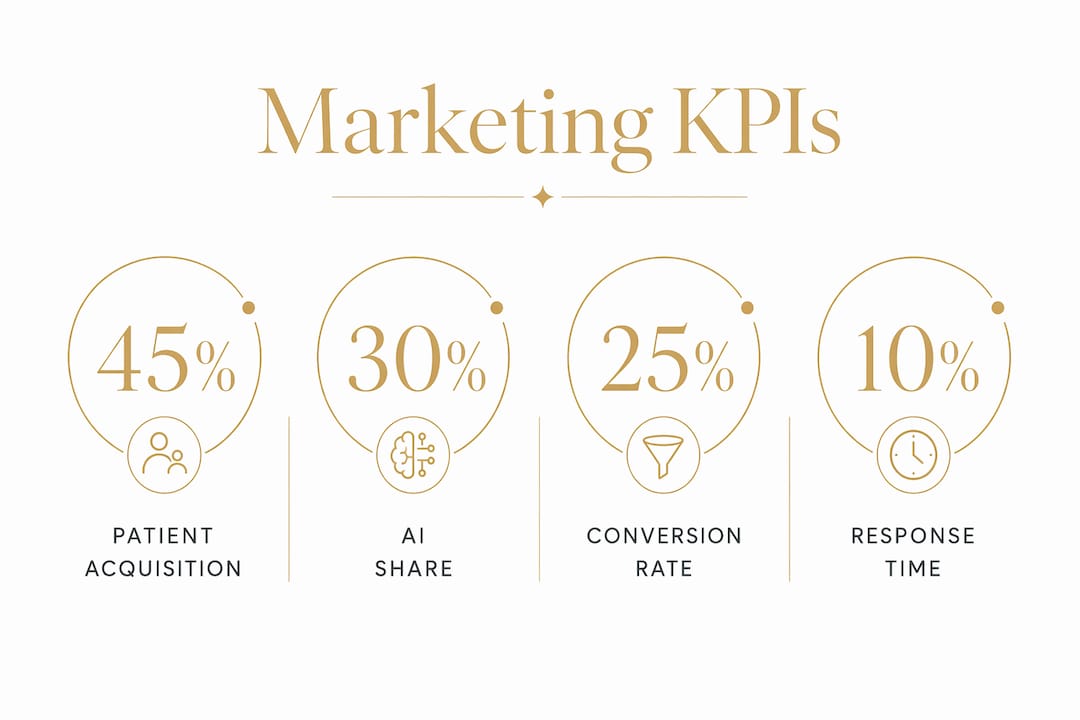
Performance-based acquisition models flip the traditional agency relationship. Instead of paying a retainer for activity, practices pay for delivered results: qualified booked appointments. That alignment removes the incentive to optimize for impressions or clicks that never convert. For a behavioral health practice, where a single retained patient can represent significant lifetime value, paying for outcomes rather than effort is a structurally better deal.
A significant portion of initial patient inquiries drop off because of slow response times or overly complex booking flows. Rapid response within 24 hours and simplified scheduling dramatically improve conversion rates. That is the gap where most practices lose patients they already paid to attract.
How Zen Spencer-Harris addresses behavioral health marketing specifically
Zensweb built its entire model around the problems that make behavioral health marketing different from general healthcare advertising: long consideration cycles, HIPAA constraints, stigma-sensitive messaging, and the growing invisibility problem on AI platforms.
Core services relevant to behavioral health practices:
- AI Share of Voice optimization: Guaranteed visibility on ChatGPT, Claude, Perplexity, and Google within 90 days through structured data, schema, and authority content
- Performance-based patient acquisition: Fees tied to booked appointments, not ad spend or traffic metrics
- Local SEO and Google Business Profile management: Complete optimization for high-intent local searches
- Online reputation building: Ethical review generation and response strategies compliant with HIPAA
- Authority content creation: Clinician-reviewed content built around niche patient questions that outperform generic mental health topics
- Team coaching: Internal capability building so marketing gains compound over time
The free healthcare audit Zensweb offers identifies exactly where a practice's digital presence is leaking visibility, whether that is an incomplete Google Business Profile, missing schema, thin content, or a booking flow that drops half its inquiries before they convert.
Actionable steps for marketing leaders implementing this strategy
Getting behavioral health marketing right is a sequencing problem as much as a tactics problem. Most practices try to run paid ads before they have fixed the organic foundation, then wonder why cost per acquisition stays high.
Prioritized implementation sequence:
- Define your clinical niche precisely. Niche-specific content on topics like postpartum anxiety or adolescent OCD consistently outperforms broad mental health content in both engagement and search authority.
- Audit your E-E-A-T signals. Every clinician on your site needs a bio with credentials, linked publications or affiliations, and a photo. Anonymous content does not rank in YMYL categories.
- Fix your Google Business Profile. Accurate categories, updated hours, service descriptions, and active Q&A are table stakes for local visibility and AI citation.
- Implement schema and structured data. This is the technical layer that lets AI platforms understand what your practice does, who it serves, and where it operates.
- Align messaging with ethical standards. Audit all existing copy against HIPAA advertising rules and psychotherapy board guidelines before scaling any channel.
- Set up a performance-based acquisition structure. Define KPIs around booked appointments, not traffic. Track cost per qualified inquiry and cost per booked appointment separately.
- Integrate telehealth in your marketing workflows. Patients searching for behavioral health services increasingly expect a telehealth option. Landing pages, ads, and directory listings should reflect your telehealth availability explicitly.
- Measure and adapt monthly. Track AI citation frequency, Google Business Profile actions, organic ranking for niche terms, and booking conversion rates. Drop what does not move those numbers.
Pro Tip: Simplify your intake form to five to seven questions maximum. Complex booking flows are one of the primary reasons inquiries drop off before converting. Every additional field you require is a patient you may lose.
Zensweb delivers what most behavioral health practices actually need
Most marketing agencies will sell you a content package or a paid media retainer. Zensweb takes a different position: if your practice does not get qualified booked appointments, Zensweb does not get paid. That is the performance-based model, and it is the right structure for a specialty healthcare practice that cannot afford to fund activity without results.
The AI Share of Voice program gets your practice cited on ChatGPT, Claude, Perplexity, and Google within 90 days, using structured data, authority content, and local SEO built specifically for behavioral health. For practices that want a faster path to qualified patient bookings, the patient acquisition program is built around filling your schedule with the right patients, not just driving traffic. Start with a free audit to see exactly where your visibility is breaking down and what it would take to fix it.
Key Takeaways
Behavioral health marketing works when it combines HIPAA-compliant ethical messaging, E-E-A-T content authority, and AI platform visibility tied to a performance-based acquisition model that pays for booked appointments, not impressions.
| Point | Details |
|---|---|
| E-E-A-T is mandatory | Behavioral health content must show real clinician credentials and expertise to rank in Google's YMYL category. |
| Ethical messaging drives trust | 66% of consumers respond positively to authentic, fear-free mental health messaging per the 2024 Ad Council study. |
| AI visibility is the new front door | Practices not cited on ChatGPT, Claude, and Perplexity are invisible to a growing share of high-intent patients. |
| Booking flow determines conversion | Up to 50% of inquiries drop off due to slow response or complex intake; simplified forms and fast follow-up close that gap. |
| Zensweb | Offers performance-based patient acquisition and AI Share of Voice optimization for behavioral health practices, with fees tied to booked appointments. |