

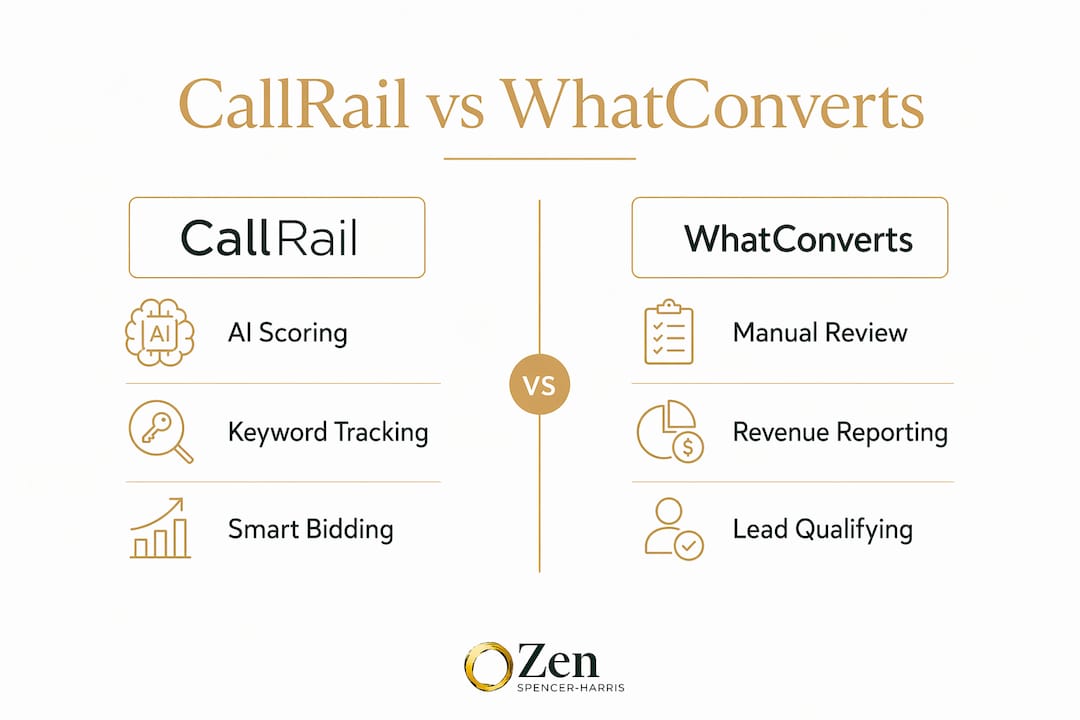
For specialty healthcare practices running a sufficient volume of calls per month, CallRail wins when your priority is keyword-level attribution feeding Google Ads smart bidding; WhatConverts wins when you need unified, revenue-focused reporting that ties every lead channel to booked appointments and patient value. Both require HIPAA verification before any pilot begins — and Zensweb recommends confirming a signed Business Associate Agreement (BAA) as step one of any vendor evaluation.
Before you open a demo, answer two questions:
- Is your primary deliverable call analysis and PPC signal quality? Pick CallRail.
- Is your primary deliverable a revenue dashboard your executive team or agency clients can act on? Pick WhatConverts.
The threshold for calls per month matters because below it, manual qualification in WhatConverts is manageable. Above it, CallRail's AI automation saves meaningful staff time.
Table of Contents
- How do CallRail and WhatConverts compare for healthcare practices?
- Which tool fits your specific healthcare marketing goal?
- How does each platform qualify leads, and what does that mean for your team?
- What HIPAA and privacy checks must you complete before buying?
- How do integrations and reporting work in practice?
- What does pricing look like, and how do you model ROI?
- How do you implement call tracking in a specialty healthcare practice?
- What's the right final decision, and when does a hybrid make sense?
- Key Takeaways
- What most healthcare marketers get wrong about this decision
- Zensweb handles the measurement so you can focus on patients
- Useful sources for procurement and vendor validation
How do CallRail and WhatConverts compare for healthcare practices?
| Dimension | CallRail | WhatConverts |
|---|---|---|
| Best for | PPC-heavy practices optimizing Google Ads smart bidding | Agencies and multi-channel practices proving revenue ROI |
| Call attribution granularity | Keyword-level, last-click by default | Multi-click journey mapping at Elite tier |
| Lead qualification method | AI-automated (transcription, sentiment, keyword spotting) | Manual rules + centralized lead inbox |
| HIPAA / BAA availability | Available, often as add-on or higher tier | Available; verify tier-specific inclusion |
| Reporting | Strong call analytics; less emphasis on branded client reports | Report Builder with scheduled, white-label branded reports |
| Integrations | Native Google Ads, GA4, HubSpot, Salesforce; Live Chat | Google Ads write-back, GA4, CRM sync, forms, chat, eCommerce |
| Pricing entry point | $50/month (core plan) | $30/month (Call Tracking plan) |
| Ease of implementation | Fast for call tracking; CRM integration needs data-mapping work | Moderate; multi-channel setup takes longer but reporting payoff is higher |
Selection rule: If your Google Ads account is the center of your patient acquisition spend, start with CallRail. If your CMO or board needs a single dashboard showing which channels produce revenue, start with WhatConverts.
Practical implications for healthcare:
- CallRail's keyword-level attribution feeds directly into Google Ads smart bidding — the clearest path to lower cost-per-appointment on paid search.
- WhatConverts centralizes calls, forms, chats, and eCommerce into revenue dashboards, making it the stronger choice when you report to stakeholders who care about total pipeline, not just call volume.
- Attribution modeling differs: CallRail defaults to last-click; WhatConverts Elite supports multi-touch journey mapping.
Which tool fits your specific healthcare marketing goal?
Match your scenario to the right platform before you spend a dollar on a pilot:
- High-volume PPC with smart bidding (50+ calls/month): CallRail. Its AI processes calls at scale and writes qualified conversions back to Google Ads without manual tagging.
- Multi-channel revenue reporting for executive stakeholders: WhatConverts. Its Report Builder produces scheduled, branded reports that tie every lead source to patient revenue.
- Franchise or multi-location specialty group: WhatConverts tracks leads across all locations in one platform, making regional performance comparisons straightforward.
- Agency managing multiple clinic accounts: WhatConverts' white-label reporting and centralized lead inbox are built for this workflow. Reporting is the deliverable; the platform is designed around it.
- Tight HIPAA controls with documented compliance: Either platform can work, but verify BAA availability and tier inclusion before signing. Teams that prefer documented compliance in tier descriptions often lean toward WhatConverts.
- Small clinic testing call tracking for the first time: WhatConverts' $30/month entry point lowers the financial risk. CallRail's setup is faster if your only goal is attributing inbound calls to Google Ads campaigns.
Hybrid approach: Some practices run CallRail for conversation intelligence on high-volume paid campaigns and pipe qualified-lead data into a revenue dashboard built in WhatConverts or their CRM. This avoids duplicating manual work but requires clean data-field mapping between systems before launch.
How does each platform qualify leads, and what does that mean for your team?
CallRail's Conversation Intelligence transcribes calls using AI trained on a large volume of voice data, then applies sentiment scoring and keyword spotting to automatically tag calls as qualified or unqualified. For a practice handling 100+ calls/month, that automation eliminates hours of manual listening. The catch: it works best when your CRM (HubSpot or Salesforce) is clean and your data fields are mapped before go-live. Expect integration work upfront.
WhatConverts takes a different path. Staff or agency reviewers apply manual rules inside a centralized lead inbox, marking each lead qualified and assigning a dollar value. Agencies often prefer this model because the human review step produces defensible, client-ready qualification logic rather than an AI score that needs explaining.
- CallRail flow: User clicks ad → DNI assigns tracking number → call captured → AI transcribes and scores → qualified tag written to CRM and Google Ads.
- WhatConverts flow: User clicks ad → DNI assigns tracking number → call captured → staff reviews in lead inbox → manually marked qualified with revenue value → data pushed to CRM and ad platforms.
Pro Tip: Before connecting either platform to your EHR or CRM, map every data field in a spreadsheet: lead source, call outcome, patient status, and appointment type. Skipping this step is the single most common cause of siloed data in healthcare call-tracking deployments.
What HIPAA and privacy checks must you complete before buying?

HIPAA-capable tiers are often add-ons and must be explicitly requested and documented in the BAA. Never assume the base plan covers your compliance obligations.
Checklist before signing any contract:
- BAA availability: Confirm the vendor will execute a BAA for your specific plan tier, in writing, before the pilot begins.
- HIPAA tier inclusion: Ask whether HIPAA safeguards are in the base plan or a paid add-on. Get the answer in writing.
- Call recording storage: Where are recordings stored, for how long, and who has access?
- Redaction and consent: Does the platform support automatic PII redaction and state-specific call-recording consent prompts?
- Access controls: Role-based permissions, audit logs, and user authentication standards.
- Encryption: Confirm encryption at rest and in transit for call recordings and lead data.
- SOC 2 certification: Ask for the vendor's most recent SOC 2 Type II report.
- GDPR notes: Relevant if your practice serves patients who may have EU residency; confirm data residency options.
Pro Tip: Ask the sales rep to show you the BAA template before the demo ends. A vendor that hesitates or says "legal will send it later" is a yellow flag. For healthcare accounts, the BAA should be a standard document they hand over without friction.
For practices in behavioral health, the intersection of HIPAA and practice management software adds another layer. Understanding how practice software ecosystems handle privacy can sharpen your vendor questions.
How do integrations and reporting work in practice?
Both platforms use dynamic number insertion (DNI) and JavaScript form tracking. Raw capture accuracy is similar; the differences show up in what happens after capture.
Integration checklist:
- Google Ads write-back: Both platforms offer it, but CallRail sometimes gates smart-bidding write-back to higher tiers. Confirm which tier unlocks this before pricing the pilot.
- GA4 event feeds: Both push call and form events to GA4; verify event naming conventions match your existing GA4 configuration.
- CRM sync: CallRail offers native two-way sync with HubSpot and Salesforce. WhatConverts connects via native integrations and webhooks/Zapier for less common CRMs.
- EHR mapping: Neither platform has a native EHR connector for most specialty systems. Plan for a middleware layer (Zapier, Make, or a custom webhook) to push qualified leads into your EHR.
- White-label reporting: WhatConverts' Report Builder supports scheduled, branded reports. CallRail's reporting is strong for internal analysis but less oriented toward client-facing deliverables.
Data flow: user click → DNI assigns number → call captured → AI score (CallRail) or manual review (WhatConverts) → qualified lead pushed to CRM/EHR → conversion written back to Google Ads.
What does pricing look like, and how do you model ROI?
CallRail's core plan starts at $50/month; advanced conversation intelligence and smart-bidding features sit in higher tiers. WhatConverts starts at $30/month for call tracking, with usage-based fees that can add up as call volume and channel count grow.
Cost drivers to model:
- Base plan fee
- Per-number or per-account charges
- Minutes and text overages
- API or integration costs
- HIPAA add-on fees (often not in base pricing)
- Agency multi-account billing
ROI example for a mid-size specialty practice (100 calls/month): Assume 40% of calls are qualified new-patient inquiries, 60% of those book an appointment, and average revenue per appointment is $300. That's 24 booked appointments/month. If CallRail's AI qualification saves two hours of staff review per week at $30/hour, the time savings alone cover the platform cost. The real ROI question is whether better Google Ads signal quality reduces your cost-per-appointment enough to justify the higher tier.
Procurement tips:
- Request a 14-day pilot on a live ad campaign, not a sandbox demo.
- Ask for two or three healthcare-specific references before signing.
- Model total cost of ownership including HIPAA add-ons and integration middleware.
- Define pilot success metrics in writing: call-to-book rate, qualified-lead rate, and correct keyword attribution.
How do you implement call tracking in a specialty healthcare practice?
- Discovery and BAA execution (Day 1–3): Confirm HIPAA tier, execute BAA, document data-field mapping for CRM/EHR.
- DNI and form tracking deployment (Day 3–7): Install tracking script, configure dynamic numbers for each campaign, set up form tracking on all patient intake forms.
- CRM/EHR mapping (Day 7–14): Map lead source, call outcome, and appointment type fields; test webhook or native sync end-to-end.
- Staff training (Day 14–21): Train front-desk and marketing staff on the lead inbox, qualification workflow, and call review process.
- QA and attribution testing (Day 21–28): Place test calls from each campaign source, verify keyword attribution, confirm Google Ads write-back, and check CRM records.
Small clinics can complete steps 1–4 in under two weeks. Multi-location practices with EHR integration should budget 4–6 weeks. During the pilot, track three metrics: call-to-book rate, transcription accuracy (for CallRail), and correct campaign attribution on at least 90% of calls.
What's the right final decision, and when does a hybrid make sense?
Three-step action plan:
- Decide your primary reporting question (Google Ads signal quality vs. revenue attribution) and pick the platform that answers it natively.
- Pilot on a live campaign for two weeks with real call volume, not demo data. Measure call-to-book rate and attribution accuracy.
- Validate HIPAA/CRM flows before scaling. A signed BAA and a confirmed data path to your CRM are non-negotiable before you expand tracking to all campaigns.
Hybrid option: run CallRail for conversation intelligence on your highest-volume paid campaigns, then push qualified-lead data into WhatConverts or your CRM for revenue reporting. This works well for practices that need both deep call analysis and a unified revenue dashboard, provided data fields are mapped cleanly before launch.
When to bring in a managed partner: if your team lacks the engineering bandwidth to handle DNI deployment, EHR mapping, and Google Ads write-back configuration simultaneously, a performance-based patient acquisition partner like Zensweb can handle the implementation lift while tying fees to delivered booked appointments rather than platform hours.
Key Takeaways
WhatConverts is the stronger choice for revenue reporting; CallRail is the stronger choice for keyword-level PPC attribution — and HIPAA verification must happen before either platform goes live.
| Point | Details |
|---|---|
| Platform selection rule | Choose CallRail for Google Ads smart-bidding signal quality; choose WhatConverts for multi-channel revenue reporting. |
| HIPAA is never assumed | BAA availability and tier inclusion must be confirmed in writing before any pilot begins. |
| Call-volume breakpoint | At 50+ calls/month, CallRail's AI qualification saves meaningful staff time over manual review. |
| Integration prep is critical | Map CRM/EHR data fields before deployment to avoid siloed data and attribution gaps. |
| Zensweb managed option | Zensweb's performance-based model handles implementation and ties fees to booked appointments, reducing internal engineering lift. |
What most healthcare marketers get wrong about this decision
The comparison between these two platforms is almost always framed as a feature checklist. That framing leads practices to buy the wrong tool. The real question is workflow: what does your team actually do with lead data after a call comes in?
CallRail's AI is genuinely impressive. Transcribing calls with AI trained on 12.5 million hours of voice data and scoring sentiment automatically is not a minor convenience at high call volumes. But that capability only pays off if your CRM is clean, your data fields are mapped, and someone on your team is actually reading the qualification scores and acting on them. Practices that buy CallRail for the AI and then use it as a basic call counter are paying for a capability they never activate.
WhatConverts' manual qualification model gets dismissed as "old-fashioned" by teams that assume automation is always better. It isn't. For agencies reporting to clinic clients, human-reviewed qualification produces a defensible audit trail. When a client asks why a specific call was marked qualified, you can show them the review, not an AI confidence score.
The HIPAA piece is where I see the most dangerous shortcuts. Both platforms can be HIPAA-capable. Neither is HIPAA-compliant by default. The BAA is not a formality. It is the document that defines your vendor's obligations if a breach occurs. Get it before the pilot starts, not after.
Zensweb handles the measurement so you can focus on patients
If the implementation checklist above looks like a second job, that's because it is. Deploying DNI, mapping EHR fields, configuring Google Ads write-back, executing BAAs, and training staff while running a specialty practice is a significant lift. Zensweb's performance-based patient acquisition model is built for exactly this situation.
Zensweb handles HIPAA-safe tracking setup, CRM and EHR data mapping, Google Ads offline conversion configuration, and white-label reporting for your executive stakeholders. Fees are tied to delivered results: qualified booked appointments, not platform hours or retainer invoices. Practices working with Zensweb get AI Share of Voice visibility on ChatGPT, Perplexity, Claude, and Google built into the engagement, so your measurement infrastructure and your patient acquisition strategy move together.
Start with a free healthcare audit to validate your current tracking posture, HIPAA readiness, and pilot scope before committing to either platform.
Useful sources for procurement and vendor validation
- CallRail vs. WhatConverts on G2: User reviews, pricing tiers, and feature comparisons from verified buyers.
- The GTM Directory: CallRail vs WhatConverts: Attribution modeling, AI qualification, and reporting workflow analysis.
- ToolChase: WhatConverts vs CallRail: HIPAA tier verification, pricing shapes, and attribution model differences.
- Listicler: WhatConverts vs CallRail: Revenue-first reporting and Google Ads write-back gating by tier.
- Conversion Labs: CallRail vs WhatConverts: AI qualification vs. manual rules and pilot success metrics.
- WhatConverts Help Center: What is WhatConverts?: Official product overview covering lead tracking, reporting, and integrations.
Procurement next steps:
- Request a BAA template from each vendor before the demo ends.
- Ask for two or three healthcare-specific client references.
- Run a two-week pilot on a live paid campaign with real call volume.
- Measure call-to-book rate, qualified-lead rate, and keyword attribution accuracy.
- Confirm Google Ads write-back is included in the tier you are actually buying.
This article provides general information for marketing decision-making and does not constitute legal, compliance, or medical advice. Confirm HIPAA obligations and BAA requirements with a qualified healthcare compliance professional for your specific situation.