

Claude is a practical, operational tool for SEO in specialty healthcare, and you can start using it this week. Feed it your Google Search Console export, run a technical audit, and assign a clinician to review every output before anything goes live. That three-step sequence is the entire pilot in miniature.
The evidence behind that claim: Claude Search runs on Brave's index, meaning your practice's visibility in AI-generated answers depends on Brave crawling your pages, not just Google. Zensweb's AI Share of Voice program targets exactly that gap, putting specialty practices in front of patients asking questions on ChatGPT, Claude, Perplexity, and Google within 90 days.
Your first three actions:
- Run a Brave index check (search
site:yourpractice.comin Brave) and confirm your key service pages appear. - Export 90 days of Google Search Console data as a CSV, ready to feed Claude.
- Assign one person, ideally a compliance-aware team member, as the human reviewer for every AI-generated output.
Table of Contents
- What Claude can actually do for your SEO
- How to run a Claude-powered technical SEO audit
- Build loops, not one-off prompts
- Privacy, HIPAA, and what never to send Claude
- How to measure impact and what a 90-day pilot looks like
- A 6-step pilot checklist to test Claude SEO safely
- How Zen Spencer-Harris approaches Claude SEO for specialty practices
- Key Takeaways
- The real advantage is governance, not the tool
- Zensweb's AI Share of Voice program: what a pilot looks like
- Primary sources and further reading
What Claude can actually do for your SEO
Claude handles the analytical and structural work that used to eat entire afternoons. Give it a Screaming Frog crawl export and it will flag broken internal links, missing schema, and thin pages. Give it a keyword list and it clusters by intent. Give it a competitor's URL structure and it identifies content gaps your practice hasn't addressed.

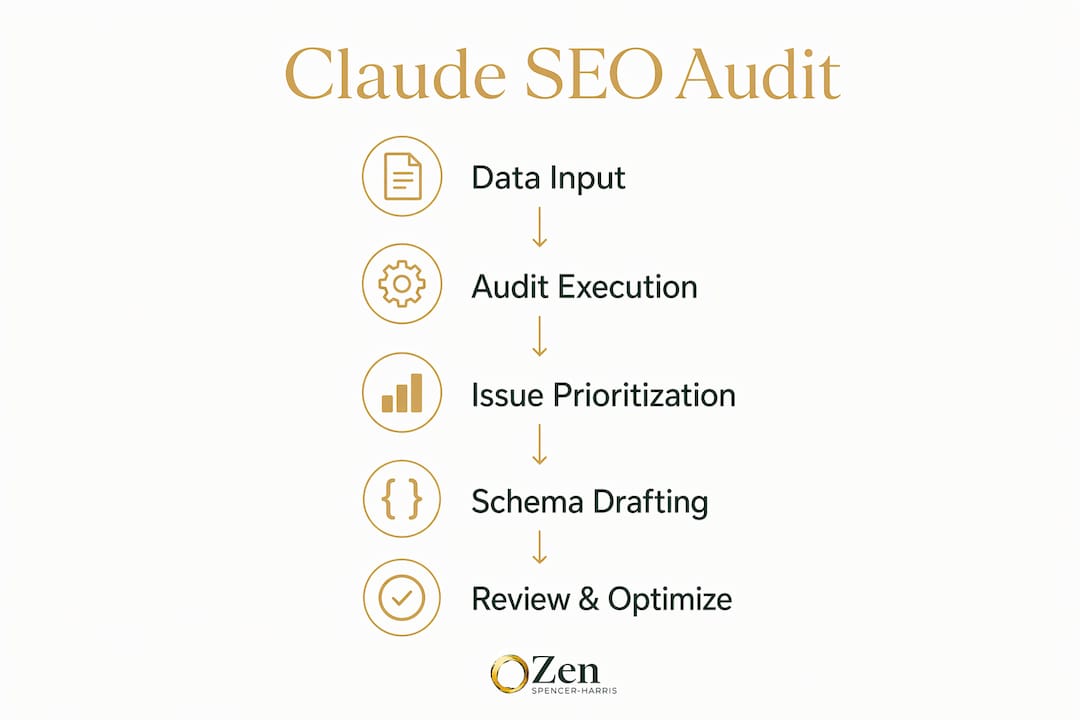
Concrete outputs your team should expect: technical audit summaries with prioritized issue lists, JSON-LD schema drafts for MedicalBusiness or Physician entities, meta description drafts for service pages, FAQ content mapped to patient questions, and internal-link suggestions based on topical clusters.
What Claude cannot do reliably: live SERP scraping, verifying statistics it generates, or making final clinical or legal judgments. Every number Claude produces needs independent confirmation before it appears on your site.
Pro Tip: Feed Claude your own data first. A prompt that starts with "Here is my GSC export for the last 90 days" produces dramatically sharper analysis than one that asks Claude to guess at your performance. Tools like Screaming Frog, Ahrefs, and Google Search Console are your data layer; Claude is the analyst.
Formatting for extractability matters here too. Pages with a concise direct answer immediately after each H2, clearly labeled tables, and several FAQ items are significantly more likely to be cited by Claude in web-backed responses.
How to run a Claude-powered technical SEO audit
The open-source Claude SEO toolkit coordinates 25 sub-skills and 18 specialist agents through a single command: /seo audit. That command triggers parallel scans for technical errors, schema mismatches, and E-E-A-T indicators, then synthesizes a prioritized action plan.
Before you run any agentic audit, prepare this checklist:
- Export a full Screaming Frog crawl as CSV (URLs, status codes, title tags, meta descriptions, H1s, word count).
- Pull 90 days of GSC data: queries, impressions, clicks, and average position.
- Confirm robots.txt does not block Brave's crawler (
BraveBot). - Strip all PHI from any file before upload. No patient names, no appointment data, no insurance identifiers.
- Use a restricted API token with read-only access if connecting live data sources.
Sample audit output table:
| Issue type | Severity | Pages affected | Recommended action |
|---|---|---|---|
| Missing MedicalBusiness schema | High | 12 service pages | Generate JSON-LD, validate in Schema.org validator |
| Thin content | Medium | — | Expand with patient FAQ blocks |
| Broken internal links | High | — | Redirect or update anchor targets |
| No FAQ schema | Medium | — | Add FAQ markup to top-performing posts |
| Blocked by robots.txt (BraveBot) | Critical | Entire site | Update robots.txt immediately |
For cost control, manage the effort parameter: use low or medium for routine passes and reserve xhigh for complex multi-file audits. Starting at high and calibrating down preserves quality while cutting token spend.
Build loops, not one-off prompts
The single biggest mistake teams make is treating Claude like a search bar. One prompt, one output, done. That produces mediocre content and zero auditability.
The better model is a repeatable loop:
FEED → ANALYSE → EDIT → VERIFY. Practitioners who use this structured workflow consistently report higher-quality, auditable outputs compared to single-prompt approaches. The loop keeps humans in control at every handoff.
Role matrix for a specialty healthcare practice:
| Role | Responsibility | Checkpoint |
|---|---|---|
| Marketing lead | Feeds GSC/crawl data, sets brief scope | Before Claude runs |
| Claude | Generates audit, brief, or draft | Output stage |
| Clinical reviewer | Approves all health claims and statistics | Before editing |
| Compliance officer | Validates PHI handling and legal claims | Before publishing |
| SEO lead | Validates schema and technical recommendations | Before deploying |
For transparent healthcare workflows, this kind of documented approval chain is not optional. It protects the practice and produces content patients can trust.
Pro Tip: Use progressive disclosure for context loading. Instead of one massive prompt file, load small modular skill files only when needed. This prevents instruction forgetting and keeps Claude focused on the current task without burning through your context window.
Privacy, HIPAA, and what never to send Claude
The rule is simple: Claude is a content and analysis tool, not a patient data system. Keep those two things completely separate.
Never send Claude:
- Patient names, dates of birth, or contact information
- Appointment logs or scheduling data
- Insurance identifiers or billing records
- Any data that could identify an individual, even indirectly
When you need Claude to analyze performance data, de-identify it first. Aggregate GSC query data is fine. A spreadsheet with patient visit counts by zip code, with no names attached, is fine. Anything that could reconstruct an individual's identity is not.
Vendor questions to ask Anthropic before deploying in a clinical context:
- Does Anthropic offer a Business Associate Agreement (BAA) for your deployment tier?
- Where is data stored, and does it persist after a session?
- Do agentic calls invoke live web search that could log query content?
- How are API call logs retained and who can access them?
Use test datasets during piloting. Create synthetic patient scenarios with fictional names and plausible but invented data. Restrict API tokens to read-only access. Run audits in isolated accounts separate from your production systems.
Healthcare data breaches cost an average of millions of dollars per incident, the highest of any industry. 9.77 million dollars per incident That figure alone justifies a rigorous PHI firewall around every AI workflow.
How to measure impact and what a 90-day pilot looks like
Success in a Claude SEO pilot has two layers: visibility gains and booked appointments. Both are measurable.
| KPI | Measurement method | Baseline | 90-day target |
|---|---|---|---|
| AI Share of Voice | Claude/Perplexity citation tracking | 0 mentions | a small number of citations for core service queries |
| Organic impressions (Brave/Google) | GSC + Brave Webmaster Tools | Current 90-day average | a measurable lift on target pages |
| Rich result appearances | GSC Search Appearance filter | Current count | Schema on all service pages live |
| Booked appointment conversions | CRM or scheduling platform | Current monthly average | Measurable lift tied to organic channel |
Timeline:
- Weeks 0–2: Stakeholder alignment, data exports, compliance review, robots.txt audit.
- Weeks 3–6: Claude audit run, schema deployment, quick-win content fixes.
- Weeks 7–12: Content brief creation, FAQ expansion, internal-link updates.
- Day 90: Full measurement review against baseline.
Attribution in healthcare requires multi-touch thinking. A patient may see your practice in a Claude response, visit your site, read a blog post, and book three weeks later. Track the organic channel as a whole, not just last-click. Zensweb's patient acquisition program is built around exactly this kind of booked-appointment attribution.
A 6-step pilot checklist to test Claude SEO safely
- Align stakeholders. Get sign-off from clinical leadership, compliance, and marketing before any AI tool touches content. Define what "success" means in writing.
- Export your data. Pull 90 days of GSC, a full Screaming Frog crawl, and your top 20 service pages as plain text. Strip all PHI.
- Scope the test. Pick 5–10 pages, ideally your highest-impression, lowest-click service pages. These are your quick wins.
- Run the audit. Use the
/seo auditcommand or a structured prompt with your crawl data. Collect the prioritized issue list. - Apply governance. Every output goes through the role matrix: clinical review, compliance check, SEO validation. Nothing publishes without three sign-offs.
- Measure at day 90. Compare impressions, rich results, and booked appointments against your baseline. Use the KPI table above.
Common failure modes:
- Claude hallucinating statistics: always verify every number independently before publishing.
- Missing data: Claude's analysis is only as good as what you feed it. Thin inputs produce thin outputs.
- Blocked crawlers: if BraveBot can't reach your pages, no amount of content optimization will get you cited in Claude's responses.
How Zen Spencer-Harris approaches Claude SEO for specialty practices
Zensweb combines Claude-centered technical workflows with human clinical review to deliver measurable patient bookings, not just traffic reports. The service covers AI Share of Voice optimization, schema and structured data implementation, authority content creation, Google Business Profile management, and online reputation building.
The performance-based model means Zensweb gets paid when you see results: booked appointments and measurable visibility gains. There are no retainer fees for work that doesn't move the needle.
Pro Tip: The fastest path to AI Share of Voice is fixing the technical foundation first. Schema errors and Brave indexing gaps are invisible to most practice owners but directly determine whether Claude can cite your pages. Zensweb's audit process starts there, before any content is written.
Zensweb's AI visibility program targets presence across ChatGPT, Claude, Perplexity, and Google simultaneously, because patients use all four. A practice that appears in one engine but not the others is leaving qualified referrals on the table.
Key Takeaways
Claude is a practical SEO tool for specialty healthcare when paired with real data, structured workflows, and mandatory human review at every clinical and compliance checkpoint.
| Point | Details |
|---|---|
| Start with Brave indexing | Confirm BraveBot can crawl your site before any other optimization step. |
| Feed real data | GSC exports and Screaming Frog crawls produce far sharper Claude analysis than open-ended prompts. |
| Never send PHI | Keep patient data completely separate from every AI workflow; use de-identified or synthetic data only. |
| Measure booked appointments | Track organic-channel conversions, not just impressions, to connect visibility gains to revenue. |
| Zensweb's AI Share of Voice | Zensweb's performance-based program targets Claude, ChatGPT, Perplexity, and Google visibility within 90 days, paid on results. |
The real advantage is governance, not the tool
Most practices that struggle with AI-assisted SEO aren't failing because Claude isn't capable enough. They're failing because no one owns the review process.
The practices that win with Claude-based SEO treat it like a junior analyst: genuinely useful, fast, and occasionally wrong. They build the loop before they run the first prompt. They assign a clinical reviewer before they write the first brief. They check every statistic Claude produces against a primary source before it touches a published page.
The pitfalls are predictable: over-automating without human checkpoints, feeding PHI into a general-purpose AI tool, trusting Claude's generated statistics without verification, and running agentic audits without scoped token limits. Every one of those mistakes is avoidable with a documented workflow.
Training your editorial and clinical teams matters as much as the technical setup. A clinician who understands what Claude can and cannot verify will catch errors a marketer might miss. That combination, technical SEO rigor plus clinical judgment, is what produces content patients and search engines both trust.
Zensweb's AI Share of Voice program: what a pilot looks like
Specialty practices that are invisible on AI answer engines are losing patients to practices that aren't. Zensweb's performance-based pilot fixes that directly.
A Zensweb engagement starts with a scoped technical audit: Brave indexing check, schema gap analysis, robots.txt review, and a content brief for your five highest-priority service pages. From there, the team deploys schema, fixes crawlability issues, and builds the content structure that gets your practice cited in Claude, ChatGPT, and Perplexity responses. The results window is 90 days. Payment is tied to measurable outcomes, specifically booked appointments and verified visibility gains, not hours logged.
Request your free healthcare audit to see exactly where your practice stands in AI search today and what it would take to close the gap.
Primary sources and further reading
- Claude prompting best practices (Anthropic): The authoritative guide to adaptive thinking, effort parameters, and multi-step agentic task design. Best for: marketing leads and developers setting up workflows.
- Best practices for Claude Code (Anthropic): Covers agentic patterns, subagent coordination, and automation scoping. Best for: developers building automated audit pipelines.
- Claude SEO open-source toolkit (GitHub): 25 sub-skills, 18 agents, and 32 commands including
/seo audit. Best for: technical SEO leads running structured audits. - Claude Search Optimization guide: Explains Brave Search's role in Claude citations and formatting rules for extractability. Best for: content and marketing teams.
- How to Use Claude AI for SEO (NextAISEO): Practical FEED → ANALYSE → EDIT → VERIFY framework with real workflow examples. Best for: any team member running day-to-day SEO tasks.
- Context engineering for Claude (Anthropic blog): Progressive disclosure and modular skill files for keeping Claude focused. Best for: teams building repeatable prompt systems.
- Patient-centered online presence guide: Practical recommendations for content and reputation signals specific to healthcare practices. Best for: compliance and content teams.