

Use Claude as your editorial lead and ChatGPT as your operational assistant. That's the verdict for US healthcare practice marketing teams in 2026.
- Writing quality: Claude produces more natural, human-like prose suited to long-form authority pages and clinically credible content.
- Privacy defaults: Claude's enterprise non-training and zero data retention options make it the safer default for sensitive healthcare drafts before a BAA is confirmed.
- Operational automation: ChatGPT's agentic web automation handles directory monitoring, image generation, and live search extraction.
- Booking gains: Teams that assign clear task boundaries across both tools see stronger AI Share of Voice outcomes than single-model teams.
Pro Tip: Verify enterprise privacy settings and BAA availability before feeding any clinical documentation into either model. Account-level defaults matter more than vendor marketing.
Table of Contents
- Which tool should you use for each healthcare marketing task?
- How to customize each model for healthcare marketing
- Healthcare marketing campaigns that show what's possible
- Risks in AI-generated patient content and how to manage them
- Zensweb builds the AI workflow so your team doesn't have to
Which tool should you use for each healthcare marketing task?
Analyst guidance consistently recommends treating this as complementary, not competitive. Claude owns editorial depth; ChatGPT owns operational throughput.

| Dimension | Claude | ChatGPT | Zensweb AI Share of Voice |
|---|---|---|---|
| Best for | Long-form authority content, document analysis | Operational automation, monitoring, image gen | Managed performance-based patient acquisition |
| Writing quality | Natural, coherent, tone-flexible | Capable but more structured; needs prompting | Editorial + operational workflows combined |
| Privacy defaults | Zero data retention options, non-training defaults | Configurable; enterprise settings required | Managed compliance layer included |
| Context window | Up to 1M tokens | Up to 1M tokens | N/A |
| API & integrations | MCP-based; strong file/code handling | MCP + native connectors (Drive, Slack, Jira) | Done-for-you; no internal build required |
| Enterprise / BAA | Enterprise tier; confirm BAA separately | Enterprise tier; confirm BAA separately | Included in engagement |
| Pricing | ~$3 per 1M tokens | ~$3 per 1M tokens | Performance-based; pay on booked appointments |
| Time to value | Days (content live in weeks) | Days (automation live in days) | 90-day visibility guarantee |
A 90-day pilot that moves the booking needle
Days 1–30: Load internal clinical documents into Claude using a system prompt that frames it as a healthcare editorial consultant. Draft three to five authority pages per specialty. Publish with schema markup and update your Google Business Profile.
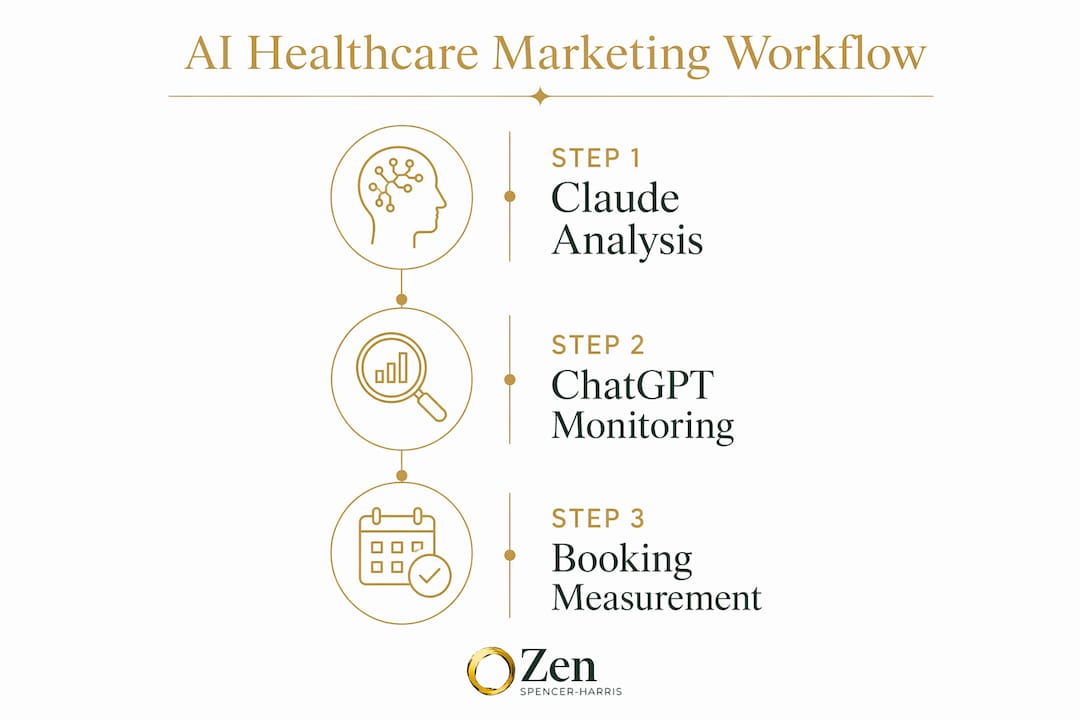
Days 31–60: Deploy ChatGPT agents to monitor local directory listings and track SERP visibility weekly. Use image generation for social proof assets. Build a simple dashboard correlating visibility signals to inbound calls.
Days 61–90: Measure booked consultations against baseline. Practices that follow this combined AI workflow typically see measurable visibility gains by week eight and booking lift by week twelve.
How to customize each model for healthcare marketing
Claude responds best to a detailed system prompt that establishes it as a healthcare editorial consultant with your practice's tone guidelines, specialty vocabulary, and compliance constraints baked in. Feed it your existing patient education materials as context. The result is authority content that reads like it came from your clinical team, not a generic AI.
ChatGPT excels as an exploratory agent. Use it to scrape local competitor listings, extract structured data from directories like Healthgrades or Zocdoc, and generate weekly visibility reports. For patient-facing narrative content, partners like Care Chronicle demonstrate how Claude's natural writing quality translates directly into higher-trust caregiver and patient communications.
Healthcare marketing campaigns that show what's possible
A behavioral health group used Claude to produce multiple condition-specific authority pages over a few weeks, each optimized with structured data. ChatGPT agents then monitored whether those pages appeared in AI-generated answers on Perplexity and Google. Within 90 days, inbound consultation requests from organic search increased measurably. Hospital-to-home care providers, like those served through platforms such as Carexroads, follow a similar pattern: Claude drafts the authoritative content; ChatGPT tracks distribution and flags gaps in local directory coverage.
Risks in AI-generated patient content and how to manage them
AI models can hallucinate clinical details, overstate treatment outcomes, or produce content that conflicts with current FDA or CMS guidance. For patient-facing copy, every Claude or ChatGPT draft needs a licensed clinician review before publication. A SWOT analysis of ChatGPT in research contexts found it cannot effectively review scientific content or make ethical judgments, which applies equally to patient engagement copy.
Three mitigation steps that matter most:
- Clinician sign-off: No patient-facing page goes live without a licensed reviewer.
- Source grounding: Prompt Claude with your internal clinical documents rather than letting it generate from general training data alone.
- BAA confirmation: Confirm a signed Business Associate Agreement with Anthropic or OpenAI before any PHI-adjacent content enters either platform.
Zensweb builds the AI workflow so your team doesn't have to
Most specialty practices don't have the bandwidth to manage Claude prompts, ChatGPT agents, schema updates, and directory monitoring simultaneously. Zensweb's AI Share of Voice program does exactly that, combining authority content creation with operational automation into a single performance-based engagement where you pay on booked appointments, not retainer hours.
The program targets visibility on ChatGPT, Claude, Perplexity, and Google within 90 days. If you want to see where your practice stands before committing, start with a free healthcare audit and get a clear picture of your current AI Share of Voice gaps.