

The fastest path to more booked appointments at your FQHC is a performance-first program that pairs AI Share of Voice with operations-aligned access design. Before you increase ad spend, run a Free healthcare audit to map exactly where visibility, access friction, and attribution are breaking down. Three things drive results: AI visibility across ChatGPT, Google, and Perplexity; a website and scheduling workflow built for mobile, uninsured patients; and measurement tied to booked appointments, not impressions.
Pro Tip: Start with the audit, not the campaign. Spending on traffic before fixing access friction is the single most common FQHC marketing mistake.
Table of Contents
- Why FQHC marketing must be treated as infrastructure
- Community-first tactics that actually move the needle
- Digital foundations every FQHC needs before scaling spend
- What is AI Share of Voice and how do you earn it in 90 days?
- How to measure success and structure performance-based pricing
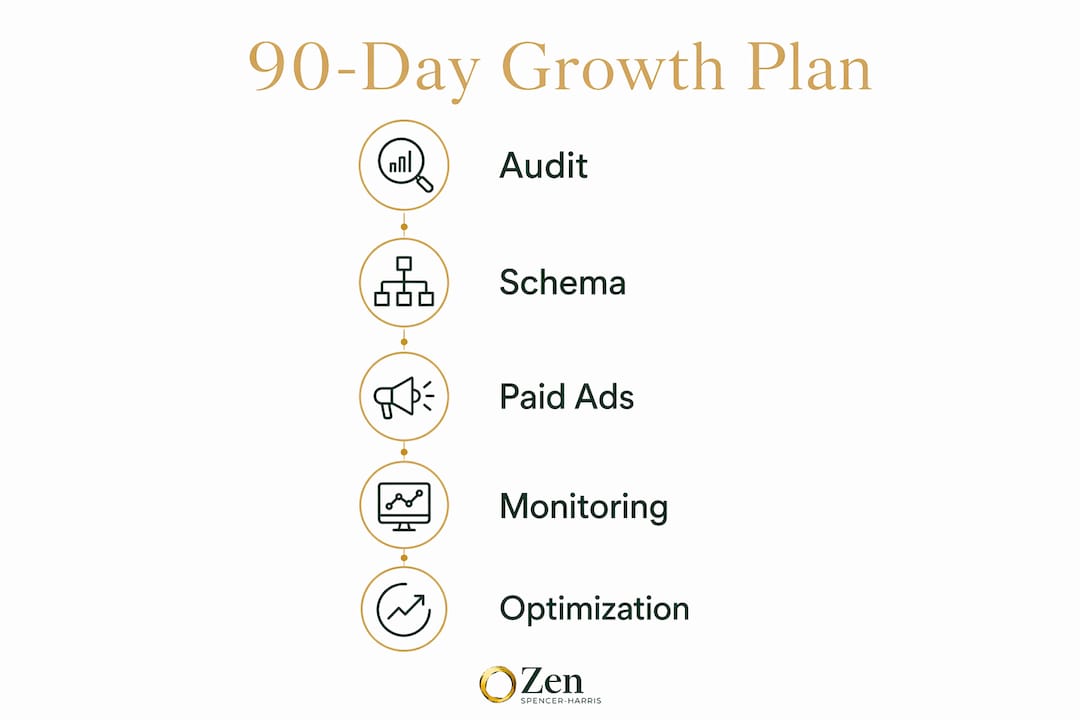
- Your 90-day FQHC marketing launch plan
- Key Takeaways
- The case for AI visibility in FQHC marketing
- What Zensweb does for FQHCs
- Useful sources and further reading
Why FQHC marketing must be treated as infrastructure
Most health centers treat marketing as promotion. The ones growing sustainably treat it as infrastructure. The difference shows up in operations: when marketing clarifies eligibility, hours, cost, and next steps, it reduces call volume, cuts no-shows, and removes the burden on front-desk staff who spend half their day answering questions the website should answer.
Marketing leaders at FQHC Associates argue the "product" is the entire bundled experience — clinical outcomes, scheduling ease, and digital intake — not just the medical service. When that bundle is unclear, marketing drives confusion, not appointments.
The operational risk runs both ways. Stopping acquisition messaging when clinical capacity is constrained prevents reputational harm. Brief your scheduling team before any campaign launches and build capacity buffers into your SLA documents. Marketing that outpaces clinical capacity creates negative first experiences that are hard to recover from.
Pro Tip: Run the 60-second homepage test. Open your site on a mobile phone, pretend you are uninsured, and try to answer three questions: Do you accept patients like me? What will it cost? How do I book? If you cannot answer all three in 60 seconds, fix that before anything else.
Community-first tactics that actually move the needle
Community engagement works best when it starts with a formal needs assessment, not a flyer. Needs assessments paired with local partnerships build the "know, like, and trust" that converts community connections into booked appointments over time.
A practical community play runs in four steps:
- Run a community needs assessment. Identify the top three unmet health needs in your service area by zip code.
- Map priority services to those needs. Align your messaging to what the community actually needs, not what you want to promote.
- Build a partner map. Identify faith-based organizations, schools, local employers, and community health workers (CHWs) who already have trust with your target population.
- Execute event-driven outreach. Text campaigns, social media ads, and on-site booths at partner locations consistently outperform generic digital ads for underserved segments.
Measuring community efforts is where most FQHCs fall short. Require intake fields that capture referral source. Use call tracking and event registration to close attribution gaps. Run geo-holdout tests when budget allows: hold one zip code out of a campaign and compare appointment rates to measure true lift.
Pro Tip: CHWs are your highest-trust channel. A CHW who attends a faith community or school can generate referrals that no paid ad can replicate. Track CHW-sourced referrals separately at intake so you can quantify their contribution.
Digital foundations every FQHC needs before scaling spend
The digital basics are not glamorous, but skipping them wastes every dollar you spend on traffic. Here is the minimum viable checklist:
| Digital Element | What "Done" Looks Like |
|---|---|
| Homepage access statement | Eligibility, sliding-scale cost, and hours visible above the fold on mobile |
| Click-to-call and scheduling | One tap to call or book; no buried phone numbers |
| Google Business Profile | Verified, complete, updated weekly with posts and Q&A |
| Schema / structured data | Service, location, and FAQ schema on all key pages |
| HIPAA-aware forms | Consent language, minimal PHI capture, compliant call tracking |
| ADA-accessible content | Alt text, readable fonts, keyboard navigation, plain language |
Local SEO is the highest-ROI digital channel for most FQHCs. Consistent NAP (name, address, phone) across all directory listings, optimized location pages for each site, and a fully built Google Business Profile cost almost nothing and drive significant organic discovery. Low-cost tactics like patient reviews, social content, and GBP updates maintain visibility even when budgets are tight.
Effective healthcare marketing leaders invest in data infrastructure before scaling spend. Prioritize EHR connectors and HIPAA-compliant multi-source reporting before adding paid channels — otherwise you are flying blind on what is actually driving appointments.
HIPAA compliance in digital marketing is not optional. Avoid embedding tracking pixels on scheduling or intake pages where protected health information (PHI) is present. Use primary care access improvements to reduce friction in appointment workflows while keeping data handling clean.
What is AI Share of Voice and how do you earn it in 90 days?
AI Share of Voice is your visibility across generative AI assistants — ChatGPT, Google AI Overviews, Perplexity, and Claude — for local healthcare queries. When a patient in your service area asks an AI assistant "where can I get affordable primary care near me," your FQHC should appear. Most do not. That gap is the opportunity.
Earning AI Share of Voice in 90 days requires four concrete moves:
- Build structured, crawlable content. Service pages with clear headers, FAQ sections, and schema markup are what generative models pull from.
- Create conversational FAQ bundles. Write short-answer content that mirrors how patients actually ask questions, not how clinicians describe services.
- Feed schema to indexers. Service schema, location schema, and FAQ schema accelerate how quickly AI models recognize your authority for local health queries.
- Reinforce local signals. GBP optimization, consistent citations, and location-specific content all feed the local authority signals that AI models weight heavily.
The 90-day timeline works because it prioritizes high-intent pages first, pushes schema to indexers early, and uses paid search to generate rapid signal while organic authority builds. Zensweb's AI visibility program is built around this sequence, with performance tied to measurable discovery gains and booked appointments.
How to measure success and structure performance-based pricing

Booked appointments are the only primary KPI that matters. Everything else is a leading indicator.
Core KPI set:
- Booked appointments (primary): reconciled against EHR records, not just form submissions
- Cost per acquired patient (CAP): primary care benchmarks run $150–$300, with 4–6x lifetime value return
- Appointment-to-visit conversion: measures scheduling friction and no-show rate
- Multi-touch attributed revenue: requires offline touchpoints (CHW referrals, events) in the attribution model
| Timeline | Visibility Milestones | Appointment Milestones |
|---|---|---|
| Day 1–30 | Audit complete, schema deployed, GBP optimized | Baseline booked-appointment count established |
| Day 31–60 | AI Share of Voice measurable for branded queries | First attribution-tracked appointments from digital |
| Day 61–90 | Service query visibility improving; paid search active | Booked appointment trend line positive |
| Day 91–180 | Organic authority compounding; AI citations consistent | CAP within benchmark range; LTV modeling active |
Vendor red flags to watch for: vague definitions of "lead" versus "booked appointment," no EHR reconciliation process, up-front-only fees with no performance tie, and no HIPAA-compliant data handling documentation. The crucial but often overlooked metric is booked-appointment reconciliation: vendors must reconcile claimed leads with actual EHR appointment records to avoid over-crediting campaigns. Physician query documentation practices offer a useful parallel for how rigorous reconciliation processes should be structured.
Your 90-day FQHC marketing launch plan
Minimum team: executive sponsor, operations liaison, tech lead (or vendor), content/SEO lead, community outreach coordinator.
- Weeks 1–2 (Research and audit). Run the free healthcare audit. Map visibility gaps, access friction points, and attribution failures. Establish the booked-appointment baseline.
- Weeks 3–4 (Technical fixes and schema). Fix mobile UX issues, deploy service and location schema, verify GBP, and set up HIPAA-compliant call tracking.
- Weeks 5–7 (Content and AI signals). Publish 10 service pages with FAQ bundles. Optimize for conversational queries. Submit schema to indexers.
- Weeks 8–10 (Paid activation and local signals). Launch paid search on high-intent terms. Activate community outreach with CHW partners. Run event-based outreach with intake tracking.
- Weeks 11–12 (Measurement and optimization). Review attribution dashboard. Reconcile booked appointments with EHR records. Adjust spend toward highest-CAP channels.
Critical guardrail: pause acquisition messaging if clinical capacity cannot support new patients. Coordinate scheduling capacity with your launch dates before the campaign goes live.
Pro Tip: Build a capacity buffer into your SLA before week 8. If your scheduling team cannot absorb a 20% increase in appointment requests, the campaign will generate negative experiences, not growth.
Key Takeaways
FQHC marketing works when it is treated as infrastructure, measured by booked appointments, and built on AI visibility signals that compound over 90 days.
| Point | Details |
|---|---|
| Marketing as infrastructure | Align campaigns with operational access; fix eligibility, cost, and scheduling clarity first. |
| AI Share of Voice in 90 days | Structured content, schema, and local signals drive discovery on ChatGPT, Google, and Perplexity. |
| Primary KPI: booked appointments | Reconcile vendor-claimed leads against EHR records; primary care CAP benchmarks run $150–$300. |
| Performance-based pricing | Prefer vendors who tie payment to booked appointments, not impressions or vague "leads." |
| Zensweb free audit | Start with Zensweb's free healthcare audit to map visibility, access friction, and attribution gaps before scaling spend. |
The case for AI visibility in FQHC marketing
The conventional wisdom in community health marketing is that digital channels are secondary to relationships. That is partly right. Relationships are the highest-trust channel. But they do not scale, and they do not help the patient who searches at 11 PM for affordable care near them and never finds your center.
What most FQHC marketing programs miss is the moment of intent: the patient who is ready to book right now, searching on their phone, and asking an AI assistant for a recommendation. If your center does not appear in that answer, the relationship never starts. AI Share of Voice is not a replacement for community trust-building. It is the digital front door that catches the patients your community work already warmed up.
The performance-based model matters for a different reason. FQHCs operate on thin margins. Paying a vendor for impressions or "leads" that never reconcile to appointments is a budget leak that is hard to detect and easy to rationalize. Tying vendor payment to booked appointments, verified against EHR records, aligns incentives in a way that most marketing contracts do not. That is the model Zensweb uses, and it is the model worth insisting on regardless of which vendor you choose.
What Zensweb does for FQHCs
Zensweb works with specialty healthcare practices and community health centers on a performance-based model: payment tied to booked appointments, not traffic or impressions.
The core program covers AI Share of Voice optimization (visibility on ChatGPT, Claude, Perplexity, and Google within 90 days), technical SEO and schema deployment, authority content creation, Google Business Profile and local citation management, and EHR-aware attribution so every booked appointment traces back to its source. The 90-day patient acquisition program is built for practices that need measurable results on a defined timeline, not a retainer that runs indefinitely.
The entry point is the free healthcare audit, which maps your current visibility gaps, access friction points, and attribution failures before any spend increases. It takes under an hour and gives you a prioritized action list you can act on immediately, with or without Zensweb.
Useful sources and further reading
The strongest FQHC marketing programs combine formal community needs assessments, access-first digital design, and attribution models that reconcile marketing data with EHR appointment records. No single tactic works in isolation.
- 5 FQHC Marketing Strategies for Sustainable Growth — FQHC Associates: marketing-as-infrastructure framework and practical tactics
- 5 Proven Strategies for FQHC Community Engagement — Visum Solutions: needs assessments and partnership models
- FQHC Marketing Isn't Broken. It's Being Used Wrong. — Wickersham Group: access-first diagnostics and capacity guardrails
- Healthcare Marketing Strategy Guide — Improvado: KPI benchmarks, attribution infrastructure, and HIPAA-compliant data handling
- Community Outreach Strategies for Community Health Centers — Cal Poly thesis: text, social, and booth outreach tactics for underserved populations
- Affordable Marketing Strategies for FQHCs — FQHC Associates: low-cost visibility tactics for budget-constrained centers
- AI Share of Voice: 90-Day Visibility Program — Zensweb: productized AI visibility service for healthcare practices
- Free Healthcare Audit — Zensweb: entry-point audit covering visibility, access friction, and attribution gaps