

Turn reputation into predictable patient acquisition: prioritize volume, recency, and coverage while wiring reviews into AI visibility and conversion workflows. 84 % des patients consultent des avis en ligne avant de choisir un professionnel de santé ; 61 % affirment qu'un avis négatif peut l'emporter sur une recommandation personnelle. That is not a soft brand metric. That is your new patient pipeline.
The fastest path to booked appointments right now is treating medical reputation management as a performance channel, not a PR task. Here is where to start:
- Claim and complete your Google Business Profile and specialty directory listings on Healthgrades and Vitals today.
- Activate automated review requests tied to your EMR or scheduling system so every patient encounter generates a potential review.
- Set a 90-day target: measurable lift in review volume, response rate, and AI-cited visibility across Google and conversational search.
For a performance-based pilot with clear booked-appointment targets, a Free Healthcare Audit with Zensweb is the low-friction starting point.
Table of Contents
- Why does reputation management drive AI-driven patient acquisition?
- What are the three reputation pillars every specialty practice needs?
- How do you build a reputation management system that runs itself?
- How do you measure reputation management ROI in 90 days?
- What are the HIPAA rules for responding to patient reviews publicly?
- How does Zensweb turn reputation into booked appointments?
- Key Takeaways
- Why reputation is the most underused performance channel in specialty healthcare
- A performance-based path to more booked patients starts here
- Useful sources and further reading
Why does reputation management drive AI-driven patient acquisition?
The connection between review signals and AI-driven discovery is no longer theoretical. Reputation signals and AI visibility are tightly linked: consistent data management, prompt responses, and steady review generation are the same actions that give AI the signals it needs to recommend a practice. When a patient asks ChatGPT or Perplexity which psychiatrist to see in their city, the answer draws on structured listings data, review text, and response activity — not just your website.
The platforms that feed this ecosystem matter:
- Google Business Profile: the primary signal source for local AI recommendations and map-pack visibility.
- Healthgrades and Vitals: specialty directories that AI systems treat as authoritative for clinical credentialing and patient feedback.
- Yelp and Facebook: consumer-facing platforms that broaden coverage and contribute to AI confidence in your practice's legitimacy.
Centraliser les listings sur Google Business Profile et les annuaires spécialisés réduit les obstacles à la découverte et améliore la visibilité en recherche et auprès des systèmes d'IA. De nombreux patients ne considèrent pas un professionnel de santé avec une note moyenne inférieure à 4,0 étoiles. Le volume et la régularité des avis sont essentiels pour rester au-dessus de ce seuil dans le temps.
What are the three reputation pillars every specialty practice needs?
Patients evaluate reputation using three pillars: volume builds credibility, recency signals current care quality, and coverage shows breadth across providers and service lines. A static 4.8-star average from two years ago does less work than a 4.3 with 40 new reviews this quarter.
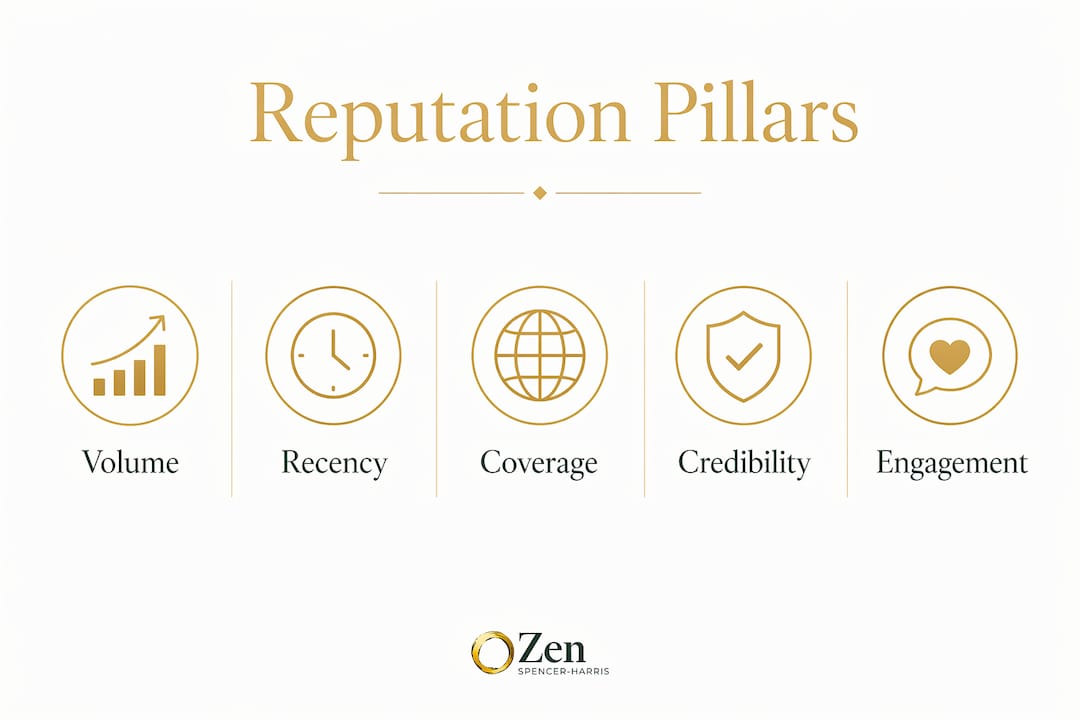
| Pillar | KPI | Measurement Method | 90-Day Target |
|---|---|---|---|
| Volume | Total reviews per provider | Directory dashboards, GBP Insights | new reviews per provider |
| Recency | Recent reviews count | Monitoring platform date filter | At least 4 new reviews/month per location |
| Coverage | % of active directories with reviews | Listings audit tool | Reviews present on 4+ platforms |
Pro Tip: Avoid chasing a perfect 5.0. A steady stream of authentic, mixed-but-recent reviews signals genuine patient activity to both AI systems and prospective patients. A suspiciously perfect score often triggers skepticism, not trust.
For a specialty practice with multiple providers, coverage also means distributing reviews across individual provider profiles, not just the practice page. A patient searching for a specific cardiologist needs to find that provider's own review record.
How do you build a reputation management system that runs itself?
The one-sentence answer: establish automated review generation, centralized monitoring, and service-recovery workflows tied to your CRM and scheduling system.
- Claim and verify all listings. Start with Google Business Profile, then Healthgrades, Vitals, Yelp, and Facebook. Consistent NAP (name, address, phone) data across all platforms is the foundation AI systems use to confirm your practice is real and active.
- Integrate EMR triggers. Connect your scheduling system to an automated review-request tool. SMS outperforms email for quick review asks; send the request within 24 hours of the appointment.
- Sequence internal surveys first. Combining first-party surveys with third-party review invites lets you surface dissatisfied patients privately before they post publicly. Route low-satisfaction responses into a service-recovery workflow immediately.
- Centralize monitoring. Use a reputation dashboard that aggregates reviews across all platforms, flags sentiment trends, and routes negative feedback to the right team member within hours.
- Set response SLAs. Patients expect a reply within a few days; negative reviews should get a response within 24 hours. Assign ownership: one team, one queue, no gaps.
- Activate service recovery. Intercept dissatisfied patients before they post. A private outreach call or message converts a frustrated patient into a retained one far more often than a public reply ever will.
For tool selection, look for a listings manager that syncs to Google Business Profile, a review automation platform with EMR webhook support, and a sentiment analysis layer that routes issues by urgency.
Governance checklist: designate a single review-response owner, define escalation rules for clinical complaints, require approval gates for any response that mentions a patient by name, and log all responses for audit purposes.

How do you measure reputation management ROI in 90 days?
Measure both reputation health and business outcomes. Vanity metrics like aggregate star rating tell you almost nothing about whether reputation work is driving appointments.
| KPI | Data Source | Short-term performance check | 90-Day Target |
|---|---|---|---|
| New review volume | GBP Insights, directory dashboards | Baseline established | measurable lift vs. prior period |
| Response rate | Monitoring platform | majority of reviews answered | high sustained response rate |
| AI-cited visibility | AI Share of Voice tracking | Baseline audit complete | Appearing in AI results for 3+ queries |
| Click-to-call / directions | GBP Insights | Trending up | measurable improvement vs. baseline |
| New patient bookings | CRM / scheduling system | Attribution model live | Measurable lift tied to reputation channels |
Build a simple dashboard: weekly operational review covering response SLAs and new review volume; monthly executive report covering booking attribution and AI visibility trends. Sentiment analysis tools let teams triage risk, prioritize high-impact responses, and route issues into operational fixes tied to internal KPIs.
What are the HIPAA rules for responding to patient reviews publicly?
The core rule: never confirm patient identity or disclose any protected health information (PHI) in a public reply. Not even to correct a factually wrong review.
What to do:
- Acknowledge the feedback in general terms ("We take all patient experiences seriously").
- Invite the reviewer to contact your office privately to resolve the issue.
- Use pre-approved, HIPAA-compliant response templates reviewed by your legal or compliance team.
- Route any response that could involve clinical details into a private, role-based service-recovery workflow.
What to never do:
- Confirm that the reviewer is or was a patient.
- Reference appointment dates, treatments, diagnoses, or billing details.
- Respond defensively with clinical specifics, even when the review is inaccurate.
HIPAA-safe reputation programs rely on encrypted handling, audit trails, and role-based controls to prevent accidental PHI exposure. When selecting a vendor, verify: HIPAA-aligned encryption at rest and in transit, audit logs for every response action, role-based access that limits who can publish replies, and automated flagging of high-risk language before a response goes live.
Pro Tip: Build your response templates before you need them. A library of 8–10 pre-approved, HIPAA-reviewed templates for common scenarios (positive feedback, wait-time complaints, billing concerns) cuts response time and eliminates compliance risk in the moment.
How does Zensweb turn reputation into booked appointments?
Zensweb runs online reputation for healthcare as a performance channel, not a brand exercise. The approach links review signals and structured data fixes directly to AI Share of Voice outcomes and paid-on-results patient bookings. You do not pay for effort; you pay for delivered appointments.
A typical 90-day pilot covers:
- Listings audit and correction: NAP consistency across Google Business Profile, Healthgrades, Vitals, Yelp, and Facebook.
- Review generation activation: EMR-integrated automated requests with SMS sequencing and internal survey gating.
- AI visibility baseline and tracking: measuring how often your practice appears in ChatGPT, Claude, Perplexity, and Google conversational results for target queries.
- Response governance setup: HIPAA-compliant templates, role assignments, and escalation workflows.
- Attribution reporting: booking data tied to reputation channel activity so you can see exactly what moved.
Payment triggers when agreed patient-acquisition targets are hit. That accountability structure is what separates a performance pilot from a retainer that runs indefinitely without proof.
Key Takeaways
Specialty practices that treat reputation as a performance channel, not a PR function, see measurable gains in AI visibility and booked appointments within 90 days.
| Point | Details |
|---|---|
| Volume, recency, coverage | Target a steady increase in new reviews per provider over several months across multiple platforms. |
| Reputation feeds AI visibility | Consistent listings, review velocity, and prompt responses are the signals AI uses to recommend providers. |
| Measure bookings, not stars | Track click-to-call, new patient bookings, and AI-cited visibility alongside review volume. |
| HIPAA compliance is non-optional | Use pre-approved templates, role-based access, and audit logs for every public response. |
| Zensweb performance pilot | Zensweb links reputation work to booked appointments with a paid-on-results model and a 90-day AI visibility target. |
Why reputation is the most underused performance channel in specialty healthcare
Most specialty practices treat reputation management as reactive cleanup: respond to the occasional bad review, hope the good ones accumulate. That framing costs real revenue.
The practices that grow fastest right now are the ones that have wired review generation into their clinical workflow so it runs without anyone thinking about it. They are not chasing a perfect score. They are building a steady, authentic signal that AI systems can cite and patients can trust. The difference between a practice that shows up when a patient asks an AI assistant for a recommendation and one that does not often comes down to review recency and listing accuracy, not clinical quality.
Service recovery deserves more credit than it gets. A dissatisfied patient who gets a private, prompt, genuine response before they post publicly is far more likely to become a loyal patient than one who feels ignored. That is retention work disguised as reputation work.
Performance accountability changes the dynamic entirely. When a vendor's fee is tied to booked appointments rather than hours worked, the incentive structure aligns with yours. That is the model worth demanding.
A performance-based path to more booked patients starts here
Specialty practices that want measurable results, not monthly reports full of impressions, need a different starting point. Zensweb's Free Healthcare Audit identifies exactly where your listings, reviews, and AI visibility are losing patients right now, at no cost and no commitment.
The audit covers listing accuracy across Google Business Profile and specialty directories, review velocity gaps by provider and location, and your current AI Share of Voice on ChatGPT, Claude, Perplexity, and Google. From there, a 90-day performance pilot targets specific booked-appointment outcomes. You pay when results are delivered.
Book your Free Healthcare Audit to see exactly where your practice stands and what a 90-day pilot would target.
Useful sources and further reading
- athenahealth: Online Reputation Management for Healthcare — source for the volume/recency/coverage pillars and patient review behavior statistics.
- Yext: FAQ on Healthcare Reputation Management — covers AI visibility linkage, response cadence, first-party/third-party sequencing, and HIPAA template guidance.
- Yext: How to Create a Healthcare Reputation Management Strategy — step-by-step strategy framework including monitoring, sentiment analysis, and transparency.
- RepuGen — service-recovery workflow best practices and PHI compliance pitfalls.
- InMoment: Healthcare Reputation Management Guide — listings centralization and discoverability research.
- Reputation: Healthcare Reputation Management and Patient Experience — centralized dashboards, sentiment routing, and HIPAA-aligned platform controls.
- Solutionreach: Reputation Management for Medical Practices — automated review request channel effectiveness, including SMS vs. email engagement.
- Press Ganey: Reputation Management Platform — enterprise-grade review response, AI-drafted replies, and compliance-friendly workflows for regulated healthcare environments.