

What HIPAA-compliant AI actually means for your practice
HIPAA-compliant AI is any artificial intelligence system deployed in healthcare marketing workflows that enforces the full set of patient privacy and security requirements under the Health Insurance Portability and Accountability Act. That means minimum necessary access to protected health information (PHI), immutable audit trails, encryption in transit and at rest, and a signed Business Associate Agreement (BAA) with every AI vendor that touches patient data.
For specialty healthcare marketers, the stakes are concrete. HHS Office for Civil Rights (OCR) enforces these rules, and AI tools handling ePHI must satisfy the same access controls, encryption standards, and minimum necessary requirements as any other covered system. The January 2025 HIPAA Security Rule update made that even clearer by eliminating the old "required vs. addressable" distinction, so every safeguard is now mandatory.
Key compliance components specific to AI in marketing:
- Business Associate Agreements with all AI vendors processing PHI
- Minimum Necessary Rule limiting ePHI access to what each workflow actually requires
- Access controls using role-based (RBAC) and context-based (CBAC) frameworks
- Audit logging per 45 CFR 164.312(b), capturing agent identity, operation, authorization, and timestamp
- Strong encryption at rest and in transit, consistent with current HIPAA standards
- Risk assessments documenting AI data flows, access permissions, and remediation procedures
Foley & Lardner LLP's legal analysis, Verisys's operational track record, and Zen Spencer-Harris's performance-based marketing model each represent a distinct layer of this compliance picture: legal, operational, and strategic.
Table of Contents
- Key HIPAA regulations you need to understand before deploying AI
- How agentic AI shifts compliance from a checklist to a living system
- Common misconceptions that create real compliance gaps
- Strategies to integrate AI while protecting patient data and growing your practice
- How Zen Spencer-Harris drives patient acquisition with built-in compliance
- How to de-identify patient data before it enters an AI model
- How to evaluate AI vendors for real HIPAA compliance
- Steps to take when a potential HIPAA breach involves AI
- Regulatory updates and trends shaping HIPAA AI compliance in 2026
- What successful HIPAA-compliant AI looks like in specialty practices
- Key Takeaways
Key HIPAA regulations you need to understand before deploying AI
The HIPAA Privacy Rule governs how covered entities and business associates use and disclose PHI. The Security Rule governs ePHI specifically, requiring confidentiality, integrity, and availability across every system that creates, receives, maintains, or transmits it. When an AI platform touches patient records to personalize outreach or verify provider credentials, both rules apply.
- Minimum Necessary Rule: AI systems may only access the PHI fields required for a specific task. Broad EHR access for a scheduling bot violates this standard.
- §164.312(b) audit controls: Standard AI tools lack granular audit trails that OCR expects during investigations.
- Encryption mandates: The January 2025 update made AES-256 and TLS 1.3 non-optional for all ePHI systems.
- BAA obligation: Any AI vendor processing PHI on your behalf is a business associate. No BAA, no legal cover.
- Risk management documentation: Regulators now require full inventories of AI technologies interacting with ePHI, including data flow maps, access logs, vulnerability assessments, and patch histories.
- Multi-factor authentication: Mandatory under the 2025 Security Rule update for all systems accessing ePHI.
How agentic AI shifts compliance from a checklist to a living system
Static compliance means someone reviews a policy document after the fact. Agentic AI flips that model entirely. As Foley & Lardner LLP describes it, agentic AI uses deterministic execution, constrained autonomy, and human-in-the-loop oversight to encode compliance policies as executable logic embedded directly in workflows.

In practice, that means a prior authorization request gets validated against payer rules before it leaves the system. A credentialing check flags a discrepancy in real time rather than surfacing it during a quarterly audit. Documentation integrity monitoring catches a missing signature before a claim is submitted.
Benefits and architectural commitments of agentic AI compliance:
- Real-time workflow gating: Transactions that violate policy rules are blocked before execution, not flagged afterward.
- Automated audit trail generation: Every agent action is logged with operation type, PHI fields accessed, authorizing user, and timestamp.
- Reduced administrative error: Verisys reports that AI automation cuts credential verification mistakes and catches suspicious EHR access patterns that human reviewers miss.
- Faster audit response: Pre-built logs satisfy OCR investigation standards without scrambling to reconstruct activity.
- Human oversight preserved: Constrained autonomy means the AI executes within defined parameters; a human approves anything outside them.
For marketing teams, this matters because credentialing delays and documentation errors directly affect how quickly a new provider can be listed, scheduled, and promoted to prospective patients.
Common misconceptions that create real compliance gaps
The most dangerous assumption in healthcare AI adoption is that an AI tool marketed as "HIPAA compliant" is actually compliant for your specific use case. It usually is not without additional controls.
- Misconception: The vendor's HIPAA badge covers you. A vendor claiming HIPAA compliance without a signed BAA provides zero legal protection. The BAA is the contract; the badge is marketing.
- Misconception: De-identified data is always safe to share. Uploading PHI to public AI tools without a BAA means that data may lose HIPAA protections entirely, and large-scale re-identification risks are real when third parties integrate their own AI models.
- Misconception: Broad EHR access is fine if the AI is internal. The Minimum Necessary Rule applies regardless of whether the system is internal or external. Operation-level restrictions are required.
- Misconception: A policy document equals technical enforcement. Layered technical safeguards including PHI masking, RBAC, and immutable audit logs must be implemented in the system itself, not just described in a compliance manual.
- Misconception: Generic AI tools have adequate audit trails. Most do not. OCR expects logs that capture which agent accessed which PHI field, what operation it performed, who authorized it, and when.
Foley & Lardner LLP's analysis of agentic AI compliance reinforces this: policy intent and technical enforcement are two different things, and regulators judge you on the latter.
Strategies to integrate AI while protecting patient data and growing your practice
Start with vendor verification. Before any AI platform touches patient data, confirm it will sign a HIPAA-compliant BAA and can demonstrate operation-level PHI restriction, not just a general compliance statement.
- Implement RBAC and CBAC: Restrict each AI agent's PHI access to the minimum required for its specific function. A marketing automation tool should never see clinical notes.
- Use context-preserving PHI masking: Replacing PHI with semantically consistent tokens lets AI models analyze patient data meaningfully without exposing identifiable information. Model accuracy is preserved; privacy risk is minimized.
- Encrypt everything in transit and at rest: AES-256 and TLS 1.3 are the current mandatory standards post the 2025 Security Rule update.
- Integrate AI into your HIPAA risk analysis: Document every AI tool's data flows, access permissions, and remediation procedures as part of your annual security risk assessment.
- Log all PHI interactions: Operation-level audit logs satisfy OCR standards and simultaneously meet FDA and GDPR requirements.
- Conduct vendor due diligence annually: AI platforms update their models and data handling practices frequently. A vendor that was compliant last year may have changed its architecture.
Pro Tip: Ask every AI vendor for a copy of their most recent third-party security audit, not just their BAA template. A vendor that cannot produce one is a vendor that has not been tested.
How Zen Spencer-Harris drives patient acquisition with built-in compliance
Zensweb's AI Share of Voice program is built around one specific problem: specialty healthcare practices are invisible on the AI-assisted search platforms where patients now look first. ChatGPT, Claude, Perplexity, and Google's AI Overviews are where referral decisions increasingly begin, and most practices have no presence there.
The performance-based model means Zensweb only gets paid when measurable results arrive: booked appointments, qualified patient inquiries, and documented visibility gains. HIPAA-compliant data handling is embedded in every campaign, so marketing workflows never expose PHI to uncertified tools or unsecured channels.
Zensweb's differentiators for compliant healthcare AI marketing:
- AI Share of Voice optimization targeting ChatGPT, Claude, Perplexity, and Google to boost visibility promptly
- Technical SEO including structured data and schema markup that signals authority to both AI and traditional search
- Authority content creation that positions providers as credible sources AI platforms cite
- Online reputation management building the review volume and sentiment that AI systems weight heavily
- Local SEO via Google Business Profile and directory listings optimized for specialty care searches
- Team coaching through the Engagement OS platform, embedding compliance-aware marketing habits across staff
Specialty practices ready to grow without the compliance risk can start with a free healthcare audit to assess AI readiness, current visibility gaps, and marketing compliance posture before committing to a full program.
How to de-identify patient data before it enters an AI model
HIPAA recognizes two de-identification methods. The Expert Determination method requires a qualified statistician to certify that re-identification risk is very small. The Safe Harbor method requires removing all 18 specific identifiers listed in the Privacy Rule, including names, geographic data smaller than a state, dates more specific than year, phone numbers, and device identifiers.
For AI applications, context-preserving tokenization goes further than Safe Harbor alone. It replaces identifiers with semantically consistent synthetic values so the AI model can still detect patterns, clinical relationships, and scheduling trends without ever processing a real patient name or date of birth. This approach satisfies HIPAA's de-identification standard while keeping the data useful for analysis.
How to evaluate AI vendors for real HIPAA compliance
Vendor evaluation is where most practices make their biggest compliance mistake: they accept a vendor's self-attestation instead of verifying technical controls.
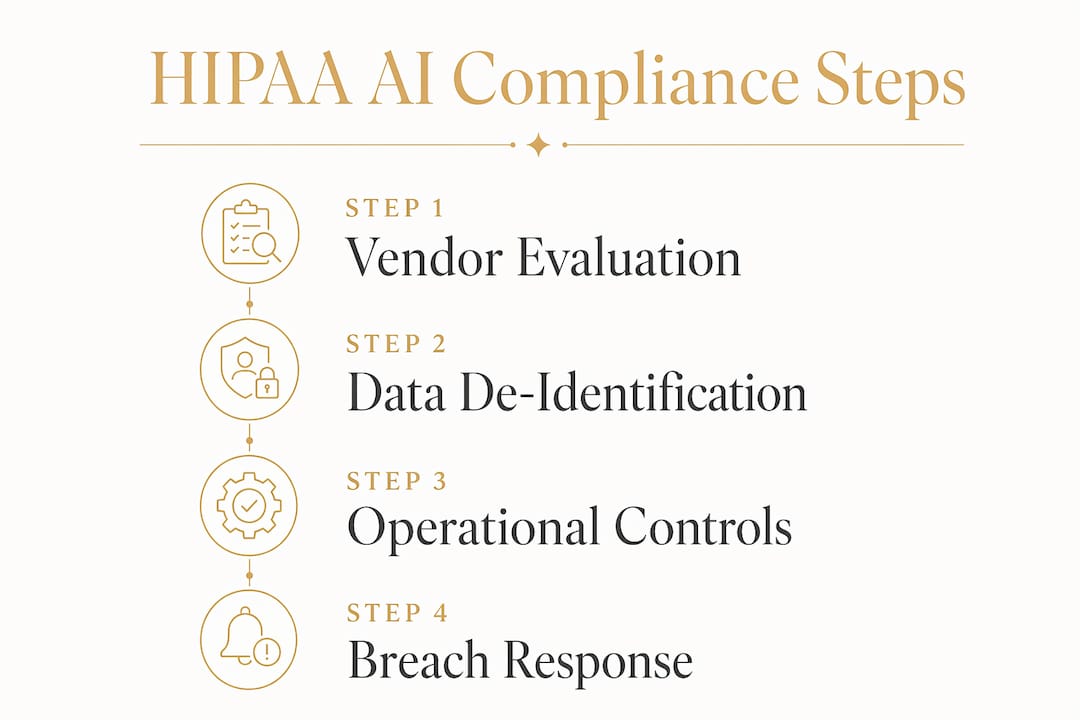
Request and review: a signed BAA before any data sharing; documentation of operation-level PHI access restrictions; third-party security audit results (SOC 2 Type II is the relevant standard for most SaaS platforms); encryption specifications confirming AES-256 at rest and TLS 1.3 in transit; and a clear data retention and deletion policy.
Ask specifically how the vendor handles model training. Some AI platforms train on customer data by default. If your patient data is used to improve a vendor's general model, that is a potential HIPAA violation regardless of what the BAA says about data use.
Steps to take when a potential HIPAA breach involves AI
Speed and documentation both matter. The HIPAA Breach Notification Rule requires covered entities to notify affected individuals and HHS within 60 days of discovering a breach of unsecured PHI.
When an AI system is involved, the immediate steps are: isolate the affected system to stop ongoing exposure; preserve all audit logs before any remediation that could overwrite them; determine the scope by identifying which PHI fields were accessed, by which agent, and during what time window; notify your BAA-covered vendor immediately, since business associates have their own notification obligations; and engage legal counsel, particularly firms with HIPAA enforcement experience such as Foley & Lardner LLP, before communicating with OCR.
Post-incident, update your risk assessment to document the breach, its cause, and the remediation steps taken. OCR expects to see that documentation during any subsequent investigation.
Regulatory updates and trends shaping HIPAA AI compliance in 2026
The January 2025 Security Rule update is the most significant structural change to HIPAA in years. By eliminating the required versus addressable distinction, HHS effectively mandated that every covered entity and business associate implement the full technical safeguard stack, including multi-factor authentication, encryption, and audit controls, with no exceptions based on organizational size or resources.
OCR enforcement signals in 2025 and 2026 have focused specifically on AI tools handling ePHI, with investigators scrutinizing whether organizations can demonstrate operation-level access controls rather than just producing a BAA. State-level AI regulations in California, Texas, and New York are adding additional layers on top of federal HIPAA requirements, particularly around algorithmic transparency and patient notification when AI influences a clinical or administrative decision.
What successful HIPAA-compliant AI looks like in specialty practices
Behavioral health organizations have used AI-driven credentialing automation to cut provider onboarding time, which directly shortens the window between hiring a clinician and being able to market their availability to new patients. Community health centers have deployed agentic AI for claims validation, catching documentation errors before submission and reducing denial rates without exposing PHI to external systems.
On the marketing side, specialty practices using structured data and AI-optimized content have seen their providers cited by name in ChatGPT and Perplexity responses to condition-specific queries, a visibility channel that did not exist two years ago. The compliance requirement here is straightforward: the content and schema markup that feeds AI platforms must never include PHI, and any patient-facing AI chat tool on the practice website requires a BAA with the platform provider.
Key Takeaways
HIPAA-compliant AI requires technical enforcement at the operation level, not just signed agreements and policy documents.
| Point | Details |
|---|---|
| BAAs are necessary but not sufficient | Every AI vendor touching PHI needs a signed BAA, plus demonstrated operation-level access controls. |
| 2025 Security Rule removes flexibility | AES-256 encryption, audit logs, and multi-factor authentication are now mandatory for all ePHI systems. |
| Agentic AI enables living compliance | Embedding policy as executable logic catches violations in real time rather than in retrospective audits. |
| De-identification requires method selection | HIPAA's Expert Determination or Safe Harbor methods must be applied before PHI enters any AI model. |
| Breach response starts with log preservation | Audit logs must be secured immediately after discovery to support OCR investigation requirements. |