

The single highest-impact move for a psychiatry private practice in the next 90 days is this: pick your payer model, fix your intake speed, and launch one service-line funnel. Everything else is secondary. The APA's practice-management guidance frames marketing as strategy-driven planning with defined objectives and measurable goals, not a collection of tactics you bolt on after the fact. Start there.
Your 90-day checklist, in order:
- Decide your payer model (insurance-based med management, cash-pay, or hybrid) — this determines every downstream channel and budget decision
- Create one service-line landing page (TMS, Spravato, ADHD evaluation, or your highest-margin service)
- Enable online booking with a 24-hour callback SLA for new patient inquiries
- Claim and complete your Google Business Profile, Psychology Today, and Zocdoc listings
- Launch one targeted paid search campaign pointing to that service-line page
- Set up call tracking and a UTM structure so you know which source booked the appointment
These three moves (payer mix, intake speed, service-line funnel) return the most booked appointments per dollar because they address the actual bottlenecks: unclear positioning, slow response, and generic pages that lose high-intent searchers to directories.
Table of Contents
- How does the psychiatry buyer's journey map to your marketing channels?
- What does your website need to actually convert visitors into patients?
- How should you approach SEO for a psychiatry practice?
- What content and social strategy actually builds authority for psychiatrists?
- How do you structure paid ads for psychiatry without wasting budget?
- How do you build a referral network that sends consistent patients?
- What do you need to know about telehealth compliance before you market it?
- What KPIs should you track, and how often?
- What does the research say about service-line funnels and psychoeducation?
- What mistakes do psychiatry practices make most often in marketing?
- Key Takeaways
- The part of psychiatry marketing most practices get backwards
- Zensweb's performance-based patient acquisition program
- Useful sources and further reading
How does the psychiatry buyer's journey map to your marketing channels?
Patients seeking psychiatric care do not all move at the same pace. Someone researching TMS for treatment-resistant depression has already done months of reading and is close to booking. Someone who just realized they might have ADHD is at the very beginning. That gap in readiness is the single most important thing to understand about mental health marketing, because it determines where to spend first.

Awareness stage: The patient recognizes a problem but has not yet searched for a specific provider. Content marketing, social psychoeducation, and referrals from PCPs or therapists are the primary channels here. Your job is to be findable and credible—not to sell.
Consideration stage: The patient is comparing options, reading reviews, checking credentials, and evaluating wait times. This is where your website, directory profiles, and Google Business Profile do the heavy lifting. Provider directories like Psychology Today, Zocdoc, and Headway send warm, ready-to-evaluate leads when profiles are complete with credentials, insurance info, and booking links.
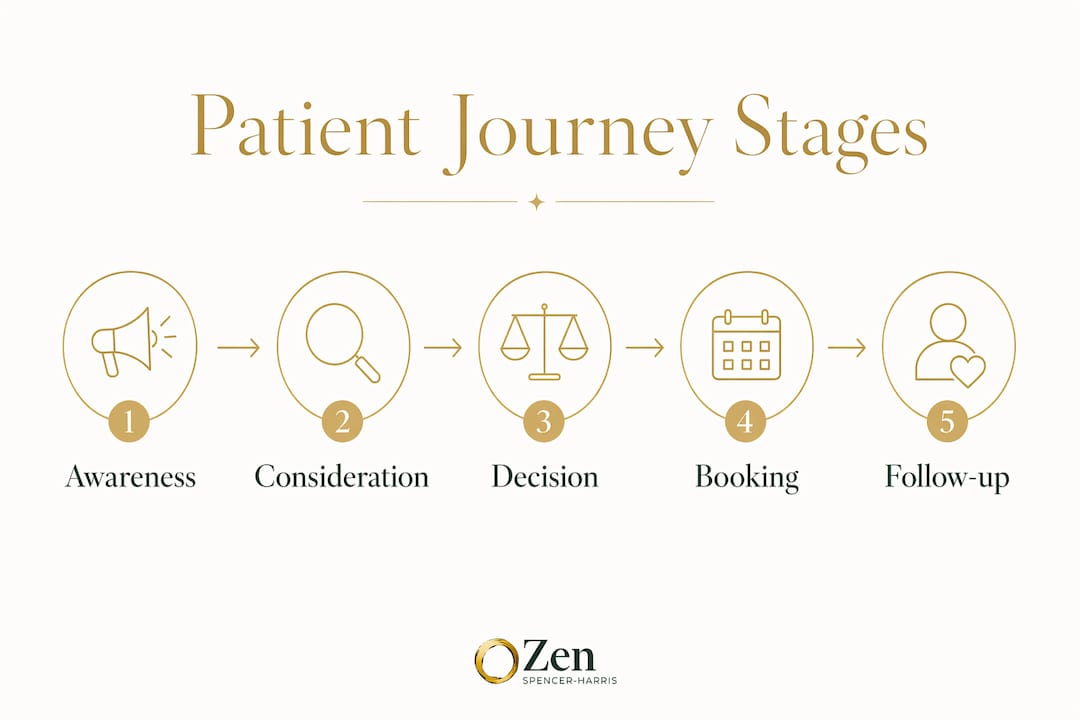
Decision stage: The patient is ready to book. Paid search, a frictionless booking flow, and fast intake response convert them. If your intake process takes more than 24 hours to respond, you lose a meaningful share of these patients to the next practice that picks up the phone.
For insurance-based med management, invest first in local SEO and directories (Consideration). For cash-pay or interventional services like TMS or Spravato, paid search and service-line funnels (Decision) return faster results because the patient is already intent-driven.
What does your website need to actually convert visitors into patients?
Your website has one job: convert a qualified visitor into a booked appointment. Not educate the whole internet. Not win design awards. Convert.
Must-have pages:
- A service-line landing page for each major offering (not one generic "services" page)
- A clear intake and booking page with a visible call-to-action above the fold
- Clinician bios with credentials, training, and a photo — patients choose providers, not practices
- A telehealth and insurance information page with plain-language eligibility details
- An FAQ page addressing wait times, what to expect at the first appointment, and how prescriptions work
- A secure contact form that does not collect protected health information in open fields
UX and trust checklist:
- Booking CTA visible without scrolling on mobile
- A visible wait-time statement (even "currently accepting new patients" is a conversion signal)
- Clinician photos with credential highlights (MD, board certification, fellowship)
- Clear language about your intake process and what happens after someone submits a form
Technical checklist:
- Mobile page speed under three seconds (Google's Core Web Vitals threshold)
- HIPAA-aware booking platform with a signed Business Associate Agreement (BAA)
- Schema markup for LocalBusiness, Physician, and MedicalClinic — include provider name, specialty, address, phone, accepted insurance, and service offered
Pro Tip: Add two or three pre-qualification questions to your intake form (insurance type, presenting concern category, preferred appointment format). This filters out leads your practice cannot serve and reduces no-shows from patients who were never a fit.
Patients value access, clear processes, and collaborative care as concrete differentiators when choosing a psychiatrist. A website that states your wait time, describes your intake process, and shows a real clinician photo does more conversion work than any paid campaign pointed at a generic homepage.

How should you approach SEO for a psychiatry practice?
Generic terms like "psychiatrist near me" are dominated by Psychology Today, Zocdoc, and Healthgrades. You will not outrank them on that term, and you should not try. The winning SEO strategy for psychiatry targets condition-specific and service-specific long-tail queries where directories have thin content and you can win with depth.
Keyword buckets to build pages around:
| Bucket | Example queries | Page type |
|---|---|---|
| Service-line + location | "TMS therapy for depression Chicago," "Spravato treatment Dallas" | Dedicated service-line landing page |
| Condition + location | "adult ADHD evaluation Austin," "bipolar disorder psychiatrist Seattle" | Condition-specific page |
| Intent modifier | "how much does TMS cost," "what to expect at first psychiatry appointment" | FAQ or blog post |
| Telehealth | "online psychiatrist Texas," "telehealth ADHD medication management" | Telehealth service page |
Local SEO checklist:
- Google Business Profile: complete every field, add photos, list all services, set your service area, and post monthly updates
- NAP consistency: your name, address, and phone number must match exactly across every directory (Psychology Today, Zocdoc, Healthgrades, Yelp, WebMD)
- Directory claims: claim and complete profiles on the top five to seven directories before building new ones
- Reviews: respond to every Google review within 48 hours, positive or negative
Schema markup for provider and service pages: On a service-line page, include Physician schema with the provider's name, MD credential, specialty, and NPI; MedicalClinic schema with address, phone, and accepted insurance; and MedicalProcedure or MedicalTherapy schema naming the specific service. A search engineer or your CMS plugin (Yoast, RankMath, or a custom JSON-LD block) can implement these fields. The payoff is rich snippets in Google Search that show your specialty and location directly in the results.
What content and social strategy actually builds authority for psychiatrists?
The APA and practice-management experts are consistent on this: marketing for psychiatrists is about distinguishing your services and building trust through educational content, not self-promotion. Psychoeducational content and referral-focused content come first. Clinical commentary on individual cases or anything that reads as diagnostic advice comes never.
Content dos and don'ts:
- Do: Explain conditions in plain language (what ADHD looks like in adults, how TMS works mechanically)
- Do: Comment on published research and Surgeon General reports as a credentialed expert
- Do: Add explicit disclaimers on every public post ("This is general information, not medical advice")
- Do not: Share patient anecdotes, even anonymized ones, without explicit written consent
- Do not: Offer diagnostic impressions on social media, even in response to direct questions
- Do not: Violate the Goldwater Rule — no public commentary on the mental health of named individuals
Platform selection by audience:
| Platform | Best for | Content type |
|---|---|---|
| PCP and therapist referral network, professional credibility | Research commentary, practice updates, referral process explainers | |
| Adults, community awareness | Psychoeducation, event announcements, FAQ posts | |
| Adults, visual storytelling | Infographics, short explainers, clinician introductions | |
| TikTok | Younger adults, high reach | Short psychoeducation videos, myth-busting |
| YouTube | All ages, long-form authority | Condition explainers, "what to expect" walkthroughs |
A focused presence on two or three platforms consistently outperforms being active everywhere. Pick the platforms where your target patient cohort actually spends time, post on a fixed schedule, and measure engagement before expanding.
Pro Tip: Build a referral-specific content stream on LinkedIn. Post one piece per month that explains your intake process, your referral workflow, or a condition you specialize in. PCPs and therapists who follow you will think of you first when a patient fits your profile.
How do you structure paid ads for psychiatry without wasting budget?
Split your paid budget by service line from day one. An insurance-based med-management campaign and a cash-pay TMS campaign need separate landing pages, separate ad copy, separate negative keyword lists, and separate KPIs. Mixing them produces mediocre results for both.
Campaign checklist:
- Build separate ad groups for each service line (ADHD, depression/TMS, anxiety med management, Spravato)
- Add negative keywords to exclude therapist, psychologist, counseling, and therapy traffic — you are a psychiatrist, not a therapist, and the wrong clicks burn budget fast
- Write ad copy that describes the condition and the process, never a guaranteed outcome ("We help adults with treatment-resistant depression explore TMS" not "TMS cures depression")
- Use geo-targeting at the city or zip-code level, not broad metro or state targeting, unless you offer telehealth across the state
- For interventional services (TMS, Spravato), bid on high-intent terms like "TMS therapy near me" and "Spravato treatment [city]" — these convert at higher rates because the patient has already decided on the treatment type
Conversion tracking checklist:
- Set booked appointment as your primary conversion event (not form fill, not page view)
- Add call tracking with a dynamic number insertion tool so phone bookings are attributed to the correct campaign
- Apply UTM parameters to every paid URL so Google Analytics shows channel-level cost per booked appointment
- Review conversion data weekly for intake speed; review channel performance at 30 and 90 days
Compliance warning: Google and Meta classify mental health as a sensitive category. Ads that imply a diagnosis, promise a cure, or use before-and-after framing will be flagged or disapproved. Google's YMYL policy applies strict scrutiny to psychiatry content, which means ad copy and landing pages must avoid clinical outcome claims entirely. Review Google's healthcare advertising policies before launching and build a compliance review step into your campaign approval process.
How do you build a referral network that sends consistent patients?
PCPs and therapists are your highest-value referral sources. Treat them like named accounts, not a mailing list. A PCP who refers two patients a month is worth more than any paid campaign, and the acquisition cost is a lunch and a one-page referral guide.
Practical outreach tactics:
- Send an introduction packet to PCPs and therapists within a five-mile radius: one page on your services, your intake process, your accepted insurance, and a direct phone line for referral questions
- Offer a 15-minute "quick consult" call for referring clinicians who have a patient they are unsure about — this builds trust faster than any brochure
- Host a quarterly CME or educational session (in-person or virtual) on a topic relevant to your referral base (ADHD in adults, medication-resistant depression, psychiatric medication interactions)
- Send a clinical note or brief update back to the referring provider after the first appointment — this closes the loop and is the single most reliable way to generate repeat referrals
Referral tracking fields to capture in your CRM or intake system:
- Referrer name and clinic
- Referrer contact (direct phone or email)
- Date of first referral
- Typical reason for referral (condition category)
- Follow-up action taken (note sent, call made)
Reciprocity matters. When you send a clinical update back to a referring PCP, you are not just being courteous — you are demonstrating that you are a reliable partner. That reputation compounds over time and becomes a referral channel that no algorithm can disrupt.
What do you need to know about telehealth compliance before you market it?
Telehealth expands your geographic reach, but it does not expand your licensure. You can only treat patients in states where you hold an active license, and you can only advertise telehealth availability to patients in those states. Marketing telehealth to a broader audience than your licensure covers is a compliance risk, not a growth strategy.
Compliance checklist for telehealth marketing:
- Use a telehealth platform with a signed BAA (Doxy.me, SimplePractice, Zoom for Healthcare, or equivalent)
- State your licensure clearly on your telehealth page: "Currently accepting telehealth patients in [State A] and [State B]"
- Include a disclaimer that your telehealth service is not a crisis or emergency service, with a visible link to 988 (Suicide and Crisis Lifeline)
- Do not collect protected health information through standard web forms — use your HIPAA-compliant platform's intake tools
- Retain marketing-related communications (email campaigns, ad copy, landing page versions) for your records in case of a compliance review
HIPAA and BAA requirements apply to online booking and telehealth platforms. Running a BAA with every vendor that touches patient data is not optional — it is a baseline requirement.
Ethical boundaries for online marketing:
- Do not respond to patient questions about their specific symptoms or medications in public social media comments — redirect to a secure message or a scheduled appointment
- Maintain clear digital boundaries: your public social accounts are for education, not patient communication
- Do not use patient photos, testimonials, or case details in marketing materials without explicit written HIPAA-compliant authorization
Pro Tip: Add a standard disclaimer block to every piece of public content: "This content is for general informational purposes only and does not constitute medical advice, diagnosis, or treatment. If you are experiencing a mental health emergency, call 988 or go to your nearest emergency room." Copy it once, save it, and paste it everywhere.
What KPIs should you track, and how often?
Track booked appointments and payer mix as your primary KPIs. Everything else is a leading indicator. A practice that optimizes for website traffic or social followers without connecting those metrics to booked appointments is measuring the wrong thing.
KPI definitions and review cadence:
| KPI | Definition | Review cadence |
|---|---|---|
| Booked appointments | New patient appointments confirmed in your scheduling system | Weekly |
| Payer mix | Ratio of insurance vs. cash-pay bookings by service line | Monthly |
| Cost per booked appointment | Total channel spend divided by booked appointments from that channel | 30/90-day |
| Speed-to-lead | Time from inquiry submission to first staff contact | Weekly |
| Conversion rate | Booked appointments divided by total new patient inquiries | 30-day |
| Referral conversion | Referrals received vs. referrals converted to booked appointments | Monthly |
Basic attribution checklist:
- Apply UTM parameters to every paid, email, and social link (source, medium, campaign, content)
- Use a call-tracking number on your website distinct from your main practice line
- Add an "How did you hear about us?" field to your intake form and make it required
- Connect your booking platform to Google Analytics 4 so appointment confirmations fire as conversion events
Test cadence: Run A/B tests on landing page headlines and booking CTAs in 30-day windows. Test ad creative at 90 days when you have enough conversion data to be statistically meaningful. Do not make channel-level budget decisions on fewer than 30 booked appointments of data per channel.
What does the research say about service-line funnels and psychoeducation?
The evidence is clear on two points. First, psychoeducational content builds the kind of authority that generates professional referrals without crossing clinical boundaries. Second, service-line funnels capture high-intent demand that generic psychiatry pages miss entirely, because patients searching for TMS or Spravato have already decided on a treatment category and are looking for a provider, not an education.
A single service-line landing page for TMS, paired with a targeted paid search campaign on terms like "TMS therapy for depression [city]," captures patients who are past the awareness stage and ready to book a consultation. The page does not need to be long. It needs to answer four questions: What is this treatment? Who is it for? What does the process look like? How do I get started? A clear booking CTA and a pre-qualification form complete the funnel.
Checklist to build one service-line funnel:
- Choose the service line with the highest margin or longest patient lifetime value (TMS, Spravato, ADHD evaluation, or medication management)
- Write a dedicated landing page answering the four questions above, with no navigation links that pull visitors off the page
- Write ad copy that names the condition and the treatment, with no outcome guarantees
- Add a two-question pre-qualifier to the intake form (insurance type or self-pay, presenting condition category)
- Define a clinician follow-up protocol: who calls the lead, within what timeframe, and what they say
- Set KPI targets before launch: target cost per booked consultation and a minimum booking volume at 30 days
What mistakes do psychiatry practices make most often in marketing?
The fastest way to lose trust or face a compliance problem is to overpromise outcomes or let your intake process collapse under new patient volume. Both are more common than they should be.
Common mistakes and what to do instead:
- Vague service descriptions: "We treat mental health conditions" tells a patient nothing. Name the conditions, the treatments, and the populations you serve.
- Mixing personal and professional social accounts: Your personal Instagram is not a marketing channel. Keep clinical and personal content on separate accounts with separate audiences.
- Failing to close the referral loop: If a PCP refers a patient and never hears back, they will not refer again. Send a brief clinical update after the first appointment.
- Slow intake response: Speed-to-lead is a primary conversion bottleneck in psychiatry. The first practice to respond often wins the patient. Set a 24-hour SLA and enforce it.
- Non-HIPAA booking forms: A standard Google Form or contact form that collects presenting symptoms is a compliance exposure. Use a HIPAA-compliant intake platform.
- Inconsistent directory listings: Mismatched phone numbers or addresses across directories confuse patients and suppress local search rankings.
Red flags that need immediate remediation:
- An ad flagged or disapproved for sensitive content (review the copy for outcome claims or diagnostic language)
- A booking form that collects protected health information on an unsecured platform
- Directory listings with conflicting NAP data across three or more platforms
- A social post that includes a patient detail, even anonymized, without documented written authorization
This article is general information, not professional legal or compliance advice. Confirm current HIPAA requirements and advertising regulations with a qualified healthcare attorney or compliance officer for your specific situation.
Key Takeaways
Effective psychiatry marketing comes down to three decisions made early: your payer model, your intake speed, and which service-line funnel to launch first.
| Point | Details |
|---|---|
| Payer model first | Decide insurance vs. cash-pay before choosing channels — it determines every budget and targeting decision. |
| Fix intake speed | Set a 24-hour response SLA; the first practice to respond to a new patient inquiry typically wins the booking. |
| One service-line funnel | Build one dedicated landing page and paid campaign for your highest-margin service before expanding to other lines. |
| Track booked appointments | Use booked appointments and cost per booked appointment as primary KPIs — not traffic or social followers. |
| Zensweb | Offers performance-based patient acquisition and AI Share of Voice programs tied to booked appointment outcomes, not vanity metrics. |
The part of psychiatry marketing most practices get backwards
Most psychiatry practices spend the first six months of a marketing effort building a brand before they have fixed the thing that actually loses patients: intake speed and a generic website. A beautifully designed site with a five-day callback window will consistently underperform a plain site with a same-day response. The research on speed-to-lead is not subtle on this point.
The second thing practices get backwards is the content strategy. Clinicians often resist marketing because they associate it with self-promotion, which conflicts with professional identity. The reframe that actually works is this: psychoeducational content is a clinical service delivered at scale. A well-written explainer on what TMS involves, or a short video on how ADHD presents differently in adults, helps patients make better decisions about their care before they ever call your office. That is not self-promotion. It is practice.
The third mistake is treating referral relationships as passive. PCPs and therapists refer to psychiatrists they know and trust. That trust is built through consistent communication: a clinical note after the first appointment, a quarterly educational email, an occasional lunch. None of that requires a marketing budget. It requires a system and a calendar reminder.
The practices that grow fastest are not the ones with the biggest ad budgets. They are the ones that fixed intake, built one strong service-line funnel, and treated their referral network like a named account list. Everything else is amplification of a working system, not a substitute for one.
Zensweb's performance-based patient acquisition program
If you want booked appointments faster than a DIY approach allows, Zensweb's performance-based patient acquisition program is built for exactly this situation. The model is straightforward: you pay for delivered results, specifically booked appointments, not for ad spend, impressions, or hours billed.
A free healthcare audit covers your website's conversion readiness, your intake speed and SLA, your service-line funnel structure, and your AI visibility across ChatGPT, Claude, Perplexity, and Google. Practices that go through the audit typically find two or three immediate fixes that increase booking rates before any new spend is added. Zensweb's AI Share of Voice program also places your practice in front of patients who are searching on AI platforms, a channel most psychiatry practices have not yet claimed.
Request your free healthcare audit to get a clear picture of where your practice stands and what to fix first.
Useful sources and further reading
The sources below informed this guide and are worth bookmarking for ongoing reference:
-
APA Private Practice Marketing Guide: The American Psychiatric Association's practice-management framework for setting marketing objectives, defining target markets, and building a review cadence. The most authoritative starting point for any psychiatrist building a marketing strategy.
-
WebProNews: Social Media Marketing for Psychiatrists: Practical guidance on using social platforms for psychoeducation and professional commentary without crossing clinical or ethical boundaries. Covers HIPAA considerations for digital presence.
-
CUFinder: Lead Generation for Psychiatrists: A tactical playbook covering service-line funnels, intake speed, and the YMYL implications of psychiatry content for paid and organic search.
-
Headway: Psychiatry Advertising and Marketing Guide: Covers directory strategy, profile optimization, and how provider platforms send warm leads when profiles are complete and current.
-
Zocdoc: Psychiatry Practice Marketing and Advertising Strategies: Platform-selection guidance and audience-matching recommendations for psychiatry practices choosing where to invest social and paid media effort.
-
Brenton Way: Mental Health and Psychiatry Marketing Guide: Covers access, wait-time transparency, and collaborative care messaging as differentiators that affect patient choice and trust.