

Perplexity SEO is the practice of structuring and distributing content so Perplexity's answer engine retrieves, extracts, and cites your pages inside its responses. The three actions that produce the fastest wins: write a direct, quotable answer under every major heading, confirm PerplexityBot can crawl your site, and build topical depth on a narrow subject so the engine treats your domain as the go-to source.
Start here today:
- Write answer-first. Put a one-to-two sentence factual summary directly under each H2 heading before any context or background.
- Allow PerplexityBot. Check your robots.txt and confirm the crawler is not blocked.
- Own a narrow topic. Publish a cluster of interlinked pages on a single subject rather than scattered posts across many themes.
Key Takeaways
Perplexity SEO requires answer-first content, confirmed crawlability, and topical depth on a narrow subject to earn consistent citations inside AI-generated answers.
| Point | Details |
|---|---|
| Answer-first structure | Place a one-to-two sentence factual answer directly under each H2 heading before any context. |
| Allow PerplexityBot | Add User-agent: PerplexityBot / Allow: / to robots.txt before any other optimization work. |
| Build topical clusters | Publish interlinked pages on a narrow subject; domain-level topical depth outweighs keyword frequency. |
| Update on a regular cadence | A visible last-reviewed date and quarterly content reviews counter Perplexity's strong recency bias. |
| Measure with the API and Semrush | Use the Perplexity Search POST endpoint and Semrush Narrative Drivers to track citation share and prioritize update targets. |
| Zensweb AI Share of Voice | Zensweb's performance-based program builds Perplexity citation visibility for specialty healthcare practices, tied to booked appointments. |
Table of Contents
- What Is Perplexity AI and How Does It Differ from Classic Search?
- How Perplexity Finds, Scores, and Selects Sources
- Priority content and editorial tactics to increase citation probability
- Technical visibility checklist: robots, crawling, rendering, and structured data
- What content formats does Perplexity tend to cite?
- How to measure Perplexity visibility, track citations, and run a monitoring workflow
- Common mistakes, risks, and realistic timing for Perplexity citation gains
- A compact EEAT playbook for U.S. specialty healthcare sites
- What most SEO teams get wrong about Perplexity
- Perplexity citation growth for specialty healthcare practices
- Sources
What Is Perplexity AI and How Does It Differ from Classic Search?
Google returns a ranked list of links and lets you decide which page to visit. Perplexity reads those pages for you, synthesizes an answer, and cites the sources it used. That single difference reshapes every optimization priority.
Perplexity operates as an answer engine built on retrieval-augmented generation (RAG). When a user submits a query, the system runs a live web retrieval pass, pulls candidate pages in real time, and feeds their content into a large language model that writes a synthesized response. Citations appear inline, numbered, and linked. The Perplexity Hub frames this explicitly as a content-discovery and SEO-strategy tool, not a traditional ranking system.
Three differences matter most for content teams:
Live retrieval. There is no static index position to hold. A page published this morning can appear in citations today if it is crawlable and answers the query cleanly.
Sub-document extraction. Perplexity does not cite a page as a whole. It lifts specific sentences or paragraphs. A well-written page with a buried answer loses to a mediocre page where the answer appears in the first two sentences under a clear heading.
Inline citations, not blue links. Users rarely click through. The goal shifts from ranking to being quoted. Your content must be written to be lifted verbatim, not just found.
Classic SEO skills still apply: domain authority, technical crawlability, and content quality all feed the retrieval pool. What changes is the final yard. A page that ranks well in Google but buries its facts behind three paragraphs of context will be retrieved by Perplexity and then passed over for a citation.
How Perplexity Finds, Scores, and Selects Sources
Understanding the mechanics here is what separates teams that get cited from teams that just get retrieved.
The process runs in four stages: retrieval, reranking, extraction, and citation generation.
Retrieval pulls a large candidate set from the live web. Perplexity uses its own crawler (PerplexityBot) alongside third-party index data. Pages that are blocked, slow to render, or paywalled drop out here before any quality signal is evaluated.
Reranking is where most pages lose. Independent research confirms that Perplexity applies a multi-layer machine-learning reranker that weighs authoritative domains, topical authority, freshness, and engagement. Keyword density is nearly irrelevant at this stage. A page with strong topical depth on a narrow subject consistently outperforms a broad page that mentions the keyword more often.
Sub-document extraction is the step Jesse Dwyer has described in detail. Dwyer explains that Perplexity processes pages at the sub-document level, meaning it reads and scores individual sections, not just the page as a whole. Being the unambiguous first-party source on a single, well-scoped fact gives you the best extraction odds.
Citation generation selects three to six sources from the reranked, extracted pool and maps them to numbered inline references in the answer. The engine often retrieves dozens of candidates but cites only a handful.
The practical implication: a page that ranks on page two of Google but answers a narrow question with a clean, extractable paragraph can outperform a page-one result that buries its answer.
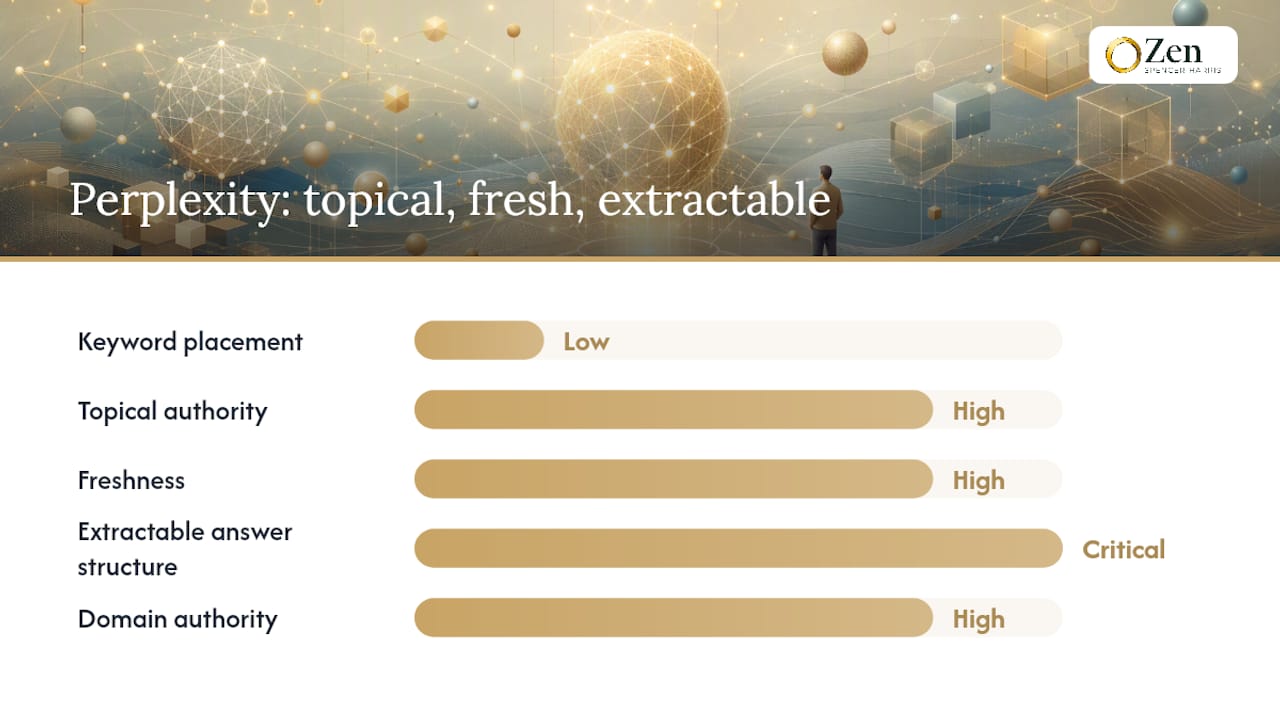
| Signal | Classic Google SEO | Perplexity Reranking |
|---|---|---|
| Keyword placement | High importance | Low importance |
| Topical authority (domain depth) | Moderate | High |
| Freshness | Moderate | High (recency bias confirmed) |
| Extractable answer structure | Low | Critical |
| Domain authority | High | High |
| Crawlability | Required | Required |
Priority content and editorial tactics to increase citation probability
The editorial decisions you make before you hit publish determine whether Perplexity quotes you or skips you.
1. Lead every section with a direct answer
Put a one-to-two sentence factual summary immediately under each H2 heading. No preamble, no "in this section we will cover." Experts consistently recommend this direct-answer-first structure as the single highest-impact editorial change for AI citation probability.
2. Build topical clusters, not scattered posts
Perplexity's reranker rewards domain-level topical authority. A site with twelve interlinked pages on psychiatric medication management will outrank a site with one comprehensive post on the same subject. Semrush's analysis of Perplexity optimization confirms that topical clusters and semantic keyword coverage are among the five most effective tactics for earning citations.
3. Update content on a regular cadence
Metehan Yeşilyurt's analysis, summarized in the Semrush research, highlights a strong recency bias in Perplexity's reranker. Pages with a visible "last updated" date that reflects a recent review consistently outperform stale content for time-sensitive queries. A quarterly review cycle for cornerstone pages is a practical minimum.
4. Cite primary sources and name your data
Perplexity's extraction model favors verifiable, attributable claims. Link to peer-reviewed studies, government databases, and named expert sources. A sentence that reads "According to the CDC's 2024 surveillance data..." is far more extractable than "Studies suggest..."
5. Earn third-party mentions
Practical guides note that Perplexity frequently pulls from community sources, including Reddit threads, industry forums, and review sites, alongside mainstream publications. Getting your brand or content mentioned in those channels increases the probability that Perplexity treats your domain as a consensus source.
Here is a short outreach checklist:
- Submit original data or commentary to industry publications in your vertical.
- Answer questions on relevant Reddit communities and link to your cornerstone pages.
- Request reviews on Google, Healthgrades, or Yelp (depending on your sector) to build third-party proof.
- Pitch guest posts to sites Perplexity already cites in your topic area.
Pro Tip: Run five to ten test queries in Perplexity on your core topics and note which domains appear in citations repeatedly. Those are the third-party sites worth targeting for mentions and links.
Technical visibility checklist: robots, crawling, rendering, and structured data
Getting the editorial side right means nothing if PerplexityBot cannot read your pages.
Allow PerplexityBot in robots.txt
The single most common technical failure for Perplexity visibility is a blanket Disallow: / rule for AI crawlers, or a wildcard block that catches PerplexityBot unintentionally. Add this line to your robots.txt:
User-agent: PerplexityBot
Allow: /
Confirm it is live before any other optimization work. A blocked site cannot be cited, regardless of content quality.
Render facts server-side
Perplexity's live fetch retrieves pages quickly and does not always execute JavaScript fully. If your key facts, statistics, or clinical claims are rendered client-side via JavaScript frameworks, they may be invisible to the crawler. Move critical content into server-rendered HTML. This applies especially to React, Next.js (client components), and Angular apps where data loads after the initial HTML response.
Schema markup: useful but not a shortcut
Structured data (Schema.org types like FAQPage, MedicalWebPage, Article) helps Perplexity understand content type and entity relationships. It does not guarantee citation. Schema works best as a supplement to well-structured prose, not a replacement for it. For healthcare pages, MedicalWebPage with medicalAudience and lastReviewed properties adds meaningful context.
Pro Tip: Use Google's Rich Results Test to confirm your schema is valid, then run a manual Perplexity query on your topic to see whether the structured content appears in the cited answer. The two tests together tell you whether the markup is actually helping extraction.
Performance and accessibility
Perplexity's live fetch has a short timeout window. Pages that take more than two to three seconds to return their first meaningful HTML are at risk of being skipped. Run a Core Web Vitals audit in Google Search Console and prioritize Time to First Byte (TTFB) on your highest-priority pages. Accessible heading structure (H1 → H2 → H3 in logical order) also improves extraction accuracy because the reranker uses heading context to score sub-document relevance.
What content formats does Perplexity tend to cite?
Format is not cosmetic. It is a functional signal that tells Perplexity's extraction layer where the answer lives.
The formats that get cited most reliably share one trait: the answer is unambiguous and immediately visible without scrolling or inference.
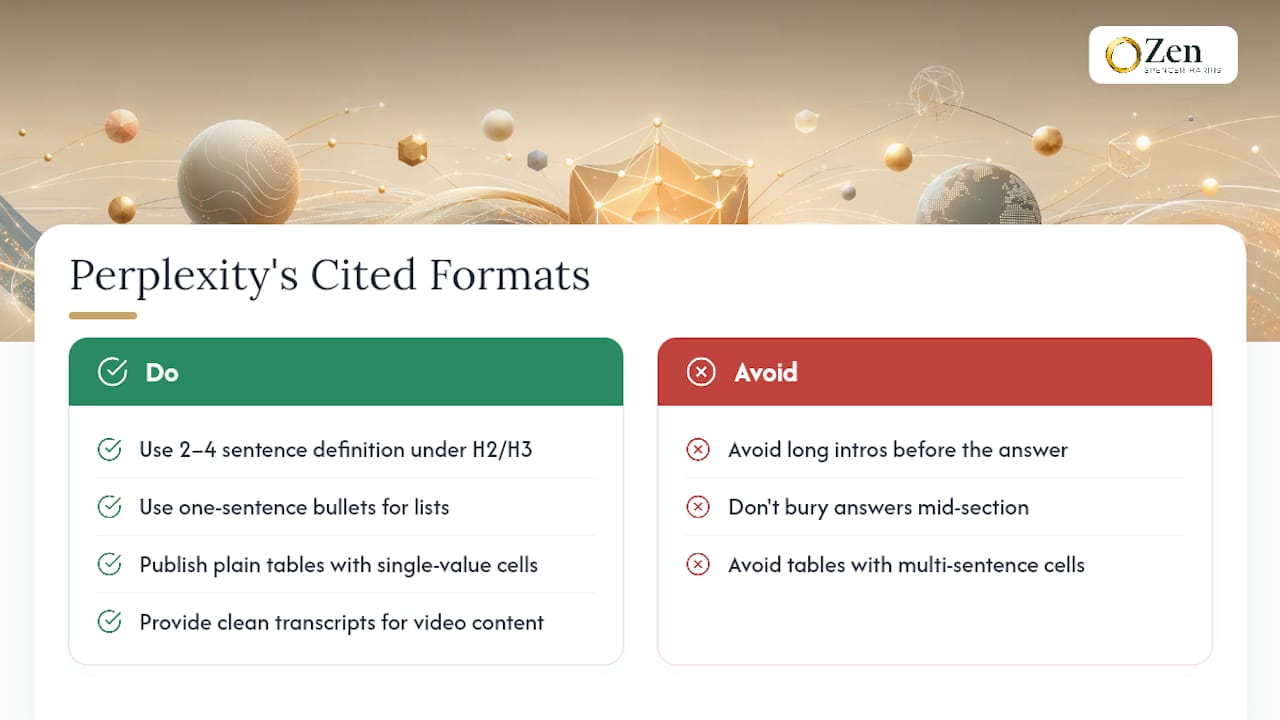
Short definitional paragraphs under clear headings. Two to four sentences that answer a specific question, placed directly under an H2 or H3 that names the question. This is the most commonly extracted format.
Numbered and bulleted lists. Lists of steps, criteria, or options are easy to lift because each item is self-contained. Keep bullets to one sentence. A five-item list of clinical criteria is far more extractable than a paragraph that lists the same five criteria in running prose.
Plain data tables. Tables with clear column headers and single-value cells (not multi-sentence paragraphs inside cells) are extracted cleanly. Avoid merged cells and footnote-heavy designs.
Named data points. A sentence that reads "The FDA approved [drug name] for [indication] in [year]" is more citable than "This medication has been approved for this use." Specificity is extractability.
Transcribed video and YouTube content. Perplexity indexes YouTube transcripts and sometimes cites video content directly. If you produce video on topics where you want citation visibility, publish a clean text transcript on the same page. This doubles your extraction surface.
Avoid: long introductory paragraphs before the answer, answers buried in the middle of a section, and tables where cells contain multiple sentences or conditional language.
How to measure Perplexity visibility, track citations, and run a monitoring workflow
You cannot improve what you do not measure. Here is a repeatable workflow.
-
Build a seed query list. Write out twenty to forty queries that represent the questions your target audience asks. These become your monitoring prompts.
-
Run queries manually in Perplexity and record results. For each query, note which domains appear in citations, whether your domain appears, and which specific page or paragraph was cited. Do this weekly for your highest-priority topics.
-
Use the Perplexity API for scale. The Search POST endpoint returns structured JSON results including title, URL, snippet, date, and
last_updatedfor each retrieved source. This lets you monitor retrieval and citation behavior programmatically across hundreds of queries. API citations are publicly available and rate limits have been increased, making regular automated checks practical. -
Validate citation URLs from the API stream. When using the streaming or Agent API, citation markers map to
search_resultIDs from the API stream. Always validate URLs from the stream itself. Never infer or construct citation URLs manually. -
Track with Semrush Narrative Drivers. Semrush's AI Visibility and Narrative Drivers features let you monitor brand mentions and citation share across AI answer engines including Perplexity. Use it to track share-of-voice trends over time and identify which topics your competitors are being cited for that you are not.
-
Prioritize pages to update. Pages that appear in retrieval but not in citations are your highest-leverage update targets. They are already in the candidate pool. A structural edit (moving the answer to the top, adding a clear heading, citing a primary source) can push them from retrieved to cited.
What to track: citation count per query, citation share versus competitors, which pages earn citations versus which are retrieved only, and any change in citation frequency after a content update.
Common mistakes, risks, and realistic timing for Perplexity citation gains
Most teams underestimate how fast early wins can come and how long durable authority takes to build.
Common mistakes that block citations:
- Burying the answer three paragraphs into a section instead of leading with it.
- Blocking PerplexityBot in robots.txt (often by accident through wildcard AI-crawler blocks).
- Publishing stale content with no visible update date, which the recency-biased reranker penalizes.
- Writing for keyword density rather than topical depth, which fails the L3 reranker entirely.
- Using paywalls or login gates on pages you want cited. Perplexity cannot extract content it cannot read.
- Relying on schema alone without fixing the underlying prose structure.
Realistic timeline:
Fresh, well-structured content on a crawlable domain can appear in Perplexity citations within days of publication, particularly for queries where few authoritative sources exist. That is the early-win window. Durable citation authority, where your domain appears consistently across a topic cluster, typically takes three to six months of sustained publishing, updating, and third-party mention building.
Healthcare-specific risks:
For U.S. healthcare content, the stakes of getting cited incorrectly are higher than in most verticals. Perplexity may extract a clinical claim out of context. Mitigations include writing claims that are accurate when read in isolation (not just accurate in context), adding clear scope language ("for adults with X condition, under physician supervision"), and avoiding absolute language that could be misapplied. HIPAA considerations apply to any patient-facing content that collects data, but the content itself does not trigger HIPAA obligations. The risk is reputational and clinical accuracy, not regulatory in most cases.
A compact EEAT playbook for U.S. specialty healthcare sites
Healthcare content faces a higher bar for citation because Perplexity's reranker applies additional scrutiny to YMYL (Your Money or Your Life) topics. The good news: the same EEAT signals that satisfy Google's quality guidelines also improve Perplexity citation odds.
Structure clinical claims for extraction
Every clinical or procedural claim should be written as a standalone, verifiable sentence. "Cognitive behavioral therapy reduces symptom severity in adults with generalized anxiety disorder, according to a 2023 meta-analysis in JAMA Psychiatry" is extractable. "CBT has been shown to help with anxiety" is not. Link the primary source. Name the study. Give the year.
EEAT elements to include on every healthcare page
- Named author with credentials. A byline that reads "Reviewed by [Name], MD, Board-Certified Psychiatrist" signals first-party expertise. Perplexity's reranker rewards this.
- Last-reviewed date. Visible, in the page HTML, not just in a meta tag. Clinical guidelines change; a page reviewed in the past twelve months signals reliability.
- Links to peer-reviewed sources and clinical guidelines. Link to PubMed, CDC, NIH, or specialty society guidelines (APA, ACS, ACC) rather than secondary summaries.
- Safe language for medical content. Include scope statements: "This information is for educational purposes. Consult a licensed provider before making treatment decisions."
For healthcare AI search optimization, the same principles apply across answer engines. A page built for Perplexity citation with strong EEAT signals will also perform better in Claude and ChatGPT responses.
Reputation and third-party proof
Earn mentions in industry press (Modern Healthcare, Psychiatric Times, Health Affairs) and in specialty society publications. These are sources Perplexity already trusts. A mention or citation in those outlets raises your domain's perceived authority in the reranker. Patient reviews on Healthgrades and Google Business Profile also contribute to the third-party proof layer, without touching any protected health information.
Pro Tip: Submit original data, survey results, or clinical commentary to a trade publication in your specialty. A single mention in a trusted outlet can lift your domain's citation odds across an entire topic cluster, not just the page that was referenced.
This is general information, not a substitute for legal, regulatory, or clinical compliance advice. Confirm current rules with a qualified healthcare attorney or compliance officer.
What most SEO teams get wrong about Perplexity
The dominant mistake is treating Perplexity like a faster version of Google. Teams optimize for keyword placement, build backlinks, and wait for rankings to move. None of that is wrong, exactly, but it misses the actual lever.
Perplexity does not rank pages. It quotes sentences. The competitive question is not "does my page rank for this keyword?" It is "is my sentence the clearest, most verifiable answer to this question in the entire retrieval pool?" That reframe changes everything: where you put the answer on the page, how you write it, how you source it, and how you structure the heading above it.
The teams seeing the fastest citation gains are not the ones with the highest domain authority. They are the ones who picked a narrow topic, wrote every page as if the first paragraph under each heading would be read aloud to a user, and updated those pages every quarter. That is a content operations discipline, not a technical SEO discipline.
One thing worth doing in the next hour: open Perplexity, run your five most important queries, and read the cited answers carefully. Notice which sentences got extracted. Then go look at those source pages and see exactly where those sentences live on the page. That single exercise will teach you more about Perplexity extraction than any framework.
Perplexity citation growth for specialty healthcare practices
Specialty healthcare practices face a specific version of this problem: they are invisible in AI search at the exact moment a prospective patient is deciding whether to book an appointment. Zensweb's AI Share of Voice program is built to fix that, with a performance model tied to booked appointments, not vanity metrics.

The program covers the full citation stack: technical crawlability audits, answer-first content restructuring, EEAT-compliant page builds, and third-party mention outreach targeted at the sources Perplexity already trusts in your specialty. Practices typically see measurable citation gains within 90 days. Because the model is performance-based, Zensweb earns fees only when results are delivered.
If your practice is not appearing in Perplexity answers for the conditions and services you treat, a free healthcare visibility audit is the fastest way to find out exactly which pages are being retrieved but not cited, and what it would take to close that gap.
Sources
These are the primary references and tools to consult as you implement.
- How Perplexity ranks content | Search Engine Land
- Perplexity AI optimization — Semrush blog
- Improve SEO strategy - Perplexity Hub
- Perplexity AI interview explains how AI search works — Search Engine Journal