

Generative engine optimization (GEO) is the practice of structuring your content and brand signals so AI-powered engines like ChatGPT, Perplexity, Claude, and Google's AI Overviews can find, trust, and cite you. It extends traditional SEO rather than replacing it. Three things you can do today: add a direct, one-sentence answer at the top of every major section; embed at least one sourced statistic with a named author in each piece; and open your Google Search Console Generative AI performance report to see which queries already surface your content in AI-generated answers.
- Add a BLUF sentence to every H2. Each section should open with a standalone answer a generative engine can lift and cite without reading the rest of the page.
- Publish sourced statistics with named authors. Academic GEO research shows that adding citations, quotations, and statistics can improve AI-cited visibility by up to 40%.
- Register in Search Console and Bing Webmaster Tools. Both platforms now surface AI-specific performance data. Check them weekly, not monthly.
Key Takeaways
GEO is an evolution of SEO that requires structuring content for AI citation, building entity trust through named authors and co-mentions, and measuring success through prompt-test citation rates and platform AI reports rather than clicks alone.
| Point | Details |
|---|---|
| BLUF structure is the highest-leverage tactic | Open every H2 with a direct, standalone answer so AI engines can extract and cite it without reading the full page. |
| Sourced statistics drive citation probability | Adding citations, quotations, and statistics produced up to 40% visibility improvement in GEO-bench evaluations. |
| Technical eligibility is the floor | Confirm AI crawlers are unblocked, pages are indexed, and Article/FAQPage/HowTo schema is implemented before scaling content. |
| Measure with prompt tests and platform reports | Track citation rate weekly via structured prompt tests across ChatGPT, Perplexity, Claude, and Gemini; check Search Console and Bing AI reports monthly. |
| Entity trust outweighs formatting | Named authors, external co-mentions, and verifiable credentials determine whether an AI engine cites you, not schema tags alone. |
| Zensweb AI Share of Voice | Performance-based program that gets specialty healthcare practices cited on major AI platforms within 90 days, with fees tied to booked appointments. |
Primary sources and official documentation
- Google Search Central: Optimizing for generative AI features — The authoritative Google guidance on what to do (and not do) for AI search optimization. Use this to verify any tactic before implementing it.
- GEO academic framework and GEO-bench evaluation — The foundational academic paper establishing GEO as a discipline and documenting which content strategies produce measurable citation improvements.
- Siteimprove: What is Answer Engine Optimization? — Practical enterprise-level guidance on the monitoring gap and how to build a prompt-testing measurement protocol.
- Semrush: GEO vs. SEO practical recommendations — Covers the shift from click-based to citation-based KPIs and how to retain SEO fundamentals while adding GEO tactics.
- Google Search Console — Use the Generative AI performance report to track AI impressions and clicks from Google AI Overviews.
- Bing Webmaster Tools — The AI Performance report tracks how your content performs in Bing Copilot responses.
- Zensweb AI Search Visibility services — For healthcare practices implementing GEO with a performance-based partner.
Table of Contents
- What is generative engine optimization and how does it differ from SEO?
- Why GEO matters for your business right now
- Core GEO strategies: a step-by-step action plan
- Technical checklist for AI discoverability
- How to measure GEO performance
- Risks and best practices: what not to do
- A 90-day E-E-A-T playbook with KPIs
- Zensweb's AI Share of Voice program for healthcare practices
- Sources
What is generative engine optimization and how does it differ from SEO?
Generative engine optimization is the discipline of making your content citable by AI answer engines, not just rankable by traditional search algorithms. Where SEO targets a position on a results page, GEO targets a mention inside a synthesized AI response. The goal shifts from "rank #1" to "get cited when someone asks a relevant question."
The two disciplines share a foundation. Google Search Central states plainly that optimizing for generative AI features is still optimizing for the search experience, which means core SEO work remains necessary. What GEO adds is a layer of structural and authority signals that make content easier for a language model to extract, attribute, and reproduce accurately.
The table below maps the two disciplines across the dimensions that matter most for planning.
| Dimension | Traditional SEO | Generative Engine Optimization |
|---|---|---|
| Definition / scope | Rank pages for keyword queries in blue-link results | Get cited inside AI-synthesized answers across ChatGPT, Perplexity, Claude, Google AI Overviews, and Bing Copilot |
| Core tactics | Keyword targeting, link building, on-page optimization, page speed | BLUF structure, chunk-level independence, sourced statistics, co-mentions, entity signals, author attribution |
| Technical requirements | Crawlability, indexing, Core Web Vitals, canonical tags | All SEO requirements plus server-side rendering, structured headings, Article/FAQPage/HowTo schema, Speakable markup |
| Measurement | Impressions, clicks, CTR, rankings in Search Console | AI citation frequency, brand mention rate, prompt-test pass rate, AI impressions in Search Console and Bing AI reports |
| Risks | Thin content, link schemes, keyword stuffing | Inauthentic co-mentions, excessive chunking, manipulative schema, llms.txt hacks that violate platform policies |
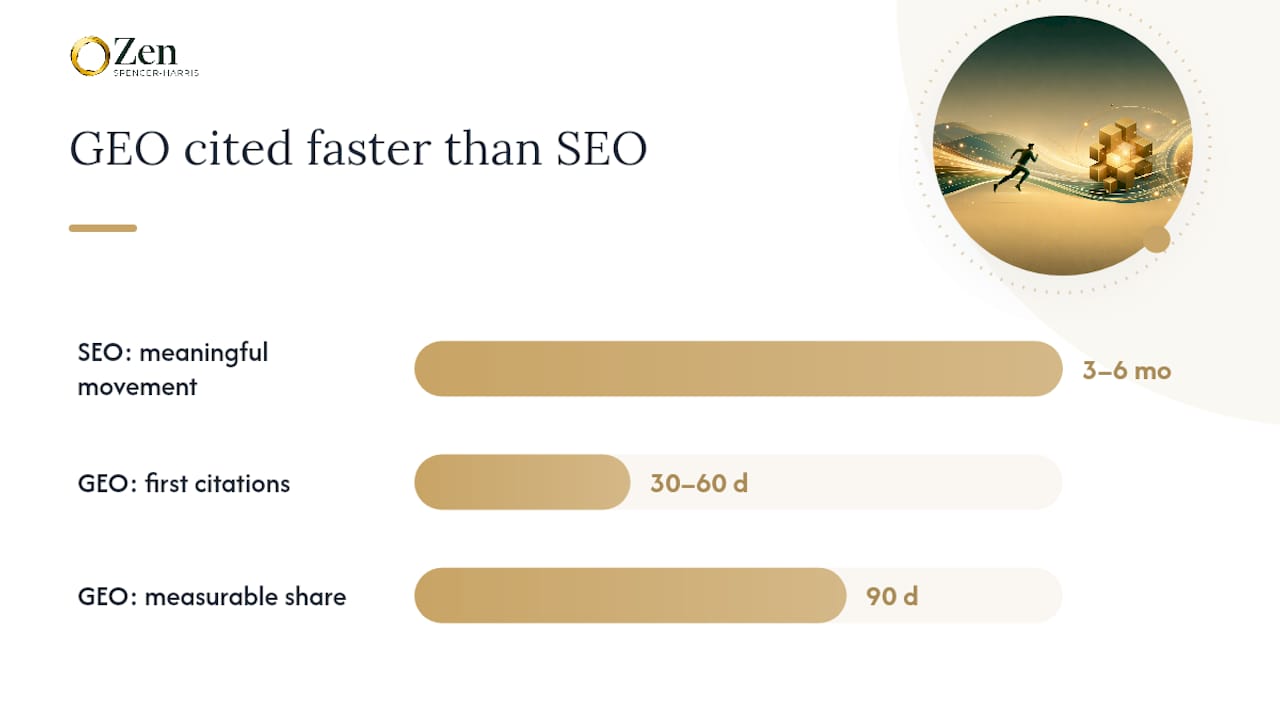
| Typical timeline | 3–6 months for meaningful ranking movement | First citations possible in 30–60 days; measurable share of voice in 90 days |
A well-structured article can satisfy SEO, answer engine optimization (AEO), and GEO simultaneously. The three disciplines share crawlability and topical authority as their common foundation. The distinction is in what you optimize for: a ranking signal versus a citation signal.
Why GEO matters for your business right now
The shift is behavioral, not just technical. Users increasingly ask AI engines for recommendations, comparisons, and how-to guidance rather than clicking through a list of blue links. When a generative engine answers a question, it may never send a click to any source, yet it still shapes what the user believes and who they contact next.
That changes which numbers matter. The Semrush blog on GEO vs. SEO frames it directly: marketers must move from chasing clicks to chasing citations, because an AI answer can drive discovery and conversion without ever registering in Google Analytics. Here are the business impacts that follow.
- AI citation frequency becomes a brand metric. How often your brand appears in AI-generated answers for your target queries is now a measurable signal of market presence, separate from organic traffic.
- Share of voice shifts to AI engines. A competitor cited consistently by ChatGPT and Perplexity for your core service category owns mindshare even if their organic rankings are lower than yours.
- Zero-click outcomes are accelerating. When a user gets a complete answer from an AI engine, they may book, call, or decide without visiting any website. Your brand needs to be the one cited.
- Brand mention rate affects downstream conversions. Users who encounter your brand name in an AI answer before visiting your site convert at higher rates because the AI has already established credibility on your behalf.
- Discovery channels are multiplying. ChatGPT, Perplexity, Claude, Google AI Overviews, and Bing Copilot each have distinct retrieval behaviors. Presence on one does not guarantee presence on others.
Consider the contrast in concrete terms. A specialty clinic optimized only for SEO might rank #3 for "anxiety treatment near me" and receive 200 clicks per month from that position. A clinic that also earns consistent citations in ChatGPT and Perplexity responses to "what should I look for in an anxiety specialist?" may never appear in those clicks, yet it shapes the decision of every user who asked that question before searching at all. The Wired reporting on GEO's emergence captures this market shift: brands that ignore AI-driven discovery are ceding ground that click-based analytics will never show them losing.
Core GEO strategies: a step-by-step action plan
The sequence below is ordered by leverage, not complexity. Do the high-leverage structural work first, then build authority signals, then scale.
The core action sequence
- Answer first in every section. Open each H2 with a direct, one-sentence answer to the sub-query that heading implies. A generative engine evaluates each chunk independently. If your H2 section requires reading three paragraphs before the answer appears, the engine skips it.
- Make every chunk independently citable. Each H2 or H3 plus its content should stand alone as a complete, attributable answer. Avoid cross-references like "as discussed above" inside a chunk. The engine may extract only that section.
- Embed sourced statistics and named authors. Content with verifiable data and attributed sources earns significantly higher citation rates. The GEO-bench academic evaluation found that adding citations, quotations, and statistics produced a 30–40% relative improvement in position-adjusted visibility metrics.
- Use structured, descriptive headings. Question-format H2s ("What is X?" "How does Y work?") align directly with how users prompt AI engines. They also signal to the model what the chunk answers.
- Build co-mentions and PR signals. Get your brand, authors, and key claims mentioned on authoritative third-party sites. AI engines weight entity co-occurrence: a brand consistently mentioned alongside recognized authorities in its field earns higher citation confidence.
- Establish multi-platform presence. Publish on LinkedIn, industry publications, podcast transcripts, and partner sites. Perplexity and ChatGPT draw from a wider corpus than Google's index alone. Structured content for AI discoverability benefits from appearing across multiple authoritative surfaces.
- Add author attribution to every piece. A named author with a linked bio and verifiable credentials is an entity signal. It tells the model who made the claim and whether that person is authoritative enough to cite.
30/60/90 prioritization
Days 1–30 (audit and quick fixes): Run a full crawl with Screaming Frog or Sitebulb. Identify pages that rank for target queries but lack BLUF openings. Add direct answers to the top 10 priority pages. Set up Search Console and Bing Webmaster Tools if not already active. Run your first structured prompt tests across ChatGPT, Perplexity, Gemini, and Claude to establish a baseline citation rate.

Days 31–60 (content building and authority signals): Publish or restructure 4–6 cornerstone pieces with full GEO treatment: BLUF openings, sourced statistics, named authors, FAQPage schema, and chunk-level independence. Begin PR and co-mention outreach targeting 3–5 authoritative publications in your vertical. Add Article and HowTo schema to priority pages.
Days 61–90 (scale and measurement): Expand GEO treatment to the next 15–20 pages. Review Search Console Generative AI impressions and Bing AI Performance data. Re-run prompt tests and compare citation rate against baseline. Adjust content based on which chunks are being cited and which are not.
Pro Tip: Run your prompt tests as a real user would phrase them, not as keyword queries. "What should I look for in a behavioral health specialist?" surfaces different citations than "behavioral health specialist near me." Test both the informational and decision-stage phrasings for every target topic.
Technical checklist for AI discoverability
Technical eligibility is the floor. A generative engine cannot cite content it cannot access, render, or parse. Work through this checklist before investing heavily in content.
- Crawlability confirmed. Verify that Googlebot, GPTBot, ClaudeBot, and PerplexityBot are not blocked in robots.txt. Check each bot's user-agent string against your current rules.
- Full indexing verified. Use Search Console's URL Inspection tool to confirm target pages are indexed and not soft-404ing or returning thin content signals.
- Server-side rendering or pre-rendering in place. JavaScript-heavy pages that render client-side may not be fully parsed by AI crawlers. Use server-side rendering (Next.js, Nuxt) or a pre-rendering service (Prerender.io) for content-critical pages.
- Core Web Vitals passing. Slow pages are deprioritized. Largest Contentful Paint under 2.5 seconds and Cumulative Layout Shift under 0.1 are the thresholds that matter most.
- Canonical tags clean. Duplicate content confuses attribution. Every page should have a self-referencing canonical or point to the authoritative version.
- Structured headings (H1 → H2 → H3). A clear heading hierarchy is how a language model maps the document's structure. Never skip levels or use heading tags for styling.
- Article schema implemented. Mark up every content page with
ArticleorBlogPostingschema, includingauthor,datePublished,dateModified, andpublisherfields. - FAQPage schema on Q&A sections. Pages with question-and-answer content should use
FAQPageschema so engines can extract individual Q&A pairs as discrete citable units. - HowTo schema on process content. Step-by-step content marked up with
HowToschema gives generative engines a structured, extractable version of your process. - Speakable schema where applicable. For content likely to be read aloud by voice-enabled AI assistants,
Speakableschema flags the most relevant passages. - Author entity markup. Use
Personschema on author bio pages withsameAslinks to LinkedIn, Google Scholar, or other authoritative profiles to strengthen entity recognition.
Statistic callout: Adding citations, quotations, and statistics to content produced a 30–40% relative improvement in AI visibility metrics in controlled GEO-bench evaluations. Structured, sourced content is not a nice-to-have for GEO; it is the primary lever.
How to measure GEO performance
The monitoring gap is real: most standard analytics platforms cannot tell you when ChatGPT or Perplexity cited your content. You have to build a measurement stack that combines official platform reports with manual prompt testing and brand-mention monitoring.
GEO-specific metrics
| Metric | Definition | How to measure |
|---|---|---|
| AI citation frequency | How often your brand or content appears in AI-generated answers for target queries | Structured prompt tests across ChatGPT, Perplexity, Claude, Gemini |
| Generative AI impressions | Impressions from AI-powered features in Google Search | Search Console → Search results → filter by "AI Overviews" appearance type |
| Bing AI Performance | Clicks and impressions from Bing Copilot and AI answers | Bing Webmaster Tools → AI Performance report |
| Brand mention rate | Frequency of unprompted brand mentions across AI engines | Prompt testing + tools like Brand24, Mention, or SparkToro |
| Prompt-test pass rate | Percentage of target queries where your brand is cited | Manual or automated prompt test log, tracked weekly |
| Share of voice in AI | Your citation count vs. competitors' across a defined query set | Prompt test log with competitive tracking |
Setting up your measurement stack
Google Search Console: Navigate to Search results, then filter the "Search type" to include AI Overviews. The Generative AI performance report shows which queries trigger AI-generated answers that include your content, along with impressions and clicks from those surfaces.
Bing Webmaster Tools: The AI Performance report inside Bing Webmaster Tools shows how your content performs in Bing Copilot responses. It is a direct analog to Search Console's AI report and should be checked on the same cadence.
Prompt testing protocol: Build a spreadsheet of 20–30 target queries, phrased as a user would ask them. Run each query weekly across ChatGPT (GPT-4o), Perplexity, Claude (Anthropic), and Google AI Overviews. Log whether your brand is cited, where in the response it appears, and what claim is attributed to you. This is currently the most reliable way to track AI share of voice.
Brand mention monitoring: Tools like Brand24, Mention, or SparkToro can surface when your brand name appears in indexed content that AI engines may draw from. They do not track AI responses directly, but they catch the upstream signals that feed citation probability.
Risks and best practices: what not to do
GEO has attracted the same category of shortcuts that damaged SEO practitioners a decade ago. Most of them will either have no effect or actively harm your standing with the platforms you are trying to influence.
- Do not create llms.txt files as a citation hack. Some guides suggest using llms.txt to feed AI engines curated content. Google explicitly warns against special machine-readable files designed to manipulate generative AI features. The tactic does not produce reliable citation gains and risks policy violations.
- Do not chunk content into tiny pieces. Breaking pages into hundreds of micro-sections to maximize "extractable chunks" degrades user experience and is specifically called out by Google as unnecessary and potentially manipulative.
- Do not manufacture co-mentions. Paying for brand mentions on low-quality sites, creating fake reviews, or orchestrating inauthentic PR placements to inflate entity signals is the link-scheme equivalent for GEO. AI engines weight source authority, not mention volume.
- Do not spam schema markup. Marking up content that does not match the schema type (e.g., applying FAQPage schema to non-Q&A content) can trigger manual actions and reduces the trust signal schema is meant to provide.
- Do not publish thin pages targeting AI queries. A 200-word page with a direct answer and no supporting depth may get cited once and then filtered out as low-quality. Depth and verifiability matter.
- Do attribute authors and sources transparently. Every claim that could be cited should have a named author and, where possible, a linked source. Transparency is what makes a claim safe for an AI engine to reproduce.
- Do follow platform content policies. ChatGPT, Claude, and Perplexity each have content policies governing what their models will cite. Content that violates those policies will not be cited regardless of its technical structure.
- Do prioritize user-first content. The underlying principle across every platform is the same: content written to help a real person answer a real question outperforms content written to game a retrieval system.
A 90-day E-E-A-T playbook with KPIs
Google's E-E-A-T framework (Experience, Expertise, Authoritativeness, Trustworthiness) maps almost directly onto what generative engines need to confidently cite a source. The playbook below operationalizes those signals week by week.
Phase 1: Weeks 1–4 (audit and foundation)
- Audit your top 20 pages for BLUF structure, author attribution, and schema coverage. Score each on a simple rubric: BLUF present (yes/no), named author (yes/no), schema type implemented (none/partial/full).
- Fix crawlability issues: unblock AI crawlers, resolve soft-404s, confirm indexing for priority pages.
- Add author bio pages with
Personschema andsameAslinks for every content contributor. - Run baseline prompt tests across ChatGPT, Perplexity, Claude, and Google AI Overviews. Log results in a shared spreadsheet.
Phase 2: Weeks 5–8 (content and authority building)
- Publish or restructure 4–6 cornerstone pieces with full GEO treatment. Each should include a BLUF opening, 2–3 sourced statistics with inline links, a named author, and FAQPage or HowTo schema.
- Launch co-mention outreach: target 5 authoritative publications or podcasts in your vertical for guest contributions, expert quotes, or data partnerships.
- Expand to multi-platform publishing: LinkedIn articles, industry newsletters, and partner sites that AI engines index.
- For healthcare practices specifically, structuring content for AI discoverability follows the same principles: direct answers, named clinicians, and verifiable claims.
Phase 2 KPIs: Generative AI impressions in Search Console (target: measurable baseline established); number of authoritative co-mentions secured; prompt-test citation rate (target: 20–35%.
Phase 3: Weeks 9–12 (scale and measurement)
- Expand GEO treatment to the next 15–20 pages based on which query clusters showed the most AI impression growth in Search Console.
- Review Bing AI Performance report alongside Search Console data. Compare citation patterns across platforms.
- Re-run full prompt test battery. Compare against Phase 1 baseline. Identify which chunks are being cited and which are being skipped.
- Adjust content based on citation data: strengthen underperforming chunks, add missing statistics, deepen thin sections.
Phase 3 KPIs: Prompt-test citation rate (target: 40% for priority queries); brand mention velocity (week-over-week growth in AI-cited appearances); Generative AI impressions trend (target: upward trajectory in Search Console).
- Align agency or contractor incentives with citation and conversion outcomes, not just content volume. A performance-based model, where fees are tied to measurable results like booked appointments or verified citation gains, keeps execution focused on what actually moves the needle.
- AI search visibility services structured around measurable outcomes give healthcare practices a clear way to evaluate whether GEO investment is producing real patient acquisition results.
Why most GEO advice misses the point
The conventional framing treats GEO as a content formatting problem: add BLUF, use schema, done. That is necessary but not sufficient. The deeper issue is entity trust. A generative engine does not just extract well-structured text; it evaluates whether the source behind that text is one it can confidently attribute a claim to. That is an E-E-A-T problem, not a formatting problem.
For healthcare practices, this distinction is especially sharp. A clinic that publishes 50 schema-tagged pages with no named clinicians, no external citations, and no co-mentions on authoritative health publications will be outperformed in AI citations by a smaller practice whose medical director has three published interviews, a linked Google Scholar profile, and consistent mentions in regional health journalism. The model is not counting schema tags. It is evaluating whether your entity is trustworthy enough to cite in front of a user asking a health question.

The practical implication: invest in the entity before you invest in the content. Get your practitioners named, quoted, and linked on authoritative external sites. Build the author bio pages. Secure the co-mentions. Then structure the content to extract cleanly. Reversing that order is the most common and most expensive mistake in GEO implementation.
Zensweb's AI Share of Voice program for healthcare practices
Specialty healthcare practices face a specific version of the GEO problem: patients are asking AI engines which psychiatrist, therapist, or specialist to trust, and most practices are invisible in those answers. Zensweb's AI Share of Voice program is built for exactly this situation. The program combines technical SEO and schema implementation, authority content creation with named clinicians, and co-mention outreach to get practices cited on ChatGPT, Claude, Perplexity, and Google within 90 days.
The model is performance-based: Zensweb's fees are tied to delivered outcomes, specifically booked patient appointments and measurable visibility gains, not content volume or hours billed. For marketing executives and practice owners who need to justify spend, that alignment matters. To see where your practice stands today, request a free Vital Audit and get a clear picture of your current AI citation rate and the fastest path to improving it.
Sources
- A Multi-Factor Brand-Recognition Audit for AI Answer Engines: An Open Instrument and Protocol for Measuring Generative Visibility
- Optimizing your website for generative AI features on Google Search | Google Search Central
- What Is Answer Engine Optimization, and Why Should Enterprise Marketers Care? | Siteimprove