

Claiming, verifying, and optimizing your practice profiles across platforms like Google Business Profile, Healthgrades, Zocdoc, WebMD, Yelp, and Vitals is what "healthcare directory listings" means in a marketing context. It is not about patients browsing for doctors. It is about you controlling how your practice appears when high-intent patients search, and converting that visibility into booked appointments. Here are five actions you can take this week:
- Build a Master NAP document: one canonical version of your practice name, address, and phone number used everywhere.
- Claim and verify your Google Business Profile — it is the single highest-leverage listing you own.
- Claim your top specialty profile on Healthgrades or Zocdoc, depending on your market.
- Set up an automated review request triggered at discharge or checkout.
- Add call tracking and a referral source field to your intake form so you can measure what is working.
Your NPI record in NPPES is the data seed most directories pull from. If it is wrong there, it will be wrong everywhere. Fix it first.
Key Takeaways
Managed healthcare directory listings produce measurable booked-appointment gains when you claim the right platforms, standardize NAP, generate reviews consistently, and instrument attribution from day one.
| Point | Details |
|---|---|
| Start with Google Business Profile | GBP is the single highest-leverage listing; claim and fully optimize it before any other platform. |
| Prioritize by conversion shape | Platforms with native booking convert at 8–12% vs. 1.2% on low-integration directories; factor this into your tier order. |
| NAP consistency is foundational | Even small formatting differences lower Google's local ranking confidence; one Master NAP document prevents this. |
| Measure bookings, not just views | Use call tracking, UTM-tagged links, and intake referral fields to attribute appointments to specific directories. |
| Zensweb ties fees to results | Zensweb's performance-based patient acquisition program charges based on booked appointments, not activity metrics. |
Table of Contents
- Why do healthcare directory listings move booked appointments?
- Which directories should you claim first?
- How do you claim, verify, and optimize each listing?
- How do you measure impact and maintain listings over time?
- When should you DIY versus hire a specialist?
- What results can a listings program actually produce?
- What should you actually do in the first 90 days?
- Zensweb gets you booked appointments, not just better listings
- Sources
Why do healthcare directory listings move booked appointments?
Directory profiles regularly outrank practice websites in Google for specialty-plus-city queries. A fully optimized Healthgrades profile can appear in Google's top three results before your own site does. That means patients searching "psychiatrist near me" or "orthopedic surgeon Chicago" may find your directory profile before they ever see your homepage.
The conversion mechanics matter here. Profile-view-to-booking conversion ranges from roughly 1.2% on low-integration platforms to 8–12% on platforms with native booking. That gap is not subtle. A platform where a patient can book directly inside the profile converts at five to ten times the rate of one that sends them to your website to figure out the next step.
Reviews drive both ranking and conversion on every major directory. Volume, recency, and your response rate are the primary within-platform ranking signals. A practice with 40 recent reviews and a 4.7 rating will consistently outplace a competitor with 8 reviews and a 4.9, even if the competitor's individual ratings are technically higher.
Pro Tip: Start with Google Business Profile before touching any other platform. GBP feeds local pack results, Google Maps, and voice search simultaneously. Every hour spent there produces more reach than the same hour spent on any single specialty directory.
Which directories should you claim first?
Prioritization matters because your team's time is finite. Here is a practical tier structure for U.S. specialty practices.
Tier 1 — claim within the first 30 days:
Google Business Profile is non-negotiable regardless of specialty. Healthgrades drives roughly 31% of identifiable directory referrals on average across markets. WebMD and Vitals carry high domain authority and frequently appear in Google's top results for condition-specific searches. Yelp matters for consumer intent and local pack signals, particularly in urban markets.
Zocdoc belongs in Tier 1 for large metros and specialties with strong native booking conversion — psychiatry, dermatology, and primary care in particular. Its native booking capability is why it converts at the high end of the range.
Tier 2 — claim within 60 days:
Insurance panel locators (Aetna, BCBS, UnitedHealthcare) and specialty board directories add credibility signals and feed local pack confidence. Patients often verify insurance coverage before booking, so your panel locator profile is a trust checkpoint, not just a listing.
| Platform | Referral share / conversion shape | Verification method | Cost |
|---|---|---|---|
| Google Business Profile | Highest local pack impact | Phone, postcard, video | Free |
| Healthgrades | ~31% of directory referrals | Email or phone | Free (paid upgrades) |
| Zocdoc | ~24% of directory referrals; 8–12% native booking | Email + credentialing | Fee per booking |
| WebMD / Vitals | High authority; referral share varies (Vitals) | Free (paid upgrades) | |
| Yelp | Strong urban consumer intent | Phone or postcard | Free (paid ads optional) |
| Insurance panel locators | Trust verification; local pack signal | Provider portal | Free |
Decision rule: if you serve a Tier 1 metro and your specialty shows strong native booking demand, add Zocdoc in the first 30 days alongside GBP.
How do you claim, verify, and optimize each listing?
The shortest path to meaningful lift: claim the profile, standardize your NAP, complete every field, add appointment links, and generate reviews. In that order.
Building your Master NAP
Your practice name, address, and phone number must be formatted identically on every platform. NAP inconsistencies lower Google's confidence in your location data and suppress local rankings. Choose one format — "Suite 400" not "Ste. 400" — and use it everywhere, including your website footer.
Completing every profile field
Directories rank complete profiles above incomplete ones. For your provider bio, write 300–500 words in plain language: conditions treated, approach to care, and what a first appointment looks like. Avoid clinical jargon. Use patient-friendly phrasing like "treating anxiety and depression in adults" rather than "management of affective disorders."
For categories, choose the most specific option available. "Psychiatrist" outperforms "Mental Health Provider" because it matches how patients actually search. Upload at least 10 photos: exterior, reception, exam room, and provider headshots. Most platforms accept JPEGs at 720px minimum width.
Verification timelines
Google Business Profile postcard verification takes 5–14 days. Phone and video verification (where available) are faster. Healthgrades and Zocdoc verify via email plus credentialing review, which can take 1–3 weeks. Build this into your timeline.
Schema markup
Add MedicalOrganization and Physician JSON-LD schema to your website. Key fields: name, address, telephone, specialty, NPI, and a booking URL. This helps search engines and AI platforms like ChatGPT and Perplexity disambiguate your specialty and enable rich results that improve click-through rates.
HIPAA-safe review responses
Never confirm a patient relationship in a public response. Never reference a diagnosis, treatment, or appointment detail. A safe response template: "Thank you for sharing your experience. We take all feedback seriously and encourage you to contact our office directly so we can address your concerns." For positive reviews, a brief thank-you with no clinical detail is sufficient. For escalations, move the conversation offline immediately. Zensweb's healthcare reputation management guidance covers this in more depth.
Pro Tip: Use a permanent business email address (not a staff member's personal account) for every directory login. Keep a credentialed master spreadsheet with platform name, login email, verification method, and date claimed. Staff turnover is the most common reason practices lose access to their own listings.
How do you measure impact and maintain listings over time?
Track booked appointments from listings using call tracking, referral source on intake, UTM-tagged booking links, and platform-native insights. These are the four instruments that prove ROI.
Core KPIs to track:
- Profile views per platform (weekly)
- Clicks to website and direction requests
- Call volume by source (use CallRail or WhatConverts for attribution)
- Bookings attributed to each directory
- Review velocity (new reviews per month) and average rating
- Cost per acquired patient for paid platforms
Audit cadence:
- Weekly: check for new reviews, respond within 48 hours, verify GBP for any Google-suggested edits
- Monthly: review platform insights, update photos if seasonal, confirm hours and services are current
- Quarterly: deeper audit of Tier 1 and Tier 2 listings, check for duplicate profiles
- Annually: full NAP sweep across all platforms, re-verify NPI/NPPES data
Monthly report template outline:
Audit listings first, then instrument referral sources before spending on paid directory placements. Paid spend on a platform you cannot measure is money you cannot justify.
When should you DIY versus hire a specialist?
DIY works when you have a single location, disciplined staff with dedicated time, and a straightforward specialty. Hire when you have multi-location complexity, no internal tracking maturity, or need guaranteed appointment outcomes tied to spend.
Decision checklist:
- Do you have a staff member who can dedicate 4–6 hours per month to listings maintenance?
- Do you have fewer than three locations?
- Do you already have call tracking and UTM parameters in place?
- Can you afford 60–90 days of gradual improvement without a performance guarantee?
If you answered no to two or more of these, a specialist pays for itself quickly.
Questions to ask any vendor:
- Are your fees tied to booked appointments, or to activity metrics?
- Do we retain access to all platform credentials and data?
- How do you handle HIPAA-safe review workflows?
- What is your SLA for updating listings after a change?
- How do you attribute bookings back to specific directories?
Red flags: opaque reporting, no credential handover, one-time audits with no follow-up, or a vendor who cannot instrument call tracking.
Pricing varies widely. Basic monthly management for a single-location practice typically runs a few hundred dollars per month. Multi-location or enterprise-level NAP sync programs run higher. Performance-based models, where fees are tied to delivered appointments rather than hours, shift the risk to the vendor.
What results can a listings program actually produce?
A published case study documented a U.S. clinic generating over 500 inbound calls, a measurable increase in direction requests, and a notable boost in bookings within 60 days. of a comprehensive listings optimization program.
The methodology was straightforward:
- Full inventory of existing listings across all platforms
- Claim and verify every unclaimed profile
- Standardize NAP across all platforms
- Refresh photos and complete all profile fields
- Launch a post-visit review request program
- Instrument call tracking and intake referral fields
- Monthly reporting against baseline
Attribution was confirmed through call tracking software and the intake referral field, which showed a direct correlation between directory-sourced calls and scheduled appointments.
For a practice considering the same approach: expect meaningful call volume increases within 30–60 days of a complete optimization. Booking attribution becomes clearer by month two once tracking is instrumented. Past results do not guarantee future outcomes, and results vary by specialty, market, and baseline listing health.
What should you actually do in the first 90 days?
Focus the first 30 days entirely on claim, verification, and tracking infrastructure. Nothing else. Claim GBP, Healthgrades, Zocdoc (if applicable), WebMD, Vitals, and Yelp. Standardize NAP. Install call tracking. Add the referral source field to intake.
Days 31–60: shift focus to review velocity and profile completeness. Send review requests within 24 hours of a positive visit. Complete every bio, photo set, and service description. Respond to every existing review.
Days 61–90: evaluate paid directory placements using the attribution data you now have. Check whether Zocdoc's per-booking fee is producing a cost per acquired patient that beats your other channels. Run your first quarterly audit.

The single highest-leverage habit for any team: instrument referrals at intake and automate review requests. Both take less than a day to set up and compound every week. A practice that does these two things consistently will outperform one with a larger budget that does neither.
Zensweb gets you booked appointments, not just better listings
Most listing programs deliver activity reports. Zensweb delivers booked patient appointments, and the fees are tied to that outcome.
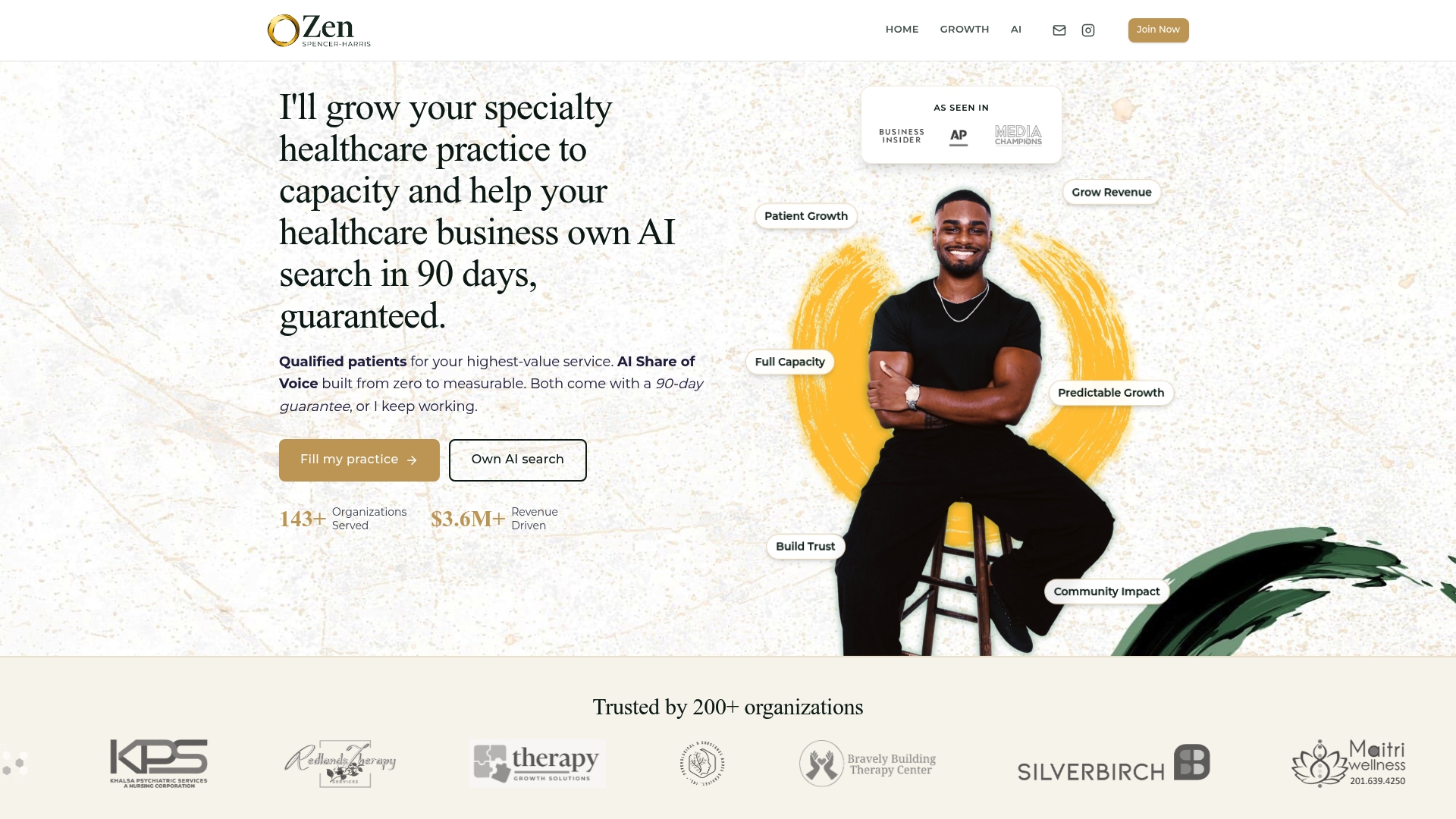
The patient acquisition program starts with a free Vital Audit: a full directory inventory, priority roadmap, quick NAP fixes, and a measurement baseline so you know exactly where you stand before spending a dollar. From there, Zensweb handles the claim, optimization, review program, and tracking instrumentation, then layers in AI Share of Voice so your practice appears when patients search on ChatGPT, Perplexity, and Google, not just traditional directories.
Performance-based fees mean Zensweb only earns when you see measurable results tied to booked appointments. No retainer for activity. No guessing whether the work is paying off.
Claim your free Vital Audit and get a prioritized roadmap for your practice within days.
Sources
- How to Get Your Medical Practice Listed and Ranked in Online Healthcare Directories - Easy Marketing School
- A 2026 guide to physician directory listings in the US
- Healthcare Directory SEO: Medical Listing Optimization | Digispot AI Blog
- Local SEO for Healthcare, Doctors & Specialists 2026 | Flento
- Case Study: How a U.S. Clinic Generated 500+ Calls in 60 Days Through Listings Optimization - Insights & Trends on Digital Solutions