

Claim and fully optimize your Google Business Profile, then build one unique location page per physical site. Those two moves, done well, drive more calls and booked appointments faster than almost anything else in local SEO for clinics and practices.
Here is your immediate action checklist:
- Claim and verify your GBP if you have not already, and complete every field: primary category, services, hours, photos, and appointment link.
- Check NAP consistency (name, address, phone) across your website, GBP, and top directories. A single formatting mismatch can suppress your local pack ranking.
- Build one location page per site using a template that includes unique NAP, a map embed, provider bios, services offered, and insurance accepted.
- Set up a HIPAA-safe review request flow using a compliant channel (more on that in the reviews section below).
- Add your appointment booking link directly to your GBP profile under the "Appointments" field.
Pro Tip: Practices that add an appointment link to GBP and start a consistent review request program typically see measurable increases in GBP-driven calls and direction requests within a few weeks. Start there before touching anything else.
Key Takeaways
Strong healthcare local SEO requires GBP optimization, unique location pages, consistent citations, and a compliant review program working together — not any single tactic in isolation.
| Point | Details |
|---|---|
| GBP is your fastest lever | Complete every GBP field and add an appointment link; expect measurable call increases within 4–10 weeks. |
| One location page per site | Write a unique page per physical location with local NAP, provider bios, and a direct booking CTA. |
| Review velocity beats rating | Aim for 2–4 new reviews per month per location using a HIPAA-safe solicitation workflow. |
| Schema feeds AI visibility | Add MedicalClinic and Physician JSON‑LD to every location and provider page; validate with Google's Rich Results Test. |
| Zensweb ties fees to results | Zensweb's performance-based program covers GBP, location pages, reviews, and AI visibility with attribution to booked appointments. |
Table of Contents
- Why does local search drive patient volume for healthcare practices?
- How do you fully optimize your Google Business Profile for a medical practice?
- What should every location page on your practice website include?
- Which schema types matter most for healthcare local SEO?
- What technical SEO basics protect patient conversions and local rankings?
- How do you audit and maintain citations across medical directories?
- How do you collect patient reviews without violating HIPAA?
- What local content and link-building tactics actually work for healthcare practices?
- How do you measure local SEO results and what should you expect?
- What U.S. compliance rules affect healthcare local SEO?
- What does a focused local visibility program actually produce?
- What most practices get wrong about local SEO (and how to fix it fast)
- Zensweb's performance-based program gets your practice booked faster
- Sources
Why does local search drive patient volume for healthcare practices?
Most patients searching for a doctor, dentist, or specialist are not browsing. They are ready to book. Searches like "psychiatrist near me" or "urgent care in [city]" carry high purchase intent, and the practices that appear in the Google local pack capture a disproportionate share of those clicks.
Industry analysis confirms that patients rely heavily on online reviews when choosing a provider, and that GBP completeness, review velocity, and service listings are among the strongest local ranking levers for healthcare. Research from TechTarget shows that most patients find new doctors online via provider directories and local search results, not word-of-mouth alone.
The practical payoff of strong healthcare local SEO:
- More inbound calls from patients who are ready to schedule.
- More direction requests, which signal genuine intent to visit.
- Higher conversion from search to booked appointment, because patients trust practices with complete profiles and recent reviews.
- Reduced dependence on paid ads for patient acquisition.
For most small and mid-size practices, local signals (GBP, citations, reviews) deliver faster, more measurable results than broad content marketing. Healthcare SEO splits into local signals and E‑E‑A‑T content, and the local-first approach wins for specialty practices competing in a defined geographic area.
How do you fully optimize your Google Business Profile for a medical practice?
GBP is the single most important control point for local visibility. A complete, well-maintained profile feeds Google Search, Google Maps, and AI answer surfaces simultaneously.
- Claim and verify your listing. Go to Google Business Profile and claim every location separately. Verification is typically by postcard, phone, or video.
- Set your primary category precisely. "Psychiatrist," "Pediatrician," "Dental Clinic," or "Urgent Care Center" outperforms a generic "Medical Office" every time. Add secondary categories for additional services (e.g., "Mental Health Clinic" as a secondary for a behavioral health practice).
- Add all services with descriptions. List each service individually, include a short description (150–300 characters), and use the city + service phrasing patients actually search (e.g., "anxiety treatment in Austin").
- Set attributes. Mark "Accepts new patients," "Telehealth available," "Wheelchair accessible," and any insurance-related attributes your GBP category supports.
- Add your appointment booking link. Paste your scheduling URL directly into the Appointments field. This creates a one-tap path from search to booking.
- Upload photos. Add at least 10 photos: exterior, interior, exam rooms, and staff (with consent). Practices with photos receive significantly more direction requests than those without.
- Enable and monitor messaging. Turn on GBP messaging only if your team can respond within 24 hours. An unanswered message is worse than no message option.
- Post weekly or biweekly. GBP posts expire after seven days. Use them for new provider announcements, seasonal health tips, or telehealth availability updates.
Pro Tip: Map your patient workflow to GBP settings. If you offer telehealth, mark it as an attribute AND create a GBP post linking to your telehealth booking page. That double signal increases the chance of appearing in "telehealth near me" queries.
Key fields to complete for healthcare GBP:
- Business description (750 characters): include your specialty, city, and one differentiator.
- Hours: set special hours for holidays and add "More hours" for phone availability vs. in-person.
- Products/Services: every billable service should appear here.
- Q&A section: seed it with three to five common patient questions and answer them yourself before patients do.
What should every location page on your practice website include?
One physical location, one unique page. That is the rule. A single "Locations" page listing all your sites is a missed opportunity for local keyword targeting and a structural weakness for AI answer engines.
Each location page needs:
- Unique NAP formatted exactly as it appears on your GBP and top directories.
- Embedded Google Map pointing to that specific address.
- Provider bios tied to that location, with credentials, photo, and a link to their full profile page.
- Services offered at this location (not a copy-paste of your main services page).
- Insurance accepted at this specific site.
- Parking, transit, and accessibility information.
- Appointment CTA with a direct booking link or phone number.
For page titles and meta descriptions, use the format: [Specialty] in [City], [State] | [Practice Name]. That pattern aligns with how patients search and how Google reads location relevance. Use Google Ads Keyword Planner to validate local search volumes before finalizing your city + service keyword targets.
Avoid duplicate content by writing a unique 150–200 word introduction for each location page that references neighborhood landmarks, nearby hospitals, or community context. "Our [City] office, located two blocks from [Local Hospital], serves patients across [Neighborhood] and [Adjacent City]" is the kind of local signal that separates a real location page from a templated one.

Pro Tip: Link each provider bio on the location page to a standalone practitioner profile page. That profile page should include credentials, publications, board certifications, and a photo. Structured practitioner bios with credentials and links to publications are strong E‑E‑A‑T signals that increase trust for YMYL content.
Provider bio pages also feed GBP. When you add a practitioner to your GBP profile, link their bio URL. Google cross-references these signals when determining which providers appear in local results for specialty searches.
Which schema types matter most for healthcare local SEO?
Structured data is how you tell search engines and AI models exactly what your practice does, where it is, and who provides care. Schema defines the types that matter most for clinical services and practitioner relationships.
The highest-value schema types for healthcare practices:
- MedicalClinic or MedicalOrganization: covers the practice entity, address, phone, hours, and medical specialty.
- Physician: for individual practitioners, includes name, credentials, specialty, and affiliation.
- MedicalProcedure: for specific treatments or procedures you offer.
- FAQPage: for patient FAQ sections, which can trigger rich results in search.
- LocalBusiness with
@type: MedicalClinic: the baseline for local pack eligibility.
For implementation, use JSON‑LD embedded in the <head> of each page. A MedicalClinic block should include name, address (with streetAddress, addressLocality, addressRegion, postalCode), telephone, openingHours, medicalSpecialty, and url. A Physician block should include name, medicalSpecialty, worksFor (linking to the clinic entity), and sameAs links to their profiles on Doximity, Healthgrades, or Zocdoc.
Structured data is not just for Google. AI answer engines like ChatGPT, Claude, and Perplexity increasingly pull from structured, locally specific content when generating responses to "find a doctor near me" queries. Practices that publish unique clinic-level facts in schema format gain a measurable advantage in AI-driven answer surfaces.
Pro Tip: Validate every schema implementation with Google's Rich Results Test before publishing. A single syntax error can invalidate the entire block. Run the test after any site update that touches structured data.
For AI visibility specifically, adding telehealth availability, accepted insurance, and new-patient status as structured attributes gives AI models the clinic-level specifics they need to surface your practice in conversational queries.
What technical SEO basics protect patient conversions and local rankings?
Technical issues are silent revenue leaks. A practice site that loads slowly on mobile or lacks HTTPS loses patients before they ever read a service description.
Core technical checklist:
- Mobile load time under 3 seconds. Use Google PageSpeed Insights to identify render-blocking resources. Most healthcare sites fail here because of unoptimized images and third-party scheduling widgets.
- HTTPS on every page. A non-secure page triggers browser warnings that destroy patient trust instantly.
- XML sitemap submitted to Google Search Console. Include all location pages and provider bio pages.
- Canonical tags for multi-location sites. If your CMS generates near-duplicate pages for different locations, canonical tags prevent Google from treating them as duplicate content.
- Structured navigation for booking. The path from homepage to appointment booking should take no more than two clicks on mobile.
- HIPAA-aware analytics. Standard Google Analytics 4 can capture PHI if misconfigured. Use a vendor that offers a Business Associate Agreement (BAA), or configure GA4 to exclude IP addresses and disable data sharing with Google's advertising products. Platforms like Matomo (self-hosted) or Freshpaint are built for HIPAA-compliant healthcare analytics.
Pro Tip: The single highest-ROI technical fix for most practice sites is image compression. Unoptimized hero images and staff photos routinely add 2–4 seconds to mobile load times. Run every image through a tool like Squoosh or ShortPixel before uploading, and convert to WebP format.
For technical SEO in healthcare, the baseline requirements are speed, security, and structured data. Get those three right before investing in content or link-building.
How do you audit and maintain citations across medical directories?
NAP inconsistency is one of the most common and most damaging local SEO problems for healthcare practices. A practice listed as "Suite 200" in one directory and "Ste. 200" in another sends conflicting signals to Google.
Citation audit checklist:
- Crawl the top general directories: Google Business Profile, Apple Maps, Bing Places, Yelp, Facebook.
- Crawl healthcare-specific directories: Healthgrades, Zocdoc, Doximity, WebMD, Vitals, US News Health, Psychology Today (for behavioral health), and your specialty's professional association directory.
- Check insurance directory listings: Most major insurers (Aetna, UnitedHealthcare, Blue Cross Blue Shield) maintain provider directories. Outdated listings there cost you patients who filter by insurance.
- Normalize NAP formatting: Pick one canonical format for your practice name, address (including suite), and phone number. Apply it everywhere without exception.
- Find and suppress duplicates: Search "[Practice Name] [City]" in Google to surface duplicate listings. Claim and merge or suppress them through each platform's support process.
Most patients find new doctors online via provider directories, which means an incomplete or inaccurate directory listing is a direct patient acquisition failure.
Pro Tip: For multi-location organizations, use a citation management tool to maintain consistency at scale. A comparison of BrightLocal vs. Whitespark for specialty healthcare can help you choose the right platform for your team's workflow and budget.
Set a quarterly review cadence for all directory listings. Addresses change, providers join or leave, and hours shift. A citation that was accurate six months ago may now be sending patients to the wrong address.
How do you collect patient reviews without violating HIPAA?
Reviews are a primary local ranking signal and a primary trust signal for patients choosing between practices. Review velocity (new reviews per month) is a stronger ranking factor than a single high average rating, so a steady flow matters more than a one-time push.
The compliance challenge: responding to a review in a way that confirms a patient-provider relationship can constitute a HIPAA violation. The HIPAA guidance from the CDC is clear that marketing actions confirming PHI must be handled carefully.
HIPAA-safe review collection:
- Request reviews via a general, non-PHI channel. A post-visit text or email that says "We'd love your feedback" without referencing the appointment, diagnosis, or treatment is generally safe.
- Use a compliant platform. If your review software accesses your EHR or patient records to trigger requests, it must have a signed BAA. Platforms like Birdeye and Podium offer BAAs for healthcare clients.
- Never incentivize reviews. The FTC prohibits undisclosed incentives for reviews, and the AMA has ethical guidance against it.
- Respond to every review, positive or negative. Keep responses generic: thank the reviewer, invite them to call your office for follow-up. Never confirm they are a patient or reference any care detail.
When responding to a negative review, the safest approach is a brief, warm acknowledgment: "We take all feedback seriously and invite you to contact our office directly so we can help." Never say "I'm sorry your procedure didn't go as expected" — that confirms a patient relationship and potentially discloses PHI.
Pro Tip: For HIPAA-safe reputation management at scale, build a review request into your post-visit workflow as a standard step, not an afterthought. Aim for at least 2–4 new reviews per month per location to maintain ranking momentum.
For crisis situations (a pattern of negative reviews or a public complaint), respond once publicly with a neutral acknowledgment, then move the conversation offline immediately. Never argue in a public review thread.
What local content and link-building tactics actually work for healthcare practices?
Generic blog posts about "the importance of annual checkups" do not build local authority. Content that wins local rankings and earns links is specific, clinician-reviewed, and tied to your geography.
Content ideas that produce real local signals:
- Localized condition pages: "Managing Type 2 Diabetes in [City]" with local statistics, local support resources, and your practice's approach.
- Procedure guides with local context: "What to expect from knee replacement surgery at our [City] orthopedic center."
- Telehealth availability pages: A dedicated page explaining which services you offer via telehealth, which states you are licensed in, and how to book. This is also a direct local SEO signal for "telehealth [specialty] [state]" queries.
- Community event recaps: Sponsoring or participating in a local health fair? A 300-word recap with photos and a link to the event organizer earns a local backlink and a GBP post.
- Provider Q&A pages: Clinician-authored answers to common patient questions, structured with FAQPage schema.
Link-building opportunities specific to healthcare:
- Local news outlets: Pitch a local health story tied to a seasonal trend (flu season, mental health awareness month). A quote from one of your physicians earns a citation and often a link.
- University and hospital partnerships: If your providers have academic affiliations, request a listing on the university's faculty or affiliated provider page.
- Local health boards and chambers of commerce: Many offer free directory listings for healthcare members.
- Insurance directory mentions: Ensure your profile on insurer directories links back to your website.
Pro Tip: For specialty practices, clinician-authored content reviewed by a licensed provider is the single strongest E‑E‑A‑T signal you can publish. A psychiatry practice that publishes a specialty-specific marketing plan built around clinician-reviewed local content will consistently outrank a practice that publishes generic wellness tips.
How do you measure local SEO results and what should you expect?
Measurement is where most practices fall short. Without clear KPIs tied to booked appointments, local SEO activity looks like a cost center instead of a revenue driver.
Primary KPIs to track:
- GBP actions: calls, direction requests, and website clicks from your Google Business Profile (visible in GBP Insights).
- Booked appointments attributed to organic/local: use call tracking (tools like CallRail vs. WhatConverts are worth comparing for healthcare attribution) to tie GBP calls to actual bookings.
- Local keyword rankings: track city + specialty keyword positions monthly (e.g., "therapist in Denver," "pediatric dentist Austin").
- Review velocity: new reviews per month per location.
- Organic traffic to location pages: measured in Google Search Console and GA4.
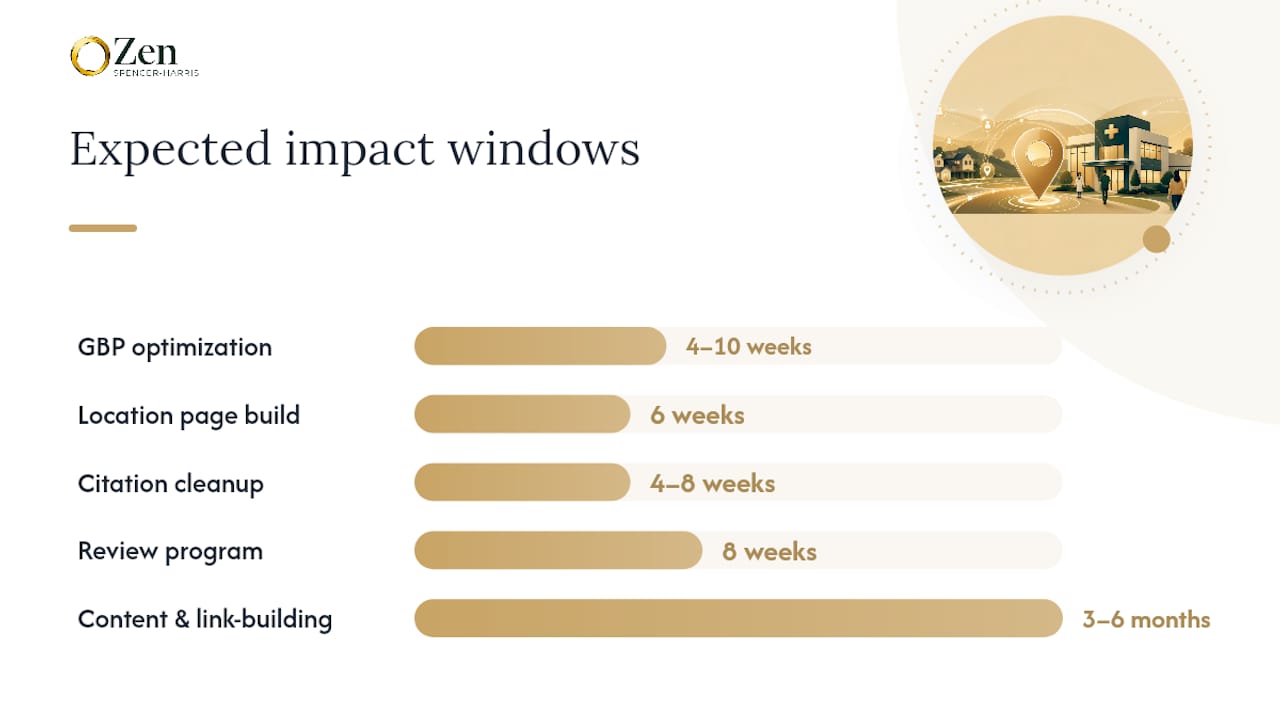
Typical impact timeline and cost ranges:
| Activity | Expected Impact Window | Typical Monthly Cost Range |
|---|---|---|
| GBP optimization | 4–10 weeks | $300 (one-time setup) |
| Location page build | 6 weeks | $500 per page |
| Citation cleanup | 4–8 weeks | $200 (one-time audit) |
| Review program | 8 weeks | $150/month |
| Content + link-building | 3–6 months | $1,000/month |
GBP and citation work produce the fastest measurable results. Content and link-building compound over 3–6 months. A performance-based program that ties fees to booked appointments removes the guesswork from cost justification entirely.
For AI visibility, AI-driven answer engines reward structured, locally specific content and unique clinic-level facts. Track your practice's appearance in ChatGPT, Perplexity, and Google AI Overviews as a separate KPI alongside traditional rankings.
What U.S. compliance rules affect healthcare local SEO?
HIPAA applies to your marketing activities, not just your clinical operations. Any public-facing action that confirms a patient-provider relationship or reveals treatment details is a potential violation.
Compliance checklist for local SEO:
- Review responses: never confirm a reviewer is a patient or reference any care detail. Keep all responses generic and invite offline follow-up.
- Testimonials: patient testimonials on your website require a signed HIPAA authorization that specifically permits use of their health information for marketing. A general consent form is not sufficient.
- Analytics vendors: if your analytics platform processes any data that could identify a patient (IP address combined with appointment data, for example), it requires a BAA. Standard GA4 without configuration does not meet this bar.
- Review solicitation platforms: any software that accesses your EHR or appointment data to trigger review requests must have a signed BAA.
- Ad targeting: using patient data to build retargeting audiences is generally prohibited under HIPAA without explicit authorization. Consult your compliance officer before running any remarketing campaigns.
The safest operating rule for public-facing healthcare marketing: treat every public response, testimonial, and campaign as if it will be read by a HIPAA auditor. When in doubt, say less and move the conversation offline.
Pro Tip: For consent management and HIPAA-aware tracking configuration, review a comparison of tools like OneTrust vs. Cookiebot before deploying any analytics or ad tracking on a healthcare site.
This section covers general operational guidance. For specific legal questions about HIPAA compliance in your marketing program, consult a qualified healthcare attorney or your organization's compliance officer.
What does a focused local visibility program actually produce?
A specialty behavioral health practice with three locations faced a common problem: strong clinical reputation, near-zero visibility in local search. Their GBP profiles were unclaimed on two of three locations, their location pages were identical copy-paste templates, and they had fewer than five reviews across all sites.
The intervention followed a straightforward sequence:
- Week 1–2: Claimed and fully optimized all three GBP profiles (categories, services, attributes, appointment links, photos).
- Week 2–4: Built unique location pages for each site with provider bios, local NAP, map embeds, and insurance information.
- Week 3–6: Launched a HIPAA-safe review request program targeting 3–4 new reviews per month per location.
- Month 2–3: Added MedicalClinic and Physician schema to all location pages and provider bio pages.
Outcomes within 90 days:
- GBP direction requests and calls increased measurably across all three locations.
- The practice appeared in the local pack for city + specialty queries where it had previously been invisible.
- Review count grew from fewer than five total to over 30 across all locations, with a consistent monthly velocity maintained.
- Booked appointments attributed to organic and GBP sources increased, with call tracking confirming the source.
The pattern holds across practice types: GBP + location pages + a compliant review program is the fastest path from local invisibility to a full appointment calendar. The practices that see the weakest results are those that optimize GBP once and then ignore it. Local SEO is a maintenance discipline, not a one-time project.
The timeline above is representative of what a focused program produces. Your specific results will depend on market competitiveness, starting baseline, and execution consistency.
What most practices get wrong about local SEO (and how to fix it fast)
The most common mistake is treating GBP as a one-time setup task. Practices claim their profile, fill in the basics, and then leave it untouched for months. Meanwhile, competitors post weekly, add new photos, and accumulate reviews steadily. The gap compounds.
Three corrections that move the needle immediately for resource-constrained teams:
- Audit your NAP consistency this week. Search your practice name in Google, Apple Maps, and Yelp. If the address, phone, or suite number differs anywhere, fix it before doing anything else. Inconsistent NAP suppresses your local pack ranking regardless of how good your content is.
- Add one review request to your post-visit workflow. A simple, HIPAA-safe text message sent after checkout asking for feedback, with a direct link to your GBP review page, is enough to start building velocity. You do not need a platform to start.
- Write one real location page per site. Not a copy-paste template. One page with a unique introduction, local provider bios, and a specific appointment CTA. That single page, properly structured, can move your local ranking within 6–8 weeks.
The measurement-first mindset matters here. Set up GBP Insights tracking and a simple call-tracking number before you start, so you can see what changes produce results. When your team's capacity runs out before your to-do list does, a performance-based program that ties fees to booked appointments is worth evaluating seriously.
Zensweb's performance-based program gets your practice booked faster
Most local SEO engagements charge a monthly retainer whether or not patients book. Zensweb works differently: the program is tied to delivered results, specifically booked patient appointments and measurable visibility gains.
The program covers every layer of local SEO for healthcare practices: GBP optimization, unique location pages, HIPAA-safe review workflows, schema implementation, and AI Share of Voice to get your practice visible on ChatGPT, Claude, Perplexity, and Google within 90 days. Attribution is built in from day one, so you see exactly which activities are driving calls and bookings, not just impressions.
Practices that go through the program get a clear reporting cadence: GBP actions, review velocity, local keyword movement, and booked appointments attributed to organic and local sources. No ambiguity about what you are paying for.
The starting point is a free healthcare audit that maps your current local visibility gaps and prioritizes the highest-impact fixes for your specific market and specialty. Request yours at Zensweb's services page and get a clear picture of where your practice stands before committing to anything.
Sources
Use these resources to validate your work, run audits, and build the case for local SEO investment with your leadership team.
Official platforms and documentation:
- Google Business Profile
- Schema
- Health Insurance Portability and Accountability Act of 1996 (HIPAA) — CDC
- Local SEO for Healthcare: The Complete Guide (2026) — Birdeye
Healthcare-specific directories to audit and maintain:
How to use these in audits: run a NAP consistency check across all directory listings quarterly. Use Google Rich Results Test after every schema update. Pull GBP Insights monthly and compare against call-tracking data to attribute patient contacts to local SEO activity. Present Search Console impressions and GBP action trends to leadership as the primary evidence of program performance.