

Effective healthcare marketing training delivers one thing above all: measurable booked patient appointments, backed by improved local and AI visibility. Any program that can't tie its lessons to appointments on the schedule within 90 days is teaching theory, not results. Four outcomes matter, and training should move all four:
- Booked appointments and calls, tracked and attributed
- Google Business Profile signals (categories, attributes, hours, appointment links)
- Review velocity and sentiment
- Visibility on AI answer engines like ChatGPT, Claude, and Perplexity
Quick benchmark: most patients now check online reviews before choosing a provider, which is why review training carries as much weight as SEO training in any program worth paying for.
Key Takeaways
Healthcare marketing training only works when it converts local and AI visibility gains into booked appointments within a measurable, defined timeline.
| Point | Details |
|---|---|
| Measure bookings, not activity | Track cost-per-booked-appointment and verified bookings, not raw leads or impressions. |
| Prioritize GBP and reviews first | Fix Google Business Profile accuracy and launch a review program in the first 30 days. |
| Train the right roles | Give front-desk and operations staff the deepest hands-on time since they own daily execution. |
| Set a 90-day horizon | Expect visible local and AI ranking movement within 30 to 90 days of structural fixes. |
| Choose performance-based training | Zensweb ties payment to booked appointments through its AI Share of Voice and patient acquisition programs. |
Table of Contents
- What Should Healthcare Marketing Training Actually Achieve?
- What Modules Belong in a Real Curriculum?
- How Long Does Training Take to Show Results?
- Who on Your Team Needs This Training?
- How Do You Vet a Training Provider?
- What Does a 90-Day Sprint Look Like in Practice?
- The Recommended Path: Performance-Based Training and a Free Audit
- Why Practice-Focused Training Beats Generic Marketing Courses
- Frequently Asked Questions
- Sources
What Should Healthcare Marketing Training Actually Achieve?
A training program earns its cost when it moves five specific numbers: booked appointments, phone/online booking volume, local pack placement, review count and sentiment, and citation frequency on AI platforms. Anything short of that is a lecture series.
Booked appointments are the primary KPI because every other metric is a proxy for it. An improved Google Business Profile ranking means nothing if it doesn't convert to a filled slot on Tuesday at 2 PM. Local pack visibility matters because the Local Pack captures a large share of clicks on local medical searches, and a majority of patients search online before booking anything.
Review sentiment deserves its own line item, not a footnote. Practices that train staff on structured review requests typically see faster review accumulation within 60 to 90 days of launching a consistent ask, which compounds into both trust signals and ranking improvements.
- Booked appointments: the number your front desk confirms, not leads generated
- GBP performance: category accuracy, appointment links, and photo freshness
- Review velocity: consistent monthly review volume, not one-time pushes
- AI citation visibility: whether ChatGPT or Perplexity name your practice for relevant queries
What Modules Belong in a Real Curriculum?
Skip any syllabus that spends more time on branding philosophy than on the mechanics that generate bookings. The essential curriculum covers nine areas, and the split between essential and advanced matters when you're deciding what your team needs first.
Essential modules:
- Local SEO and Google Business Profile management. Staff learn to set correct categories, keep hours accurate, and build appointment links directly into the profile. Deliverable: a fully optimized GBP live within week one.
- Reputation and review systems. Teams learn HIPAA-safe request timing and response protocols. Deliverable: a review-request workflow triggered at checkout.
- Location pages and provider bios. Writers learn to match page depth to what patients actually search for, not generic "about us" copy. Deliverable: three rebuilt service pages.
- Website conversion and booking flows. Training covers CTA placement, insurance and accessibility info, and reducing booking friction. Deliverable: an audited, simplified booking path.
- Technical and structured data. Teams learn to implement MedicalOrganization and provider schema so search engines and AI models parse the practice correctly.
- Tracking and attribution. Call tracking and GA4 setup so every booked appointment traces back to its source.
- HIPAA-safe patient engagement. Staff learn what can and cannot appear in public-facing review prompts or AI-assisted messaging.
Advanced add-ons: AI Share of Voice optimization (visibility across ChatGPT, Claude, and Perplexity), multi-location data governance, and paid media scaling tied strictly to verified bookings rather than raw clicks.
How Long Does Training Take to Show Results?
Format matters more than most vendors admit. Hands-on workshops build staff confidence fast but rarely produce lasting change without follow-up. Remote coaching stretches learning over weeks, which helps retention but delays action. Blended sprints, where training and execution happen in the same cycle, tend to produce the fastest measurable movement because the team implements what they just learned instead of filing it away.

Realistic timelines follow a predictable arc, and structural and content fixes typically show measurable results in 30 to 90 days, not overnight.
| Timeframe | What Happens | Expected Outcome |
|---|---|---|
| Days 0-30 | Audit, GBP fixes, review program launch | Cleaner listings, first new reviews |
| Days 31-60 | Service pages, schema, booking flow updates | Early local-pack movement, faster load-to-book |
| Days 61-90 | AI visibility push, paid media scaling, attribution review | Verified booked-appointment lift, AI citations |
For ROI math, divide total program cost by verified booked appointments, then compare that number against average patient lifetime value. A program that costs $8,000 and delivers 40 verified new bookings in 90 days is producing a $200 cost-per-booking, which for most specialty practices is a strong return.
- Track cost-per-booked-appointment monthly, not quarterly
- Compare against patient lifetime value, not marketing spend alone
- Demand verified, not self-reported, booking numbers
Who on Your Team Needs This Training?
Not every role needs the full curriculum. The practice owner or CEO needs strategic fluency, roughly two hours a week during the sprint. The operations manager and front-desk lead need the deepest hands-on time, closer to four to six hours weekly, since they own booking flows and review requests. A marketing manager or agency partner needs full immersion across every module.
- Practice owner/CEO: strategic oversight, budget approval, KPI review
- Clinical director: sign-off on provider bios and patient communication tone
- Operations manager: booking flow and call-tracking implementation
- Front-desk/booking lead: review requests and appointment link management
- Marketing manager or agency partner: full curriculum, ongoing execution
Naming one internal "training champion" to own reinforcement after the formal sessions end prevents the common failure mode: a great workshop that fades within a month because nobody owned follow-through.
How Do You Vet a Training Provider?
Ask for proof before you ask for a proposal. A provider with real results can show you booked-appointment outcomes from specialty practices similar to yours, not generic engagement metrics.
- Request a sample 90-day plan with specific deliverables, not vague milestones
- Confirm whether they implement the work or only teach concepts and walk away
- Ask how they handle HIPAA-safe review collection and AI tool use
- Check for direct experience with specialty practices and multi-location groups
- Require a defined reporting cadence tied to booked appointments, calls, and local visibility
Red flags: a generic marketing certificate with no healthcare specialization, no measurement tied to bookings, silence on HIPAA when you ask about review workflows, or a one-size-fits-all syllabus that doesn't distinguish a dermatology practice from a behavioral health clinic.
Pro Tip: Ask a prospective provider one direct question: "What happens to a patient review request if it accidentally includes diagnosis information?" Their answer tells you in ten seconds whether they've actually built HIPAA-safe systems or are improvising.
What Does a 90-Day Sprint Look Like in Practice?
A working sprint blends training sessions with real implementation, so the team is executing what it just learned rather than taking notes for later.
- Weeks 1-2: Discovery and audit. Review current GBP, listings, review volume, and site structure.
- Weeks 3-4: Listings and GBP fixes. Correct categories, add appointment links, fix multi-location data inconsistencies.
- Weeks 5-6: Review velocity launch. Deploy HIPAA-safe request templates at checkout and via text.
- Weeks 7-8: Service and provider page updates. Publish pages matching real patient search intent.
- Weeks 9-10: Booking funnel optimization. Simplify CTAs, verify call tracking, fix mobile friction points.
- Weeks 11-12: AI visibility and paid media. Roll out structured data, monitor AI citations, scale ad spend only against verified bookings.
Deliverables to expect: a fully optimized GBP, roughly 30 verified new reviews requested, three published service pages, working call tracking, and a documented handoff of what to maintain internally.
- KPI checklist: booked appointments, inbound calls, local-pack rank, AI mentions
- Attribution: every booking traced to source through GA4 and call tracking, not guessed
The Recommended Path: Performance-Based Training and a Free Audit
Zensweb built its training around one principle: pay for outcomes, not hours in a classroom. The performance-based patient acquisition program ties compensation to booked appointments, and the AI Share of Voice sprint is built specifically to make your practice visible on ChatGPT, Claude, Perplexity, and Google within 90 days.
Every module in the curriculum above, from GBP fixes to review systems to structured data, maps directly onto what Zensweb implements alongside your team rather than handing you a slide deck and walking away. You keep the systems and the staff know how to run them; Zensweb runs point on execution during the sprint. That combination matters for specialty practices and multi-location groups especially, where generic advice tends to fall apart against real scheduling complexity.
Start with the Free Healthcare Audit, which delivers a quick snapshot of your current Google Business Profile health and where your practice stands on AI visibility right now. From there, explore the full range of SEO, AI search, and paid media services built specifically for specialty healthcare practices.
Why Practice-Focused Training Beats Generic Marketing Courses
Generic marketing courses teach branding and content calendars. They rarely touch the mechanics that actually fill a schedule: GBP category accuracy, review request timing, or how a search engine parses provider schema. Training built around a specialty practice's actual booking funnel produces operational change because staff practice on real systems, not hypothetical case studies.
Zen Spencer-Harris built the AI Share of Voice model and a performance-based pricing structure specifically because healthcare leaders were tired of paying for visibility promises with no measurement attached. Post-training support isn't an afterthought here. It's built into the same 90-day cycle as the work itself, with reporting cadences tied to booked appointments from day one.
Frequently Asked Questions
How long does healthcare marketing training take to show results? Most practices see measurable local and AI visibility movement within 30 to 90 days when training pairs directly with implementation, not lecture-only formats.
What's the difference between healthcare marketing training and general marketing courses? Practice-focused training teaches GBP optimization, HIPAA-safe review systems, and AI visibility tactics tied to booked appointments. General courses teach branding concepts without healthcare-specific compliance or measurement built in.
Who should attend healthcare marketing training at a specialty practice? The owner or CEO, operations manager, front-desk lead, and marketing manager or agency partner all need some level of involvement, with operations and front-desk staff needing the most hands-on time.
What is AI Share of Voice, and why does it matter for training? It refers to how often and how favorably AI platforms like ChatGPT, Claude, and Perplexity mention your practice. It matters because provider-owned pages make up the largest share of what AI models cite, so training that ignores AI visibility is missing a growing patient discovery channel.
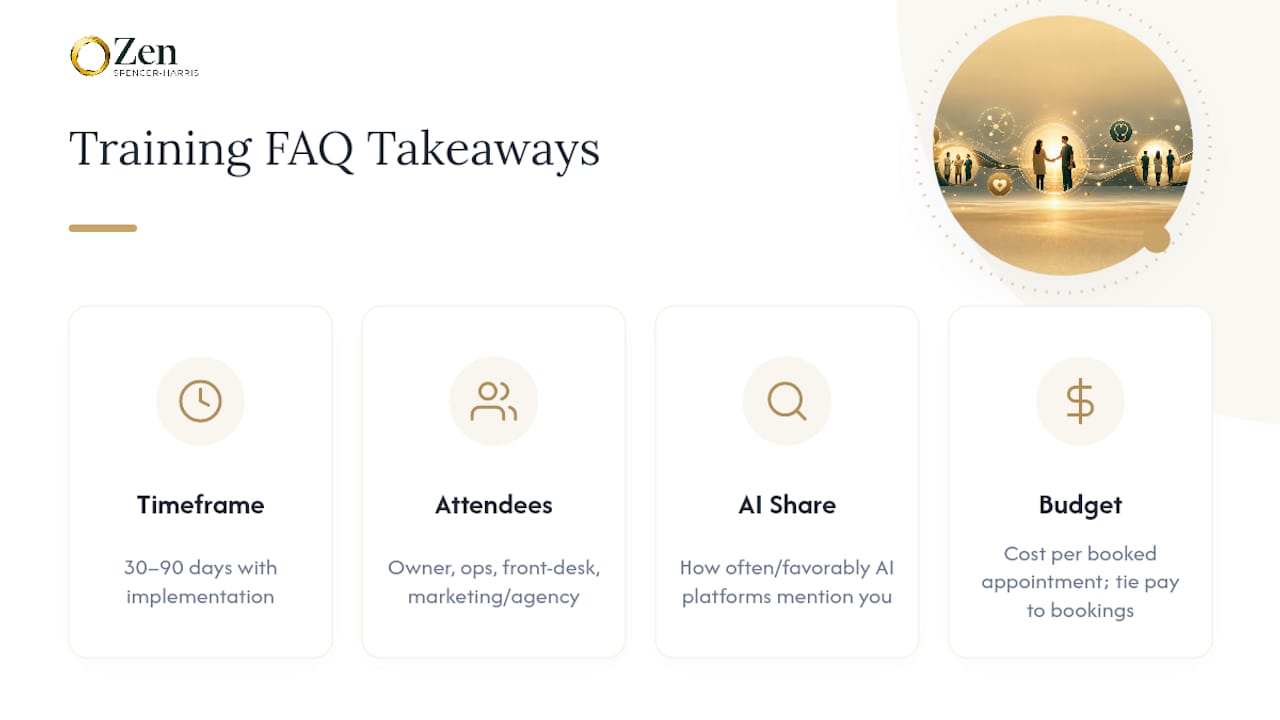
How much should a specialty practice budget for marketing training? Costs vary widely by scope and delivery format, but the more useful question is cost-per-booked-appointment. A performance-based structure, where payment ties to verified bookings, removes much of the budgeting guesswork entirely.
Sources
- Local SEO for Healthcare: The Complete Guide (2026)
- GEO for Healthcare 2026: AI Visibility for Providers | Qwairy
- Local SEO for Healthcare, Doctors & Specialists 2026 | Flento