

If you're losing leads because nobody responds fast enough, Podium is the stronger starting point. If you're losing search clicks because your listings are inconsistent or your review count is thin across multiple locations, Birdeye is the better fit.
That's the core split in the Podium versus Birdeye comparisons you'll find across every review platform: Podium is messaging-first, built around a webchat-to-SMS speed-to-lead loop; Birdeye is reputation-first, built to manage listings, reviews, and customer experience across many locations at once.
30-second shortlist:
- Best for single-location, SMS-first service businesses (home services, salons, clinics with one site): Podium
- Best for multi-location brands, franchises, and agencies managing many local listings: Birdeye
| Dimension | Podium | Birdeye |
|---|---|---|
| Core strength | Webchat-to-SMS lead conversion | Multi-location reputation and listings |
| Best for | Single-location service businesses | Franchises, multi-site brands |
| AI focus | Lead qualification and scheduling | Review response and sentiment rollups |
| Starting price (annual) | Published pricing examples place Birdeye Standard near ~$299/month (annual billing) and Podium Essentials near $399/month (annual billing). | Published pricing examples place Birdeye Standard near ~$299/month (annual billing) and Podium Essentials near $399/month (annual billing). |
| Contract typical | Multi-month contracts with automatic renewals common | Multi-month contracts with automatic renewals common |
Next step: Request a live demo from whichever vendor matches your dominant problem, and run a 30-day pilot measuring one KPI: lead-response time (Podium) or listings accuracy across locations (Birdeye).
Table of Contents
- How do Podium and Birdeye actually compare feature by feature?
- What does pricing actually look like, and what hidden costs should you expect?
- Which business types fit each platform best?
- Does each platform connect with the tools your team already uses?
- What does onboarding look like, and how long until you see results?
- Pros and cons: the honest short version
- How should you actually evaluate these platforms before buying?
- If you run a healthcare practice: what you need to evaluate differently
- What's the final recommendation, and what should you do next?
- What do G2, Capterra, and case studies actually say?
- What are real users actually saying about each platform?
- Key Takeaways
- What the feature race misses about this decision
- When a performance-based patient acquisition service fits better than software
- Useful sources
How do Podium and Birdeye actually compare feature by feature?
Both platforms share a surface-level overlap: they collect reviews via SMS, offer webchat, and provide some form of reporting. But their center of gravity is completely different, and that difference determines which one earns its keep.
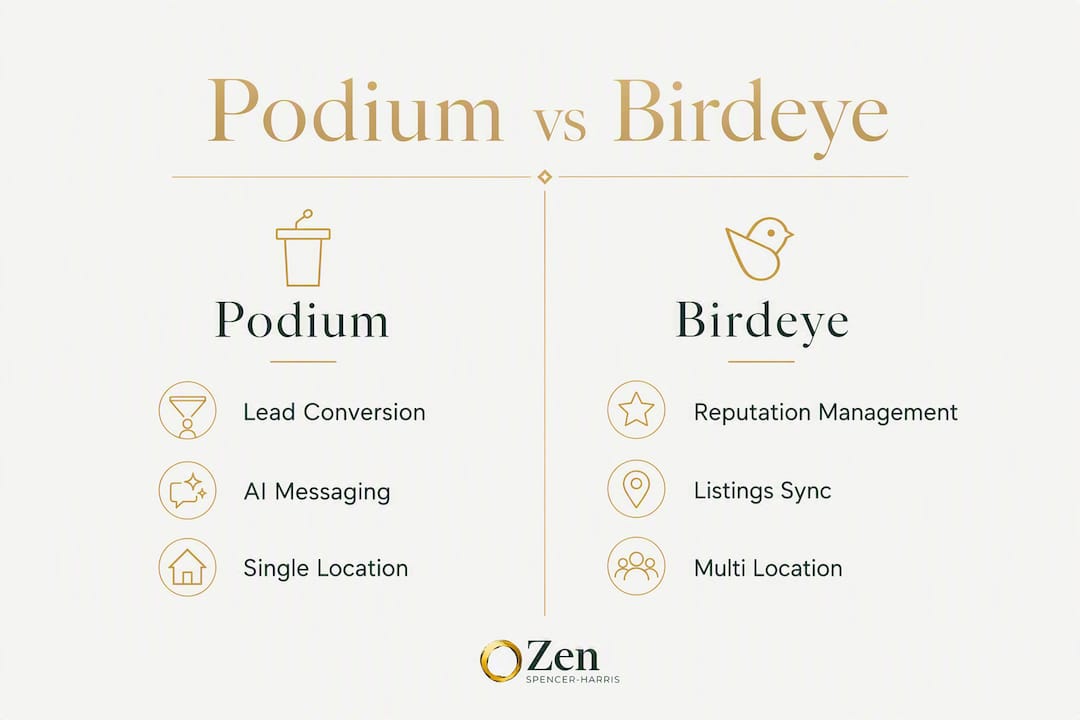
| Feature | Podium | Birdeye |
|---|---|---|
| Messaging / SMS | Core product, 24/7 AI Employee | Available, not the primary focus |
| Webchat | Webchat-to-text handoff | Available, reputation-oriented |
| Review generation | SMS-based, integrated into lead flow | Automated across 50+ directories |
| Listings management | Limited | Syncs to 50+ directories |
| Payments | Text-to-pay built in | Available as add-on |
| Surveys | Basic | Full NPS and CX survey modules |
| AI responses | Conversion-focused (AI Employee) | Reputation-focused (automated review replies, sentiment) |
| Reporting | Lead and messaging analytics | Multi-location CX dashboards, benchmarking |
| Integrations | CRMs, scheduling tools | CRMs, EHR, Google, Apple Business Connect |
Podium's AI Employee is designed to answer, qualify, and schedule inbound leads around the clock. That's a conversion tool. Birdeye's AI, by contrast, automates review responses and rolls up sentiment data across locations. Two different jobs.
Both platforms lean on SMS for review requests because SMS converts at higher rates than email for review generation. The difference is that Podium bakes review collection into the same conversational thread where the sale happens, while Birdeye fires review requests as part of a broader, multi-channel reputation program.
Pro Tip: During vendor demos, test the AI output live with a real scenario from your business. Ask the AI Employee to handle a missed-call lead for your specific service, or ask Birdeye's AI to draft a response to a negative review in your practice's voice. Vendor demos use polished examples; your edge cases reveal the real quality.
What does pricing actually look like, and what hidden costs should you expect?
Published pricing places Birdeye Standard and Podium Essentials near common SaaS pricing tiers on annual billing. Those headline numbers are the floor, not the ceiling.
Both vendors use per-location licensing. A five-location dental group on Birdeye doesn't pay $299/month total; it pays per location, which can push the annual commitment well past $15,000 before add-ons. Podium scales similarly. Setup and onboarding fees are common and often not surfaced until late in the sales process.
Advanced features are gated. AI response capabilities, survey modules, listings sync breadth, and payments processing often sit in higher tiers. Feature bloat is a documented risk with Birdeye: small teams frequently pay for enterprise-grade survey and social modules they never activate.
Before you sign, get these itemized in writing:
- Per-location fee structure and what triggers a location count increase
- AI capability gates: which tier unlocks automated review responses and AI Employee features
- Payments processing fees (text-to-pay transaction percentages)
- Listings sync scope: how many directories, and is it included or an add-on
- Survey and NPS module pricing
- Onboarding and setup fees
- Annual price escalation clauses
Contract friction is one of the most consistently documented complaints across both platforms. Buyers report 12–24 month commitments with automatic renewal clauses and difficult cancellation processes. This isn't a rumor; it shows up repeatedly in G2 and Capterra reviews.
Pro Tip: Before signing, ask the sales rep to send the cancellation policy in writing and confirm the notice period required to avoid auto-renewal. If they can't send it in 24 hours, that's a signal about what support looks like post-sale.
Which business types fit each platform best?
The core decision rule is simple: identify where you're losing revenue. Missed inbound leads point to Podium. Weak local visibility and inconsistent listings across locations point to Birdeye.
Single-location service businesses (home services, salons, auto repair, single-site clinics): Podium. The webchat-to-text handoff and integrated text-to-pay are built for the way these businesses operate: a customer finds you on Google, starts a chat, and you need to convert that into a booked appointment or a paid job before they call a competitor.

Multi-location brands, franchises, and retail groups (2–25+ locations): Birdeye. Managing listings accuracy, review volume, and CX benchmarking across dozens of locations manually is not viable. Birdeye's multi-location dashboards and automated listings sync address that directly.

Enterprise (25+ locations, agencies): Birdeye or Reputation (Reputation.com). Reputation.com competes at the enterprise end with centralized CX program management and large-scale analytics. For agencies managing many local clients, both Birdeye and Chatmeter offer multi-client dashboards, with Chatmeter specializing in local SEO and sentiment monitoring for retail and hospitality groups.
Healthcare practices (single or multi-site): This vertical gets its own section below, but the short version is: HIPAA-compliant messaging and EHR connectors are non-negotiable, and both platforms offer some level of compliance support.
Smaller multi-location groups and agencies on tighter budgets: Pluspoint competes here with simplified reputation workflows at a lower price point than Birdeye's enterprise tiers.
Does each platform connect with the tools your team already uses?
Integrations are where the practical day-to-day friction lives. A platform that doesn't talk to your CRM or scheduling system creates manual work that erodes the value you paid for.
Podium integrations commonly used by buyers:
- Major CRMs: HubSpot, Salesforce, and industry-specific tools for home services and automotive
- Scheduling and booking platforms used by service businesses
- Google Business Profile for review request triggers
- Shopify and e-commerce platforms for text-to-pay flows
Birdeye integrations commonly used by buyers:
- CRMs: Salesforce, HubSpot, and healthcare-specific platforms
- EHR and clinical scheduling systems (relevant for medical and dental practices)
- Google Business Profile and Apple Business Connect for listings sync and review management
- 50+ directory partners for listings distribution
The Google and Apple Business Connect partnerships matter more than they might appear. Listings accuracy on Google directly affects local pack rankings. Birdeye's ability to push consistent NAP (name, address, phone) data across directories at scale is a genuine competitive advantage for multi-location brands, not just a feature checkbox.
For healthcare, Birdeye's enterprise controls include SSO, audit logging, role-based access, and HIPAA options. Those aren't nice-to-haves for a multi-site behavioral health group or specialty practice; they're requirements.
Questions to ask during demos:
- Does the API allow bidirectional data sync, or is it one-way?
- What does the data export look like if we leave the platform?
- Is SSO included in our tier or an add-on?
- Which EHR systems have native connectors versus Zapier workarounds?
For a deeper look at local listings and directory strategy, the tradeoffs between managed sync and manual citation building are worth understanding before you commit to a platform's listings module.
What does onboarding look like, and how long until you see results?
Single-location Podium setups can go live in days. The webchat widget installs on your site, the SMS number activates, and the AI Employee can be configured in a few hours. Time-to-first-lead is genuinely fast for a simple deployment.
Birdeye multi-location rollouts are a different project. Claiming and syncing dozens of listings, configuring per-location review campaigns, and setting up rollup reporting typically requires a project plan and a dedicated vendor Customer Success Manager. Expect 4–8 weeks for a 10-location rollout to be fully operational — not days.
Internal team checklist for launch:
- Operations lead: owns location data accuracy (addresses, hours, phone numbers) before import
- Marketing lead: configures review request templates, campaign timing, and brand voice guidelines
- Front desk / patient-facing staff: trains on the messaging inbox and escalation protocols
- IT or web team: installs webchat widget and confirms CRM integration data flow
Podium users sometimes report frustration with aggressive sales follow-up during and after onboarding. Birdeye users occasionally flag that the platform's depth creates a steep learning curve for small teams. Neither is disqualifying, but both are worth factoring into your internal resource plan.
Pros and cons: the honest short version
Podium
- Pros: Webchat-to-SMS handoff is genuinely fast and well-executed; text-to-pay integration removes friction from the payment step; AI Employee handles inbound lead qualification 24/7
- Cons: Limited multi-location reporting; users report aggressive renewal and sales follow-up; listings management is not a core strength
One-line summary: Podium is the right tool if your primary problem is converting inbound leads faster.
Birdeye
- Pros: Listings sync across 50+ directories at scale; multi-location CX dashboards and sentiment benchmarking; enterprise controls (SSO, HIPAA options, audit logging)
- Cons: Feature bloat can overwhelm small teams; AI-generated review responses can read as repetitive without customization; per-location pricing scales quickly
One-line summary: Birdeye is the right tool if your primary problem is managing reputation and visibility across multiple locations.
How should you actually evaluate these platforms before buying?
Start with your operational data, not the vendor's demo deck.
Prioritized evaluation checklist:
- Measure your current lead-response time (average minutes from webchat/call to first reply)
- Audit listings accuracy across your locations on Google, Apple Maps, and Yelp
- Count your current review volume per location and your average star rating
- Identify which CRM or scheduling system the new platform must connect to
- Confirm your team's bandwidth for onboarding and ongoing platform management
Vendor questions to ask before signing:
- What is the per-location fee at our location count, and how does it change if we add locations mid-contract?
- Which AI features are gated to higher tiers, and what exactly triggers an upgrade?
- Who owns our review data and customer contact data if we cancel?
- What is the cancellation notice period, and is auto-renewal opt-out or opt-in?
- What does the onboarding timeline look like for our specific integration stack?
Red flags to watch for:
- Automatic 12–24 month renewal clauses buried in the contract
- Setup fees that appear only after the verbal agreement
- Vague answers about data portability and export formats
- AI feature demos that only show polished use cases, never edge cases
If you run a healthcare practice: what you need to evaluate differently
Healthcare adds a layer of requirements that generic SaaS comparisons skip. Getting this wrong isn't just an operational inconvenience; it's a compliance risk.
Healthcare-specific evaluation checklist:
- HIPAA-compliant messaging: confirm Business Associate Agreement (BAA) availability and which features are covered
- EHR and clinical scheduling connectors: native integrations with your specific system (Epic, Athenahealth, Jane, etc.) versus Zapier workarounds
- Review moderation: can you flag or respond to reviews that contain protected health information before they go public?
- Professional tone controls: can you customize AI review responses to match your practice's clinical voice, not a generic retail template?
- Role-based access: can front desk staff see messaging without accessing analytics or patient data they shouldn't see?
For HIPAA-aligned messaging and AI usage, the compliance architecture matters as much as the feature list.
Pilot plan for a clinic (30 days):
- Days 1–7: Configure messaging, install webchat, connect scheduling system, train front desk
- Days 8–21: Run live with AI Employee or review automation; track lead-response time and review request conversion rate
- Days 22–30: Audit listings accuracy, review AI response quality for professional tone, measure new review volume
KPIs to measure: lead-response time reduction, new reviews per week, listings accuracy score, and appointment booking rate from webchat.
One honest note: if your practice has fewer than three locations and your primary goal is booking more new patients in the next 90 days, buying and operating a SaaS platform may not be the fastest path. A performance-based patient acquisition engagement, where you pay for delivered booked appointments rather than software seats, often produces faster results with less internal overhead.
For a broader look at reputation management for specialty practices, the evaluation criteria differ meaningfully from general retail or service business use cases.
What's the final recommendation, and what should you do next?
Choose Podium if your dominant problem is lead-response speed. Choose Birdeye if your dominant problem is multi-location reputation and listings visibility. That's the tie-breaker that real-world comparisons consistently land on.
Next steps for your procurement or vendor team:
- Identify your primary revenue leak (missed leads vs. weak local visibility) before contacting either vendor
- Pull your current lead-response time and listings accuracy data as baseline metrics
- Request itemized quotes from both vendors, including per-location fees and onboarding costs
- Run a 30-day pilot with one vendor before committing to a full contract
- Measure three KPIs during the pilot: lead-response time, new review volume per location, and listings accuracy score
Pilot metrics template:
| KPI | Baseline (pre-pilot) | Target (end of pilot) |
|---|---|---|
| Lead-response time | Significantly reduced lead-response time | |
| New reviews per location per week | Meaningful increase in review volume | |
| Listings accuracy score | High consistency in NAP (name, address, phone) data across listings | |
| Webchat-to-appointment conversion | Measurable lift |
Include operations, marketing, and front desk in the pilot team. Vendor success teams should be on the hook for onboarding deliverables, not just training calls.
What do G2, Capterra, and case studies actually say?
On G2, Birdeye holds a 4.7/5 rating from over 3,200 reviews, and Podium holds a 4.6/5 from over 1,850 reviews. On Capterra, Birdeye scores 4.7 from 701 reviews and Podium 4.3 from 522 reviews. Both are well-regarded, but the gap on Capterra is worth noting.
Birdeye's case studies tend to feature multi-location healthcare groups, auto dealer networks, and franchise brands, which aligns with its product positioning. Podium's case studies lean toward home services, automotive, and single-site service businesses.
Partnership signals matter here too. Birdeye's Google and Apple Business Connect integrations are not just marketing claims; they affect how quickly listings updates propagate and how review data surfaces in local search results. For franchise groups with many locations, this can be a material operational advantage.
What are real users actually saying about each platform?
GetApp and G2 reviewers paint a consistent picture. Birdeye users praise the listings management and CX analytics, particularly the ability to see review trends across locations in one dashboard. The most common complaint is that AI-generated review responses can feel generic and repetitive without significant customization.
Podium users consistently praise the webchat-to-text handoff and the speed at which leads move from first contact to conversation. The recurring complaints center on aggressive sales follow-up during the buying process and renewal pressure at contract end.
Neither platform has a clean record on contract flexibility. Both appear in reviews where buyers felt locked in longer than expected. The FTC's final rule banning fake reviews and testimonials is worth knowing about: any platform that incentivizes or manufactures reviews creates compliance exposure for your business, not just the vendor.
One pattern worth noting: buyers who tested AI outputs during the pilot rather than trusting vendor demos consistently reported better post-purchase satisfaction. The demo environment is optimized; your real customer messages are not.
Key Takeaways
Birdeye wins on multi-location reputation and listings at scale; Podium wins on single-location lead conversion speed, and both require careful contract scrutiny before signing.
| Point | Details |
|---|---|
| Primary decision rule | Choose Podium for missed leads; choose Birdeye for weak multi-location visibility and listings. |
| Pricing reality | Both start with published rates (Birdeye Standard at ~$299/month and Podium Essentials at ~$399/month) but scale per location; get itemized quotes before committing. |
| Contract risk | Both vendors commonly require 12–24 month contracts with auto-renewal; negotiate exit terms in writing. |
| Healthcare requirements | HIPAA BAA, EHR connectors, and review moderation controls are non-negotiable for clinical practices. |
| Zensweb alternative | For practices prioritizing booked appointments over software management, a performance-based patient acquisition engagement may deliver faster results. |
What the feature race misses about this decision
The Podium vs Birdeye debate gets framed as a feature comparison almost every time, and that framing leads buyers to the wrong conclusion. The real question isn't which platform has more features. It's which problem is costing you more revenue right now.
A single-location physical therapy practice that loses three new patient inquiries a week because nobody responds to the website chat within an hour doesn't need a multi-location reputation dashboard. It needs a faster response loop. Podium solves that. Buying Birdeye for that practice is paying for infrastructure you won't use.
Conversely, a 15-location urgent care group with inconsistent Google Business Profiles, a 3.2-star average on some locations, and no systematic review program isn't going to fix that with a better SMS tool. The problem is visibility and trust at scale. Birdeye is built for that.
The mistake I see repeatedly is buyers evaluating platforms by feature count rather than by operational fit. Birdeye's extensive feature set is genuinely impressive, and it's also the reason small teams end up paying for survey modules and social publishing tools they never touch. Stage your feature rollout. Use the core capability for 90 days before activating anything else.
One more thing: neither platform replaces the need for a clear patient or customer acquisition strategy. Software manages the process; it doesn't create demand. If your pipeline is thin, a messaging tool won't fix that. That's when a performance-based engagement, where someone else is accountable for the booked appointments, is the more honest answer.
When a performance-based patient acquisition service fits better than software
Podium and Birdeye are strong platforms for teams with the bandwidth to operate them. But for specialty healthcare practices whose immediate goal is predictable new patient bookings, not software management, there's a different path.
Zensweb's performance-based patient acquisition program is built for practices that need measurable results tied to booked appointments, not monthly software seats. The model is straightforward: you pay for delivered outcomes. That means AI visibility on ChatGPT, Claude, Perplexity, and Google, structured reputation building, and local SEO execution, all without a long-term SaaS contract or an internal team learning a new platform.
If your practice has limited internal marketing bandwidth, an urgent patient-booking goal, or you've already tried a platform and found the ROI unclear, a performance-based engagement may be the more direct route. Start with a free visibility audit at zensweb.com/vital-audit to see exactly where your practice stands before committing to any software purchase.
Useful sources
- Birdeye vs Podium on G2 — side-by-side ratings from verified users
- Birdeye on Gartner Peer Insights — enterprise buyer reviews and security/compliance notes
- FTC final rule on fake reviews — compliance context for review generation practices