

AI can drive measurable booked-patient growth for specialty practices when it is built on a governance layer and tied to outcome-based measurement. Research published on arXiv reports a 34% improvement in engagement prediction (AUC) and a 28% lift in content relevance scores versus traditional approaches. Meanwhile, IQVIA analysis confirms that Google and other platforms are actively testing AI advertising placements for select healthcare categories, creating new discovery channels right now. Zensweb's AI Share of Voice program has delivered measurable visibility gains and booked-patient increases for specialty practices in a relatively short time frame.
The single most important move you can make today: request a free audit to map your current visibility gaps before committing to any AI channel.
- AI drives bookings when governance and measurement are built in from day one.
- The 90-day pilot model is the fastest path from invisible to booked.
- Privacy-safe personalization is not optional; it is the condition under which AI marketing works at all.
Table of Contents
- How does AI in healthcare marketing actually move the needle on bookings?
- What do the numbers say about AI-driven patient engagement?
- What HIPAA and governance controls does your AI marketing stack need?
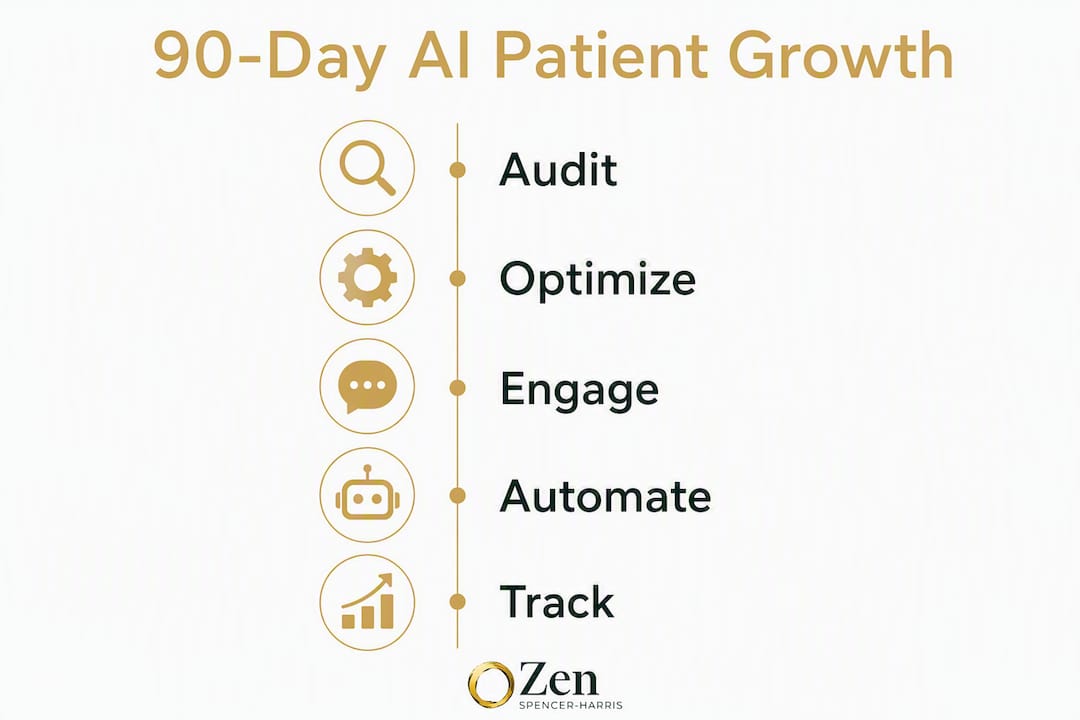
- How do you run a 90-day AI marketing pilot for a specialty practice?
- Which KPIs actually prove booked-patient ROI?
- What mistakes do healthcare marketers most often make with AI?
- What outcomes can a 90-day AI visibility program produce?
- Key Takeaways
- Why governance and performance have to come first
- Your practice's AI visibility gap is measurable and fixable
- Sources and further reading
How does AI in healthcare marketing actually move the needle on bookings?
Six use cases consistently produce measurable patient-acquisition results for specialty practices.
Intent-driven AI visibility (AI Share of Voice). When a prospective patient asks ChatGPT, Claude, Perplexity, or Google's AI Mode which psychiatrist or orthopedic surgeon to see, your practice either appears or it does not. Agent Engine Optimization (AEO) structures your content so AI agents can summarize and recommend you. The business outcome: qualified consults from patients who are already pre-sold on your specialty.
Conversion-focused local search. AI tools audit your Google Business Profile, surface citation gaps, and flag schema errors that suppress local rankings. A corrected profile with accurate structured data typically lifts map-pack visibility relatively quickly.
Privacy-safe personalized messaging. Machine learning segments audiences by behavioral signals rather than condition. The result is relevant outreach that does not trigger HIPAA's minimum-necessary standard or condition-inference risk.
Booking automation and smart reminders. AI-powered scheduling chatbots and reminder sequences help reduce no-shows by identifying content sequences that move a prospect from first touch to kept appointment.

Reputation and review orchestration. Automated post-visit prompts, sentiment analysis, and response drafting keep your star rating competitive without manual effort.
Journey sequencing. Practitioner reporting shows that modeling the content sequences leading to kept appointments outperforms simple lead-count optimization.
| Use Case | What It Does | Compliance Risk Tier | Time to Impact |
|---|---|---|---|
| AI Share of Voice / AEO | Surfaces practice in AI agent answers | Low (no PHI involved) | 30–60 days |
| Local SEO + schema | Improves map-pack and AI overview placement | Low | 30 days |
| Personalized messaging | Segments by behavior, not condition | Medium (requires de-identification) | 30–60 days |
| Booking chatbot + reminders | Automates scheduling and reduces no-shows | Medium (BAA required) | 30 days |
| Reputation management | Automates review prompts and responses | Low | 30 days |
| Journey sequencing | Models content paths to kept appointments | Medium | 60–90 days |
What do the numbers say about AI-driven patient engagement?
The arXiv EGPF research is the strongest published signal: a 34% AUC improvement in engagement prediction and a 28% lift in content relevance. In practical terms, higher intent matching means your content reaches people who are closer to booking, not just browsing. That gap between a curious visitor and a booked consult is exactly where most specialty practices lose revenue.
34% improvement in engagement prediction (AUC) and 28% lift in content relevance versus traditional approaches. Source: arXiv, Q2 2026.
Google's AI Mode pilot is running limited U.S. tests of healthcare ads with strict format and disclosure constraints, currently favoring general wellness and disease-awareness categories. Practices that build AEO-ready content now will be positioned when those restrictions loosen.
| Metric | Finding | Source | Booking Implication |
|---|---|---|---|
| Engagement prediction (AUC) | +34% vs. traditional models | arXiv EGPF | Higher intent match → more qualified leads |
| Content relevance score | +28% lift | arXiv EGPF | Relevant content → lower bounce, higher consult rate |
| AI ad channel expansion | Active U.S. testing underway | IQVIA / eMarketer | Early movers capture first-mover visibility |
Affinity-driven orchestration, where AI ranks content by a patient's behavioral affinity rather than demographic proxies, consistently improves engagement when applied responsibly. The mechanism is straightforward: the right message at the right moment shortens the decision cycle.
What HIPAA and governance controls does your AI marketing stack need?
The governance layer is not a compliance checkbox. It is the architecture that lets you scale AI communications without scaling regulatory risk. Top organizations build automated compliance checks directly into creative workflows so that every piece of content passes a claims library, channel-specific rules, and a human-in-the-loop medical-legal-regulatory (MLR) gate before it goes live.
Governance layer components:
- Claims library: a pre-approved set of statements your AI can use or combine, reviewed by legal and clinical leads.
- Channel rules: different platforms carry different risk profiles; social retargeting of a condition-specific URL is higher risk than a general wellness email.
- Automated language guardrails: flag condition-inference language (e.g., "struggling with anxiety?" in a retargeting ad) before it reaches a human reviewer.
- Human-in-the-loop MLR gating: no AI-generated clinical claim goes live without a qualified reviewer sign-off.
- Audit trails: every output, approval, and deployment is logged with timestamps.
HIPAA-aware AI marketing checklist:
- Data minimization: collect only what is needed for the marketing function.
- De-identification: strip or hash any field that could identify a patient before it enters a marketing model.
- Consent mapping: document where and how consent was obtained for each data source.
- Vendor due diligence: require a Business Associate Agreement (BAA) from every AI vendor that touches patient-adjacent data. For HIPAA-compliant AI deployment, the BAA is non-negotiable.
- Logging: maintain a record of every automated decision that touches a patient communication.
WPP's analysis is direct: perceived misuse of patient data damages the patient-provider relationship in ways that no ad budget can repair. Privacy-preserving personalization is the condition under which AI marketing earns trust, not just clicks.
Pro Tip: Build your claims library before you write a single AI prompt. Feed the library into your system prompt as a constraint, and your AI outputs will stay within approved language from the first draft, cutting MLR review cycles by a significant margin.
How do you run a 90-day AI marketing pilot for a specialty practice?
Days 1–30: Discovery and foundation
- Audit current visibility across Google, ChatGPT, Claude, and Perplexity. Map where your practice appears and where it does not.
- Classify content sensitivity tiers (general wellness vs. condition-specific vs. treatment-specific).
- Build or import your claims library and set MLR approval rules.
- Establish baseline KPIs: current booked-consult rate, cost-per-lead, and kept-appointment rate.
- Confirm BAAs with all AI vendors.
Days 31–60: Pilot setup and measurement
- Launch AEO content on two to three priority topics (your highest-volume referral conditions).
- Activate Google Business Profile optimization and local schema corrections.
- Deploy one booking automation sequence (chatbot or SMS reminder).
- Set up UTM tracking and a conversion goal in Google Analytics 4 tied to appointment confirmations.
- Run a weekly MLR review of all AI-generated outputs.
Days 61–90: Measure and scale
- Review pilot KPIs against baseline. Scale channels that hit the booked-patient threshold; pause those that do not.
- Expand AEO content to secondary topics.
- Add journey-sequencing logic to reduce cancellations.
- Document what worked for the next 90-day cycle.
The practice owns clinical oversight and final approvals. The agency or partner owns technical execution, content production, and reporting. That division of responsibility keeps the pilot moving without pulling your clinical staff into marketing operations.
Which KPIs actually prove booked-patient ROI?
- Qualified consult rate: booked appointments from AI-sourced leads divided by total AI-sourced leads.
- Booked-appointment rate: consults that convert to scheduled appointments.
- Kept-appointment rate: scheduled appointments that are actually attended.
- Cost-per-booked-patient (CPBP): total AI marketing spend divided by kept appointments in the period.
- LTV vs. CAC: patient lifetime value compared to the cost to acquire them. A specialty practice with a $4,000 average patient LTV can sustain a much higher CAC than a primary care clinic.
- Downstream revenue attribution: connect booked appointments to billed revenue using your EMR's reporting or a middleware integration.
A simple CPBP calculation: if you spend $3,000 in a month and generate 20 kept appointments, your CPBP is $150. Compare that to your average revenue per visit to determine whether the channel is profitable.
AI-powered search channels require different tracking instrumentation than traditional paid search. AI overviews and agent answers do not always pass UTM parameters cleanly. Use branded search volume trends and direct traffic as supplementary signals alongside standard conversion tracking.
Pro Tip: Track kept-appointment rate separately from booked-appointment rate. A high booking rate with a low kept rate signals a messaging-to-expectation mismatch, not a traffic problem.
What mistakes do healthcare marketers most often make with AI?
- Overreliance on high-volume content. Publishing AI-generated articles at scale without clinical review dilutes authority and risks condition-inference violations. Mitigation: cap output volume and require a clinical read on every condition-specific piece.
- Scaling without MLR guardrails. Automating distribution before the claims library is built means non-compliant language reaches patients at speed. Mitigation: no distribution automation until the governance layer is live.
- Using general-purpose LLMs for clinical intent. Domain-specific models that operate within medical and regulatory constraints outperform general-purpose tools for compliant patient acquisition. Mitigation: evaluate specialized healthcare AI vendors alongside general LLMs. For a direct comparison of Claude vs. ChatGPT for healthcare marketing, the use-case fit differs significantly by task.
- Condition inference in messaging. Retargeting someone who visited a depression treatment page with an ad that references depression by name is a HIPAA risk. Mitigation: use behavioral cohorts, not condition-specific URL retargeting.
- Poor measurement. Optimizing for leads instead of kept appointments means you are measuring the wrong thing. Mitigation: set your conversion goal at the appointment-confirmation event, not the form fill.
What outcomes can a 90-day AI visibility program produce?
Zensweb's AI Share of Voice program targets measurable visibility gains on ChatGPT, Claude, Perplexity, and Google within 90 days. Specialty practices that complete the full pilot typically see their practice surface in AI agent answers for their primary referral conditions, a category where most competitors are not yet present.
Practices that implement AEO-structured content and local schema corrections early in a pilot establish a visibility position that takes competitors months to replicate.
The program covers AEO content, technical SEO, Google Business Profile optimization, and reputation management, all within a performance-based model tied to booked-patient outcomes. For community health centers and FQHCs, the 90-day FQHC marketing playbook shows comparable outcome ranges in a similar pilot structure.
Key Takeaways
AI in healthcare marketing drives measurable booked-patient growth when governance, AEO-structured content, and outcome-based KPIs are built in from the start of a 90-day pilot.
| Point | Details |
|---|---|
| AI lifts engagement measurably | A 34% AUC improvement and 28% relevance gain versus traditional approaches justify piloting AI now. |
| AEO is the new visibility frontier | Structuring content for ChatGPT, Claude, Perplexity, and Google AI Mode captures patients before they reach your competitors. |
| Governance is non-negotiable | A claims library, MLR gating, and BAAs must be in place before any AI content goes live. |
| Measure kept appointments, not leads | CPBP and kept-appointment rate are the KPIs that prove real ROI for specialty practices. |
| Zensweb delivers in 90 days | Zensweb's performance-based AI Share of Voice program ties fees to booked-patient outcomes, not activity metrics. |
Why governance and performance have to come first
The practices that get the most from AI marketing are not the ones that move fastest. They are the ones that build the governance layer first and then move fast. Every time I see a specialty practice publish AI content at volume without a claims library or MLR process, the short-term traffic gains get wiped out by a compliance incident or a reputation problem that takes months to repair. The 90-day model works because it forces the right sequence: audit, govern, pilot, measure, scale. Performance-based pricing matters here too. When fees are tied to booked appointments rather than impressions or clicks, everyone in the engagement is aligned on the outcome that actually pays the bills.
Your practice's AI visibility gap is measurable and fixable
Most specialty practices are invisible on the AI platforms where patients are already searching. Zensweb's 90-day patient acquisition program closes that gap with AEO-structured content, technical SEO, and reputation management, all tied to a performance-based model where you pay for booked-patient results, not activity.
Every engagement starts with a free healthcare audit that maps your current visibility across ChatGPT, Claude, Perplexity, and Google and identifies the fastest path to booked consults. All work is executed within a HIPAA-aware governance framework with full audit trails. Request your free audit and see exactly where your practice stands before committing to anything.
Sources and further reading
- Personalization as a Game: Equilibrium-Guided Generative Modeling (arXiv) — backs the 34% AUC and 28% relevance findings cited in the BLUF and evidence sections.
- AI Advertising Is Coming to Healthcare (IQVIA) — covers AI ad channel expansion and preparedness recommendations for healthcare brands.
- Healthcare Ads Enter Google's AI Mode in Limited Test (eMarketer) — details on Google's current U.S. pilot restrictions and creative eligibility rules.
- Inside Semmelweis: Doceree's AI Bet on Pharma Marketing (PharmaceuticalCommerce) — source for domain-specific model advantages and MLR-ready output design.