

A specialty healthcare practice can achieve measurable ChatGPT visibility that drives booked appointments. The mechanism is a focused program combining entity clarity, conversation-first content, reputation signals, and booking integration. Visible gains often materialize inside 90 days when the program ties every deliverable to a booked-appointment KPI.
Three steps you can take today:
- Publish a clear Organization entity on your homepage. Add JSON-LD with a stable
@id, your practice name, address, phone, and at least twosameAslinks to verified profiles (Google Business Profile, a state licensing directory). - Write one answer-first service paragraph. Pick your highest-intent service query, write a 120–180 word direct answer, and place it above the fold on that service page.
- Confirm your Google Business Profile is complete and accurate. Category, hours, services, and a recent photo. This single asset feeds Gemini and local AI answers more than almost anything else on this list.
Table of Contents
- What does "ChatGPT SEO" actually mean for healthcare practices?
- How does a conversational AI decide to surface your practice?
- What structured data should your practice actually publish?
- How to write content that ChatGPT-style engines actually cite
- Which reputation signals matter most for AI citation?
- How do you measure AI visibility and connect it to booked appointments?
- What does a 90-day implementation roadmap look like?
- How do you publish for AI discovery without violating HIPAA?
- Key Takeaways
- Why healthcare leaders should treat ChatGPT SEO as mission-critical
- Zensweb's AI Share of Voice program gets your practice booked in 90 days
- Further reading and technical references
What does "ChatGPT SEO" actually mean for healthcare practices?
This guide uses "ChatGPT SEO" to mean one specific thing: optimizing a specialty healthcare practice's content, structured data, and authority signals so that ChatGPT, Claude, Perplexity, and Google AI Overviews surface that practice in conversational answers and citations.
Scope note: This guide does NOT cover using large language models to generate content drafts, run keyword research, or automate internal workflows. That is a different discipline with a different audience. Every section here is about getting your practice cited by AI, not about using AI as a writing tool.
The platforms in scope are ChatGPT with browsing enabled, Google AI Overviews (Gemini-powered), Perplexity, and Claude. Each uses a retrieval-plus-grounding model: they pull candidate content from the web, match it against an entity graph, and attribute answers to sources they trust. Your job is to be one of those trusted sources.
How does a conversational AI decide to surface your practice?
The process has three steps. First, the AI retrieves candidate content chunks from indexed pages. Second, it selects candidates that match the query's intent. Third, it grounds its answer by checking those candidates against a knowledge graph of known entities.
Your practice gets cited when it clears all three gates: the content is retrievable, it matches the patient's intent, and the entity signals are strong enough for the AI to attribute the answer with confidence. Structured data builds an entity graph that reduces ambiguity and strengthens that confidence, but schema alone is not sufficient without visible, high-quality content behind it.
Conceptual flow: Content chunk → vector index → retrieval → grounding with entity graph → attributed citation
The on-site signals that feed each step: concise, answer-first prose; Article, Organization, and Person schema; and corroboration from Google Business Profile and authoritative directories. A site ranking on page three of Google can still be preferred by AI platforms if it provides well-structured, entity-rich answers for specific patient questions.
What structured data should your practice actually publish?
Google's structured data guidance is clear: schema helps machines understand page content but does not replace strong visible content. Visible claim parity, meaning the JSON-LD says exactly what the page text says, is required.
Prioritized schema types for practices:
MedicalBusiness(subtype ofLocalBusiness) on the homepageMedicalServiceorServiceon each service pagePhysicianorPersonon each clinician pageArticleorBlogPostingon every published post, with accuratedateModifiedFAQPageonly when the Q&A is visibly rendered on the pageBreadcrumbListon deep service and condition pages
Key JSON-LD properties to include:
- Stable
@idvalues (a canonical URL for each entity, reused across pages) sameAspointing to Google Business Profile, state licensing pages, and authoritative directoriesauthorwithworksForon articlesdateModifiedupdated whenever content changescontactPointwith phone and booking URL on the Organization entityserviceTypeon every Service object
Article dateModified and accurate Author/Organization schema are practical investments for freshness and entity recognition used by AI systems. Update dateModified only when the content actually changes.
Pro Tip: Reuse the same stable @id URL for your Organization entity across every page that references the practice. Add sameAs links to your verified Google Business Profile, your state medical board listing, and any authoritative health directory. That consistency is what turns a collection of pages into a recognized entity.
How to write content that ChatGPT-style engines actually cite
Visible Q&A formatting and answer-first content correlate more strongly with AI citations than FAQPage JSON-LD alone. The format of the visible text matters more than the markup wrapping it.
Answer-first paragraph template for a high-intent service query:
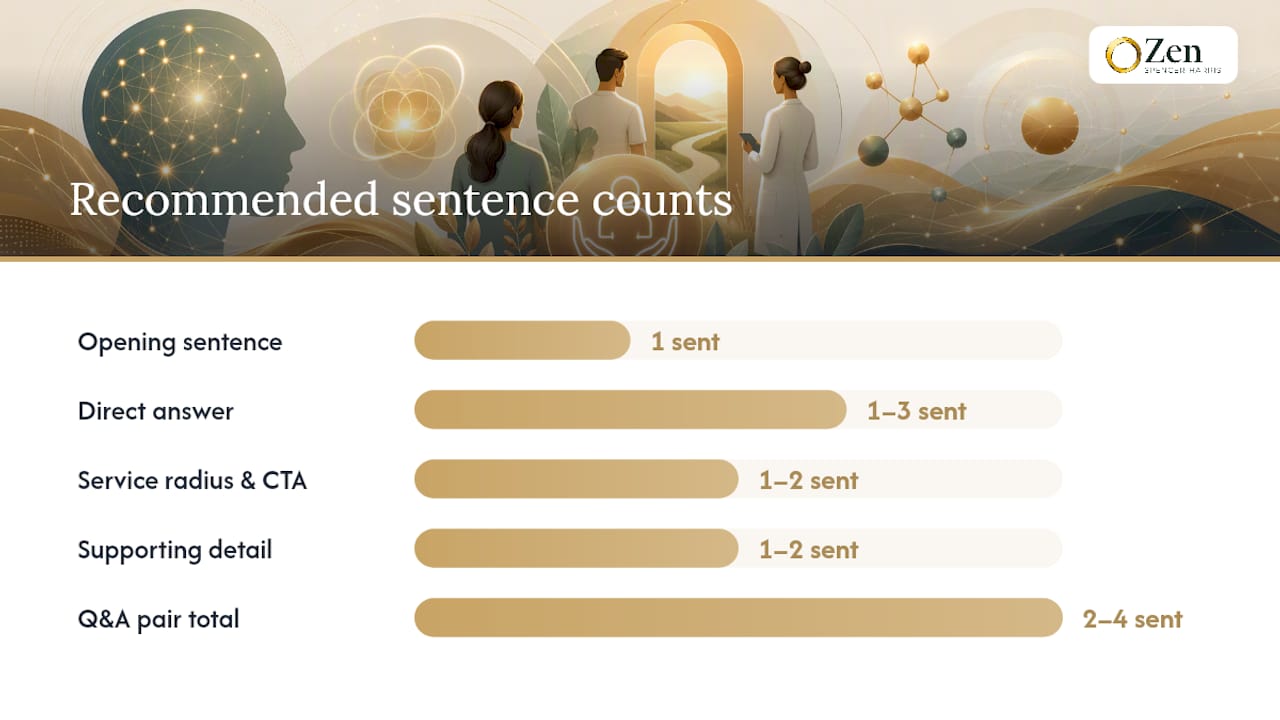
- Opening sentence: State what the service is and who it helps, in one sentence.
- Direct answer (sentences 2–4): Answer the patient's most likely question about the service. Include the condition treated, the approach used, and the typical outcome.
- Service radius and booking CTA (sentences 5–6): Name the geographic area served and include a direct booking link or phone number.
- Supporting detail (sentences 7–8): Add one clinical or procedural detail that builds credibility.
Keep this block between 120 and 180 words. Sections in that range earn meaningfully more ChatGPT citations than shorter micro-paragraphs, according to practitioner analysis.
Q&A page format: Write the question exactly as a patient would ask it. Follow with a one-to-two sentence direct answer, then a one-to-two sentence explanation. Keep each Q&A pair under 100 words total.
Dos and don'ts:
- Do write direct, factual answers and include named author attribution on every page.
- Do use clear H2 and H3 headings that match patient question phrasing.
- Don't hide the answer in a long narrative introduction.
- Don't publish FAQPage schema without rendering the Q&A visibly on the page.
Which reputation signals matter most for AI citation?
Key principle: Review quality and contextual substance matter more than raw review count. An AI system reading a review that names a specific condition, treatment, and outcome extracts far more entity signal than ten generic five-star ratings.
For local queries, Google Business Profile completeness and review substance materially affect AI citation likelihood. Treat GBP as a structured data asset, not just a listing.
Reputation checklist:
- GBP: complete every field, add services with descriptions, post monthly updates
- NAP (name, address, phone) consistent across every directory listing
- Health-specific directories: Healthgrades, Zocdoc, Doximity, Psychology Today (for behavioral health), and your state medical board listing
- Review generation: ask patients to describe the condition and outcome in their review, not just rate the experience
- Link
sameAsin your Organization schema to each verified directory profile
For local citation tool selection, BrightLocal and Whitespark are the two most-used platforms for managing NAP consistency across U.S. health directories.
How do you measure AI visibility and connect it to booked appointments?
Core KPIs:
| KPI | Baseline | Current | Delta | Goal | Notes |
|---|---|---|---|---|---|
| AI Share of Voice (%) | — | — | — | — | Citation share across tracked query set |
| Chat impressions | — | — | — | — | Tracked via UTM on AI referral clicks |
| Referral clicks from AI | — | — | — | — | UTM source=chatgpt / perplexity |
| Phone calls attributed to AI | — | — | — | — | Call tracking with AI referral tag |
| Booked appointments (AI-attributed) | — | — | — | — | CRM booking source field |
Measurement checklist:
- Define a query set of 20–40 patient-intent queries your practice should own
- Run a baseline AI citation crawl before any changes
- Check AI citations weekly using manual queries or a citation-monitoring tool
- Tag all booking URLs with UTM parameters (
utm_source=chatgpt,utm_medium=ai) - Add a booking source field to your CRM and train staff to capture it
- Set a 30-day attribution window for appointment conversion from first AI referral
AI Share of Voice, the percentage of your tracked queries where your practice is cited, is the headline KPI Zensweb uses to report progress. It translates directly into the booked-appointment pipeline.
What does a 90-day implementation roadmap look like?
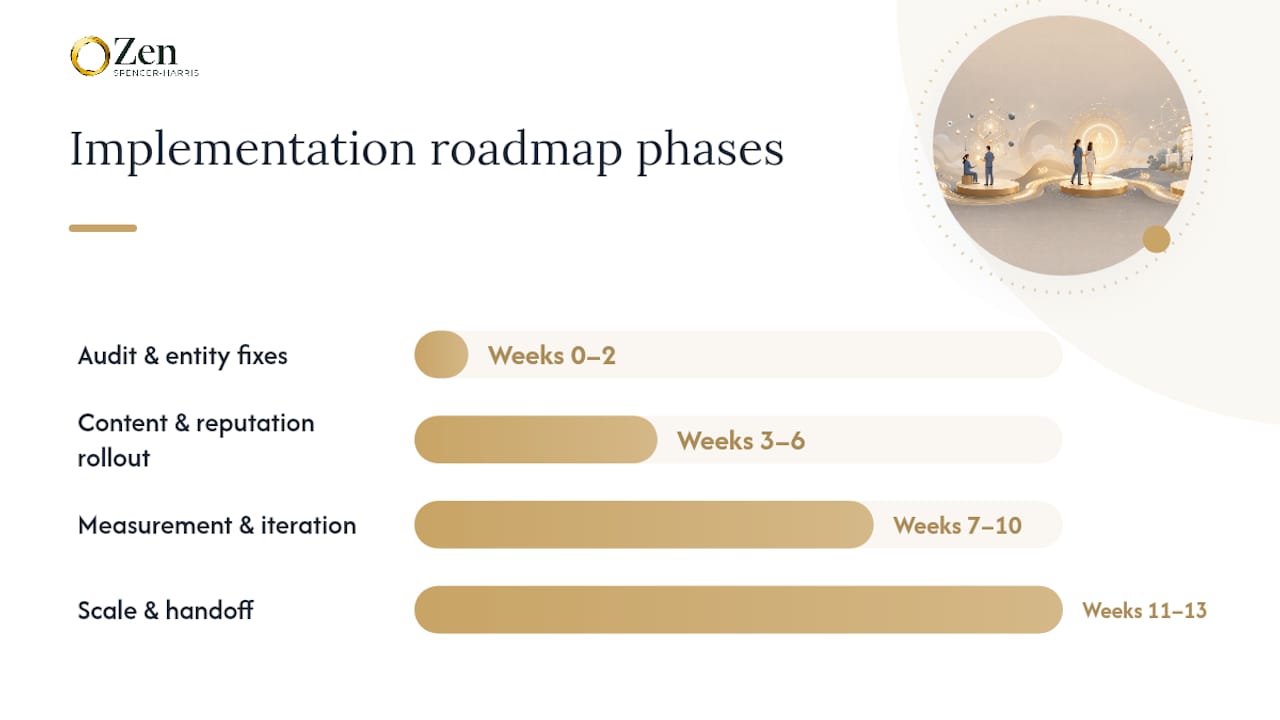
| Phase | Weeks | Owner | Deliverables |
|---|---|---|---|
| Audit and entity fixes | 0–2 | Vendor / shared | Schema audit, GBP gap report, entity @id map, NAP inconsistency list |
| Content and reputation rollout | 3–6 | Shared | 8 answer-first service pages, GBP optimization, directory submissions, review-generation plan |
| Measurement and iteration | 7–10 | Vendor / internal | Tracking setup, first AI Share of Voice report, content refinements based on citation data |
| Scale and handoff | 11–13 | Shared | Additional service pages, llms.txt deployment, CRM booking source reporting, 90-day results review |
Schema.org and llms.txt serve complementary roles: per-page structured metadata plus a site-level index help agentic systems find and interpret key pages. Deploy llms.txt in Week 11–13 once the core entity graph is stable.
The responsibility matrix is straightforward: the vendor owns technical schema deployment and citation monitoring; internal marketing owns content approval and CRM configuration; leadership owns the query set definition and KPI sign-off.
How do you publish for AI discovery without violating HIPAA?
Do not publish:
- Any patient name, date of birth, diagnosis, or treatment detail without explicit written authorization
- Identifiable case narratives, even anonymized ones where re-identification is plausible
- Raw clinician notes or intake summaries
- Booking confirmation details or appointment records in any public-facing content
Safe publication patterns:
- Use aggregate outcome statements ("patients treated for X report Y outcome") rather than individual case details
- Anonymize case examples to the point where no combination of details identifies a specific person
- Route every factual clinical page through clinical review, then legal review, before publishing
- Keep a written record of who reviewed each page and when
Pro Tip: Require a Business Associate Agreement (BAA) with any vendor that processes patient-identifiable bookings, messaging, or form submissions on your behalf. Keep written proof of clinician review for every page that makes a clinical claim. This protects the practice if a page is ever challenged.
For a deeper look at HIPAA-safe AI marketing workflows, the Zensweb guide on HIPAA-compliant AI for healthcare marketing covers the specific content review and vendor vetting steps.
Key Takeaways
Specialty healthcare practices that combine entity-graph schema, answer-first content, and reputation wiring can achieve measurable AI Share of Voice gains and attributed booked appointments within 90 days.
| Point | Details |
|---|---|
| Start with entity clarity | Publish Organization schema with a stable @id and two sameAs links before any other technical work. |
| Write 120–180 word answers | Answer-first service paragraphs in that range earn more AI citations than shorter or longer formats. |
| GBP is the top local signal | Complete every Google Business Profile field; it feeds Gemini and local AI answers directly. |
| Measure AI Share of Voice | Track citation share across a defined query set and connect it to CRM booking source data. |
| Zensweb delivers this program | Zensweb's performance-based AI Share of Voice program ties every deliverable to booked appointments, with results expected inside 90 days. |
Why healthcare leaders should treat ChatGPT SEO as mission-critical
The conventional wisdom in healthcare marketing is that Google organic and paid search are the two channels worth owning. That framing is already outdated. A growing share of patients now ask ChatGPT or Perplexity a question like "best psychiatrist for OCD in Denver" before they ever open a search results page. If your practice isn't cited in that answer, you don't exist for that patient at that moment.
What I find most underestimated is how decoupled AI citation is from traditional ranking. A practice on page three of Google can be the preferred citation in a ChatGPT answer if its entity signals are cleaner and its content is more directly extractable. That is a genuine opening for specialty practices that have been outspent on paid search for years.
AI visibility doesn't replace Google organic or paid channels. It captures a different moment in the patient decision process, earlier and more intent-rich, and feeds those downstream channels with warmer prospects. The practices that wire all three together will have a structural patient-acquisition advantage that compounds over time.
The performance-based model Zensweb uses matters here precisely because it removes the guesswork from the investment decision. When the fee is tied to booked appointments, the incentive structure is aligned. Leaders can outsource this work with confidence when the contract is built around results, not retainers.
Zensweb's AI Share of Voice program gets your practice booked in 90 days
Most specialty practices are invisible to AI platforms right now, not because their care is inferior, but because their digital presence lacks the entity clarity and answer-first content that AI systems require to cite them with confidence.
Zensweb's AI Share of Voice program delivers the full four-pillar build: entity graph and schema, answer-first service content, reputation wiring, and booked-appointment tracking, inside 90 days. The pricing model is performance-based: you pay for booked appointments, not for hours or deliverables. That means the program is self-funding when it works, and the risk stays with Zensweb when it doesn't.
To see where your practice stands today, start with a free healthcare visibility audit. The audit maps your current AI citation gaps, entity signal weaknesses, and the fastest-path fixes for your specific practice type.
Further reading and technical references
Start here if you're implementing: Google's structured data documentation and Schema.org are the two authoritative references for JSON-LD syntax. The Zensweb blog posts below apply those standards specifically to healthcare AI visibility.
- Google Search Central: Structured Data — The authoritative reference for how Google interprets schema; covers visible claim parity and content quality requirements.
- Structured Data's Role in AI and AI Search Visibility — Practitioner analysis of how entity graphs improve AI citation confidence.
- Schema for Agentic Search: A Practical Reference — Covers the complementary roles of Schema.org and llms.txt for agentic AI systems.
- Local SEO for AI Search: How to Get Cited in Location-Based Answers — GBP and local directory strategy for AI citation in location-based queries.
- Claude SEO for Specialty Healthcare: Get Found and Booked — Zensweb's applied guide to Claude-specific citation optimization for healthcare practices.
- Claude vs. ChatGPT for Healthcare Marketing Leaders — Platform comparison covering how citation behavior differs between Claude and ChatGPT and what that means for content strategy.