

LLM SEO is the practice of structuring and proving your content so large language models cite your site as the named answer, not just a ranked page. The single most important strategic move: make every priority page an extractable, attributable source by adding entity signals, schema markup, and original data that no other site can replicate.
TL;DR
- Top signals: Named entities, schema/structured data (Article, FAQPage, Person), original data, and freshness via
dateModified - Expected outcome: Measurable Share of Model — your brand named inside AI-generated answers across ChatGPT, Perplexity, Claude, and Google AI Overviews
- Timeline: 30 days for technical and schema fixes, 60 days for content retrofits and FAQ blocks, 90 days for original-data publication and PR amplification
LLM SEO is an additive discipline on top of traditional SEO — it focuses on earning citations inside AI-generated answers rather than solely ranking blue links. If you are already doing solid foundational SEO, you are closer than you think. What changes is the unit of optimization.
Table of Contents
- What is LLM SEO, and how does it differ from traditional SEO?
- How do LLMs find, evaluate, and choose sources?
- What technical infrastructure do LLM crawlers actually need?
- What content formats give you the best chance of being cited?
- Frequently Asked Questions
- How do you earn the external citations that make LLMs trust you?
- How do you measure LLM visibility and Share of Model?
- What does a 30/60/90-day implementation plan look like?
- Which tools help you validate schema, check extractability, and track citations?
- E-E-A-T in practice: what AI Share of Voice gains look like for a specialty healthcare client
- Key Takeaways
- What most LLM SEO advice gets wrong
- Zensweb gets specialty healthcare practices cited in AI search
- Useful sources and further reading
What is LLM SEO, and how does it differ from traditional SEO?
Traditional SEO optimizes a page to rank. LLM SEO optimizes a passage to be extracted and cited. That distinction sounds subtle, but it changes almost every decision you make about content structure, measurement, and outreach.
In classic search, the goal is a top-10 blue link. A user clicks, lands on your page, and you measure sessions and conversions. In AI-driven search, the user asks a question and gets a synthesized answer. The brand named inside that answer wins the consideration — often without a click at all. Ranking still matters (more on that shortly), but it is no longer sufficient.
| Dimension | Traditional SEO | LLM SEO |
|---|---|---|
| Unit of selection | Page / URL | Passage / extractable answer chunk |
| Primary signals | Backlinks, keyword relevance, page authority | Entity clarity, schema, original data, third-party citations |
| Typical measurement | Rank, organic sessions, CTR | Share of Model, AI referral conversions, citation rate |
| Content goal | Rank for a query | Become the named answer to a prompt |
| Key tools | Google Search Console, rank trackers | Schema validators, AI mention monitors, conversation log parsers |
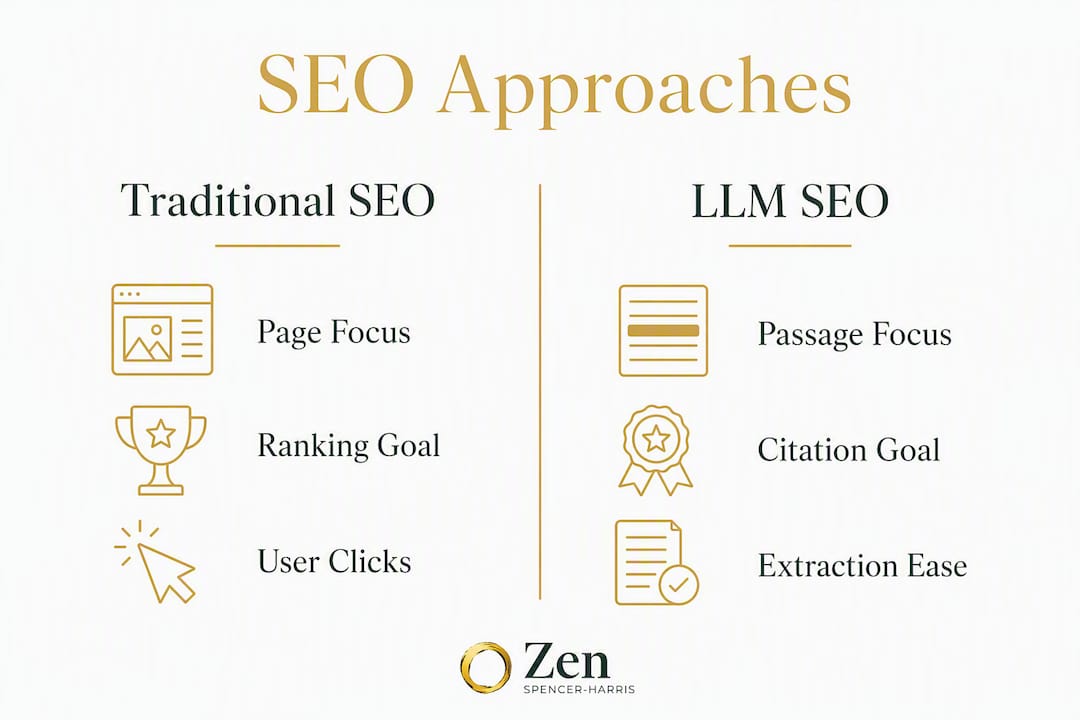
The mechanism behind this shift is entity resolution. LLMs do not retrieve pages the way a crawler does — they resolve who or what a source is, then assess whether that source is trustworthy and extractable enough to cite. Schema markup and named-entity signals are how you tell the model exactly who you are.
Here is what a well-structured 40–60 word answer capsule looks like in practice:
What is LLM SEO? LLM SEO is the practice of optimizing content so large language models extract and cite it inside AI-generated answers. It builds on traditional SEO foundations — crawlability, authority, and relevance — and adds entity signals, structured data, and original research to make content attributable and extractable by AI engines including ChatGPT, Perplexity, Claude, and Google AI Overviews.
LLMs prefer this format because it is self-contained. The model can lift the passage, attribute it to a named source, and insert it into a response without needing surrounding context. That is the entire game.
How do LLMs find, evaluate, and choose sources?
The pipeline runs in four steps: retrieval, scoring, extraction, and generation. Your content has to clear each gate.

Retrieval is where most sites fail silently. If a crawler cannot access your page, or if your answer is buried inside JavaScript that never renders, the model never sees it. Once retrieved, the system scores pages on a combination of signals before deciding which passages to extract and surface in a generated answer.
The practical signals that determine whether a source gets cited:
- Entity clarity: — Is the author, organization, and topic clearly named and consistent across the page and schema?
Per-engine behavior differs enough to matter for tactics. ChatGPT leans on Bing and third-party reference lists, Perplexity favors fresh community content, and Google AI Overviews align closely with organic top-10 results. Claude tends to weight structured, well-attributed content and named-source quotations. That means a single tactic rarely saturates all four engines — you need a platform-aware distribution strategy.
Pages ranking in top organic positions are the primary foundation for AI citations. Most AI citations come from pages that already rank well in classic search — which means your existing SEO investment is not wasted. It is the floor, not the ceiling.
Freshness is a real differentiator. Recently updated content with dateModified in Article schema increases citation likelihood, particularly for queries where recency signals quality. A quarterly refresh cadence on priority pages is the minimum viable maintenance plan.
What technical infrastructure do LLM crawlers actually need?
Schema markup is the highest-leverage starting point, but it only works if the underlying infrastructure lets crawlers reach and render your content. Start here before touching a single line of schema.
Technical prerequisite checklist:
- Allow major LLM crawlers in
robots.txt(GPTBot, ClaudeBot, PerplexityBot, Google-Extended, Bingbot) - Serve answer passages as static HTML — never lock key content inside JavaScript that requires client-side rendering
- Set canonical tags on every page to prevent duplicate-content confusion during entity resolution
- Submit an XML sitemap to both Google Search Console and Bing Webmaster Tools, and keep it current
- Verify
dateModifiedis accurate and updates automatically on content refreshes - Check page speed — slow pages get deprioritized at the retrieval stage
Schema priority order:
| Schema Type | What it signals | Where to implement |
|---|---|---|
| Article | Content type, author, datePublished, dateModified | Every editorial and blog page |
| FAQPage | Structured Q&A extractable as standalone answers | FAQ sections, pillar pages |
| Person | Author identity with sameAs links to external profiles | Author bio pages |
| Organization | Brand entity, logo, contact, sameAs | Homepage, About page |
| BreadcrumbList | Site hierarchy and topical context | All pages |
| HowTo | Step-by-step processes | Tutorial and guide pages |
Implement schema at the template level inside your CMS or framework. If you are on Next.js, inject JSON-LD in the <head> via a shared layout component so every new page inherits the correct markup automatically. Manual page-by-page schema is not scalable and creates inconsistency that undermines entity resolution.
Pro Tip: After deploying schema, validate every template type using the schema.org validator and Google's Rich Results Test before pushing to production. A single malformed property on a template can silently break schema across hundreds of pages.
llms.txt is a low-cost complement worth adding at the domain root. Some LLM providers read it as a site-level index of your most important pages. It does not replace page-level schema, but it costs almost nothing to implement and signals that your site is LLM-aware.
One often-overlooked issue: cookie consent banners that block rendering before a user interaction can prevent LLM crawlers from seeing page content. If your consent management platform gates content behind a JavaScript wall, review how it affects crawler access before assuming your pages are fully indexed.
What content formats give you the best chance of being cited?
Structure is what separates content that gets extracted from content that gets ignored. LLMs are pattern-matching systems — they are far more likely to pull a passage that is already formatted as a complete, self-contained answer.
High-extractability formats:
- 40–60 word answer capsules placed at the top of each major section, phrased to answer a likely AI prompt
- Question-led H2 headings that mirror how users phrase prompts to ChatGPT or Perplexity
- Explicit definitions at the start of concept sections ("X is the practice of...")
- Numbered steps for processes — models extract ordered lists reliably
- Tables with clear column headers that make comparisons self-explanatory
- TL;DR summaries at the top of long-form content
- Embedded FAQ blocks inside the body, not only at the bottom
Princeton's GEO research (Aggarwal et al., KDD 2024) validated that adding quotations, statistics, and inline source citations materially increases a passage's chance of being extracted and cited — with key tactics producing measurable lift in citation likelihood. Named-source quotations and attributed statistics are among the single highest-leverage edits you can make to a priority page.
Sample TL;DR block structure:
**TL;DR:** [Topic] is [one-sentence definition]. The three things that matter most are [A], [B], and [C].
If you only do one thing, [single highest-impact action].
Sample FAQ markup:
## Frequently Asked Questions

### What does [topic] mean for [audience]?
[40–60 word answer phrased as a complete, standalone response. Cite a named source or statistic where possible.]

### How long does [process] take?
[Direct answer in the first sentence. Supporting detail in sentence two.]
Phrase every FAQ question the way a user would type it into ChatGPT or Perplexity. "What is the best way to..." outperforms "Overview of..." every time.
| Format | Extractability | Best placement |
|---|---|---|
| 40–60 word answer capsule | Very high | Top of each H2 section |
| Question-led H2 | High | Major section headings |
| FAQ block (in-body) | Very high | After key concept sections |
| Numbered steps | High | Process and how-to content |
| Data table | High | Comparison and spec sections |
| TL;DR summary | High | Article opening |
| Long narrative paragraphs | Low | Supporting context only |
Author attribution matters more than most marketers realize. A Person schema with a populated sameAs array — linking to three or more independent, verifiable external profiles like LinkedIn, a professional directory, or a published interview — tells the model that the author is a real, resolvable entity. That confidence in the author's identity increases the model's confidence in the content.
How do you earn the external citations that make LLMs trust you?
A page can be perfectly structured and still get ignored if no external sources reference it. LLMs use third-party mentions as a trust signal, the same way PageRank used links — but the signals now include unlinked brand mentions, community discussions, and reference-site appearances.
Practical citation-earning tactics, sequenced by impact:
- Publish a proprietary dataset or original survey. Pages with original data are cited substantially more often because they contain facts the model must attribute to a single source. One well-promoted dataset can generate citations across dozens of AI responses.
- Run targeted digital PR. Pitch findings from your original data to industry publications, newsletters, and journalists. A single placement in an authoritative outlet creates a third-party reference that multiple AI engines can resolve.
- Earn spots on industry listicles and reference pages. ChatGPT and Claude frequently pull from "best of" and "top tools" lists. Getting listed on three to five authoritative reference pages in your category is often more valuable than a dozen generic backlinks.
- Participate in community platforms. Perplexity weights fresh community content heavily. Thoughtful, attributed answers on Reddit, Quora, and niche forums — where your brand is named — create the kind of community signal Perplexity's retrieval system favors.
- Secure guest research placements. Contributing original analysis to a respected publication puts your brand name next to authoritative content that AI engines already trust.
- Build unlinked brand mentions. Even without a hyperlink, a brand mention in a credible publication contributes to entity resolution. Healthcare reputation management and consistent brand presence across directories, review platforms, and professional associations all feed this signal.
Asset types by citation value:
| Asset type | Citation value | Primary engine benefit |
|---|---|---|
| Proprietary dataset / survey | Very high | All engines |
| Original benchmark report | High | ChatGPT, Claude, Google AI Overviews |
| Interactive calculator / tool | High | Perplexity, ChatGPT |
| Exclusive expert interview | Medium-high | Claude, Google AI Overviews |
| Industry listicle placement | Medium-high | ChatGPT, Claude |
| Community forum answers | Medium | Perplexity |
| Guest article (no original data) | Medium | Google AI Overviews |
The sequencing matters. Publish the unique data first, then amplify it through PR and community channels, then secure third-party references. That sequence gives AI engines a chain of evidence: original source, third-party confirmation, community discussion. Each link in that chain makes your entity easier to resolve and your content easier to cite.

Per-engine retrieval preferences mean you should not treat all four engines identically. For Google AI Overviews, organic ranking is still the primary lever. For Perplexity, freshness and community presence matter more. For ChatGPT, reference-site placements and Bing-indexed authority content carry the most weight.
How do you measure LLM visibility and Share of Model?
Organic rank tells you nothing about whether ChatGPT recommends you. You need a separate measurement layer built specifically for AI-driven visibility.
Core LLM KPIs:
- Citation rate: How often your brand or content is mentioned across a defined set of AI prompts in your category
- Share of Model: Your brand's share of total mentions across AI-generated responses, compared to the category
- Recommendation rank: Whether your brand appears first, second, or third in a ranked AI recommendation
- AI referral conversions: Sessions and conversions attributed to traffic from AI platforms (visible in GA4 as referrals from chat.openai.com, perplexity.ai, claude.ai, etc.)
- Downstream conversion quality: Whether AI-referred visitors book appointments, request quotes, or convert at a higher rate than organic visitors
AI-referred visitors convert at materially higher rates than traditional search referrals in multiple practitioner reports. That conversion differential is the business case for investing in LLM visibility — and it is the metric that gets executive buy-in.
Measurement instrumentation:
| KPI | How to capture it | Validation method |
|---|---|---|
| Citation rate | Manual prompt sampling across ChatGPT, Perplexity, Claude, Google AI Overviews | Run 20 prompts per category per month; log brand mentions |
| Share of Model | Brand mentions ÷ total brand mentions in category across sampled responses | Normalize by prompt count; track trend over 90 days |
| Recommendation rank | Position of brand mention within AI response | Log first/second/third position per prompt |
| AI referral conversions | GA4 referral source tracking (chat.openai.com, perplexity.ai, etc.) | Cross-reference with CRM for downstream conversion quality |
| Closed-session mentions | LLM-driven log parsing (Claude Code or equivalent workflow) | Parse exported conversation logs for brand name variants |
Traditional web analytics cannot see inside closed AI chat sessions. Use LLM-driven analytics workflows — running a model like Claude against exported conversation logs or support transcripts — to detect brand mentions that never generate a trackable click. This is where Share of Model measurement gets its real depth.
Pro Tip: Run your prompt sampling at consistent intervals (every two weeks minimum) and use the same prompt set each time. Variation in prompts is the single biggest source of noise in Share of Model tracking.
For statistical confidence, sample at least 20 prompts per topic cluster per engine before drawing conclusions. Smaller samples produce too much variance to detect real movement.
What does a 30/60/90-day implementation plan look like?
Prioritize by impact-to-effort ratio. Technical fixes and schema rollouts come first because they unlock everything else. Content retrofits and original-data launches follow. PR amplification is the final phase.
30/60/90-day implementation plan:
| Phase | Tasks | Acceptance criteria | Priority pages |
|---|---|---|---|
| Day 1–30 | Audit robots.txt for LLM crawlers; fix JS rendering issues; deploy Article + FAQPage + Person schema on templates; submit updated sitemap to Google Search Console and Bing Webmaster Tools; add llms.txt at domain root | Schema validated (zero errors in Rich Results Test); all LLM crawlers allowed; sitemap submitted and indexed | Money pages, pillar pages, author bio pages |
| Day 30–60 | Retrofit top 10 pages with 40–60 word answer capsules; add question-led H2s; embed FAQ blocks in-body; add dateModified to all priority pages; add Person schema with sameAs array to all author pages | FAQ blocks present on all pillar pages; answer capsules added to top 10 pages; author schema validated | Pillar pages, FAQ/how-to pages, top organic landing pages |
| Day 60–90 | Publish one original dataset or survey; run digital PR campaign; secure three to five listicle placements; launch community participation on Perplexity-favored platforms; begin monthly prompt-sampling for Share of Model | Original data published and indexed; at least two third-party references secured; Share of Model baseline established | All priority pages; new original-data asset |
Start the 90-day AI visibility program with the technical audit — it takes one sprint and unlocks every subsequent phase. Without crawlability and schema, content and PR work cannot reach their full citation potential.
The pages to prioritize first are money pages (where conversions happen), pillar pages (where topical authority lives), and FAQ/how-to pages (where extractable answer formats are most natural). Template-level schema rollouts let you cover all three categories in a single deployment.
Which tools help you validate schema, check extractability, and track citations?
You do not need a large tool stack. A handful of well-chosen validators and monitors cover the full workflow.
- schema.org validator: Paste any page URL or JSON-LD snippet to check for errors and warnings before deployment
- Google Rich Results Test: Confirms which rich result types your schema qualifies for and flags critical errors
- Google Search Console: Monitors indexing status, crawl errors, and Core Web Vitals — the baseline health signals that affect retrieval
- Bing Webmaster Tools: Validates Bing indexing and crawl access, which directly affects ChatGPT's retrieval since ChatGPT uses Bing as a primary index
- Perplexity.ai (manual sampling): Run category prompts directly in Perplexity to check whether your brand appears in responses and at what position
- ChatGPT (manual sampling): Same approach — run 20–30 prompts per topic cluster and log brand mentions
- Claude (manual sampling): Claude's responses tend to be more structured; use it to test whether your answer capsules are being extracted verbatim
- GA4 referral source tracking: Filter for chat.openai.com, perplexity.ai, claude.ai, and gemini.google.com to capture AI-driven referral traffic
- Web mention monitors (e.g., Google Alerts, Brand24): Track unlinked brand mentions across the web to measure third-party citation growth
Quick extractability check (no special tools required):
- Open the page in a browser and select the target answer passage
- Paste it into ChatGPT or Claude with the prompt: "Is this a complete, standalone answer to [target question]?"
- If the model says yes and can repeat it accurately, the passage is extractable
- Run the page URL through the schema.org validator to confirm markup is error-free
- Check that
dateModifiedreflects the actual last-edit date
E-E-A-T in practice: what AI Share of Voice gains look like for a specialty healthcare client
A specialty behavioral health practice came to Zensweb with a clear problem: qualified patients were finding competitors through ChatGPT and Google AI Overviews, but the practice was invisible in both. The objective was to increase AI citations and convert that visibility into booked appointments within 90 days.
Methodology:
- Deployed Article, FAQPage, Organization, and Person schema across all service pages and the provider bio page, with a
sameAsarray linking to three verified external profiles - Retrofitted the top eight service pages with 40–60 word answer capsules and question-led H2 headings
- Published one original patient-outcome summary (anonymized per HIPAA guidelines) as a citable data asset
- Ran a targeted digital PR campaign securing placements on two behavioral health reference sites
- Established a monthly prompt-sampling workflow across ChatGPT, Perplexity, and Google AI Overviews to track Share of Model
Before the engagement, the practice had zero measurable presence in AI-generated answers for their primary service categories. After 90 days of schema deployment, content retrofits, and PR amplification, they appeared in AI-generated responses for their core service queries and saw a meaningful increase in appointment bookings attributed to AI referral traffic — with AI-referred visitors converting at a noticeably higher rate than organic search visitors.
The most important lesson from this engagement: schema and content structure alone were not enough. The third-party reference placements were what pushed the practice from "occasionally mentioned" to "consistently named." LLMs need external confirmation to trust a source, and two authoritative placements were enough to shift the model's confidence.
Claude-specific tactics for healthcare played a meaningful role here — Claude's preference for well-attributed, structured content made the answer capsule retrofits particularly effective on that engine.
Key Takeaways
LLM SEO requires entity clarity, schema markup, and original data working together — without all three, even well-ranked pages get passed over for AI citations.
| Point | Details |
|---|---|
| Schema is the foundation | Deploy Article, FAQPage, Person, and Organization schema at the template level before any content work. |
| Answer capsules drive extraction | Write 40–60 word standalone answer passages at the top of each major section, phrased as AI prompt responses. |
| Original data earns citations | Publish at least one proprietary dataset or survey; pages with unique facts are cited substantially more often. |
| Measure Share of Model, not just rank | Sample 20 prompts per topic cluster monthly across ChatGPT, Perplexity, Claude, and Google AI Overviews. |
| Zensweb delivers this in 90 days | Zensweb's performance-based AI Share of Voice program covers schema rollout, content retrofits, PR amplification, and measurement for specialty healthcare practices. |
What most LLM SEO advice gets wrong
The most common mistake is treating LLM SEO as a content volume play. Marketers publish fifty "AI-optimized" articles in a month, none of which contain original data, none of which have been cited by a single external source, and then wonder why their Share of Model does not move. Volume without attribution is invisible.
The second mistake is ignoring the measurement layer entirely. You cannot optimize what you cannot see. Most teams spend 90% of their effort on content and 0% on prompt sampling, which means they have no idea whether any of it is working. Share of Model is not a vanity metric — it is the leading indicator for AI-driven patient acquisition, and it needs a real tracking cadence.
There is also a persistent myth that training-data manipulation — publishing content specifically designed to influence future model training — is a viable LLM SEO tactic. It is not. Models are retrained on timelines you cannot predict or control, and the retrieval-augmented generation systems that power real-time AI search do not use training data for live responses. They retrieve from the live web. That means the same signals that have always mattered — authority, structure, freshness, and third-party confirmation — are what actually move the needle.
The forward-looking reality is that LLM SEO and traditional SEO are converging, not diverging. The practices that make content citable by AI engines — entity clarity, original research, authoritative third-party mentions, and clean technical infrastructure — are the same practices that build durable organic authority. Treat them as one integrated visibility strategy, not two separate workstreams.
Zensweb gets specialty healthcare practices cited in AI search
Specialty healthcare practices that are invisible in ChatGPT, Perplexity, and Google AI Overviews are losing qualified patients to competitors who show up as the named answer. Zensweb's AI Share of Voice program delivers measurable citation presence across all four major AI engines within 90 days — or you do not pay.
The program covers the full stack: schema and technical infrastructure rollout, answer capsule content retrofits, original-data asset production, digital PR amplification, and a monthly Share of Model measurement workflow. Every engagement is performance-based, tied to booked appointments and verifiable AI citation gains — not hours billed or reports delivered.
If you want to know exactly where your practice stands in AI-generated answers today, start with a free healthcare visibility audit. You will leave with a clear picture of your current Share of Model and the three highest-impact fixes to pursue first.
Useful sources and further reading
| Source | Type | Best for |
|---|---|---|
| Forget What You Know About Search. Optimize Your Brand for LLMs. | Strategic reading | Executive-level framing of the LLM SEO shift |
| schema.org | Technical validation | Schema type reference and validator |
| LLM SEO: The Guide to Ranking in AI Search Engines | Strategic reading | Practitioner overview of ranking signals and tactics |
| LLM SEO: How Search Optimization Changes for AI | Strategic reading | Detailed breakdown of how AI-driven search differs from classic search |
| TurboAudit LLM SEO playbook | Research summary | Princeton GEO findings and evidence-backed content tactics |
| Search Engine Land — What is LLMO? | Strategic reading | Per-engine retrieval behavior and platform-specific tactics |
| Ritner Digital — LLM SEO complete guide | Practitioner guide | Original data as citation magnet; organic rank as AI citation foundation |
| Nadia Mohamed — LLM SEO practitioner guide | Practitioner guide | Freshness signals, dateModified implementation, and AI referral conversion data |
| Zensweb AI visibility program | Service page | 90-day AI Share of Voice program for specialty healthcare practices |
| Zensweb SEO services | Service page | Performance-based SEO foundations that LLM SEO builds upon |
This article is general information for digital marketers and SEO professionals. For healthcare-specific compliance questions — particularly around patient data and HIPAA in content production — consult a qualified legal or compliance professional and verify current regulations with the relevant primary authority.