

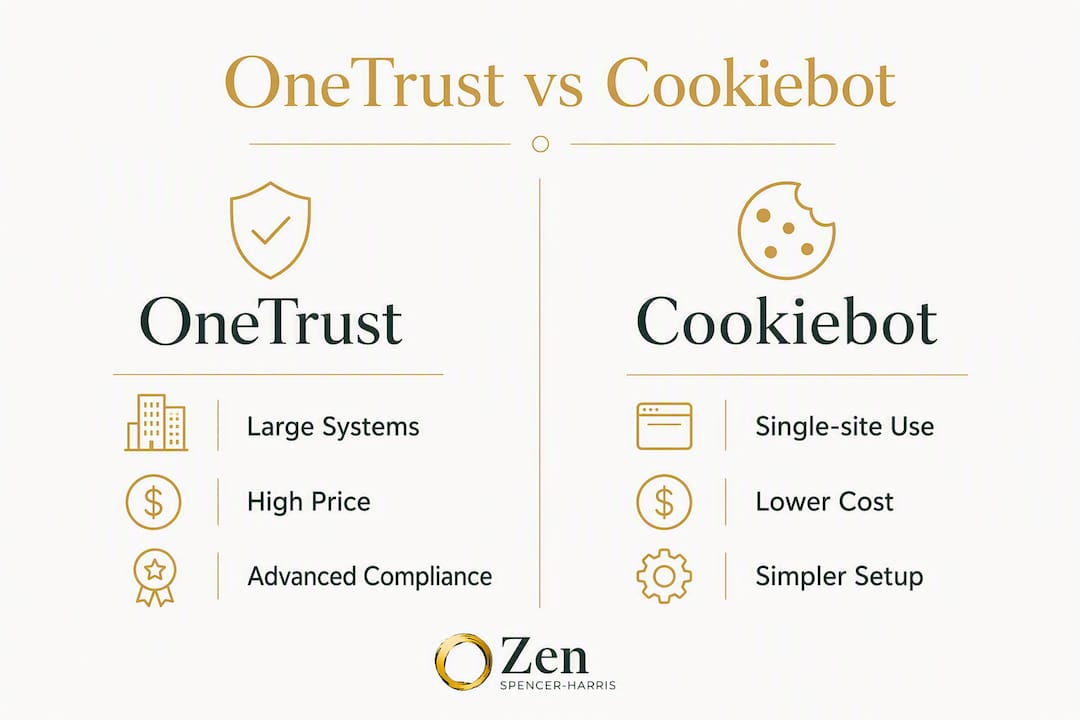
Choose OneTrust for large, multi-jurisdiction healthcare systems with mature privacy programs and dedicated privacy teams; starting investment often exceeds $10,000/year and typically takes weeks to months to deploy. Choose Cookiebot for single-site specialty clinics and smaller practices that need fast, low-cost cookie consent (entry plans roughly €7–14/month for small domains) with EU-native data hosting.
TL;DR: Your decision hinges on privacy-program maturity, not feature lists. OneTrust starts with a high entry cost and takes weeks to deploy. Cookiebot entry plans have low monthly fees and deploy quickly. A third gap exists: mid-market practices often fall between both tools.
- Pick OneTrust if you operate across multiple states or jurisdictions, need DSAR automation, data mapping (ROPA), or vendor risk modules, and have a privacy team to run them.
- Pick Cookiebot if you run one or two sites, need GDPR-oriented consent banners quickly, and want EU data residency without transfer impact assessments.
Table of Contents
- OneTrust vs Cookiebot: side-by-side for U.S. healthcare practices
- How each platform handles healthcare compliance
- Consent banner UX and what it means for patient acquisition
- Customization options for healthcare branding
- Zensweb helps specialty practices get compliance and patient growth right
- Key Takeaways
OneTrust vs Cookiebot: side-by-side for U.S. healthcare practices
| Dimension | OneTrust | Cookiebot |
|---|---|---|
| Best for | Large systems, multi-jurisdiction, mature privacy teams | Single-site clinics, small practices, EU deployments |
| Core features | Full privacy ops: DSAR, ROPA, vendor risk, CMP | Consent-only: auto-scan, auto-blocking, consent log |
| Pricing / entry cost | Starting investment often exceeds $10,000/year; real year-one cost often rises considerably with implementation services | Entry-level plans roughly €7–14/month for small domains; typical fees vary by domain count |
| Data residency | U.S.-headquartered; requires DPA + transfer impact assessment | Denmark-based; EU/EEA hosting by default, no transfer assessment needed |
| Integrations | SSO, SCIM, API, 100+ privacy laws, Google Consent Mode V2 | Google Consent Mode V2, WordPress, Shopify app, 44 languages |
| Deployment time | Deployment usually requires professional services over a period of time | Self-service deployment can be completed rapidly |
| Support & SLAs | Dedicated CSM, SLA tiers, enterprise contracts | Email and knowledge base; no live chat or dedicated account manager |
| Scalability | RBAC, SCIM provisioning, multi-domain, multiple sites | Limited RBAC; no SCIM provisioning; single-domain pricing compounds fast |
OneTrust in practice: Expect a multi-month sales cycle, a 12-month minimum contract, and implementation services that often double the headline price. The breadth is genuine — DSAR workflows, data mapping, and vendor risk all live in one platform — but mid-market practices frequently pay for modules they never open.
Cookiebot in practice: Setup is genuinely fast. The billing risk is less obvious. Cookiebot's scanner runs monthly and auto-upgrades plans based on detected subpage counts, including hidden technical pages most teams don't know exist. A content-rich practice site can trigger an unexpected tier jump with no manual override.
Vendor questions to ask before signing either contract:
- How does your platform handle HIPAA-covered data in consent logs?
- Can you export all consent records and DSAR data if we migrate?
- What triggers a billing tier upgrade, and can we cap it?
- How often does your scanner run, and can we trigger ad-hoc scans?
- What is your SLA response time for a compliance incident?
- Do you offer role-based access control and audit trails for our privacy team?
Year-one cost model (entry scenario):
| Scenario | OneTrust | Cookiebot |
|---|---|---|
| Entry price | Starting investment often exceeds $10,000/year | Entry-level plans roughly €7–14/month for small domains |
| Implementation estimate | Substantial professional services fees may apply | Minimal; self-serve |
| Year-one realistic total | Year-one total costs can be significant | Year-one costs vary depending on site size and usage |
How each platform handles healthcare compliance
Neither OneTrust nor Cookiebot is a HIPAA Business Associate by default. HIPAA compliance depends on your configuration, your BAA negotiation, and what data flows through the consent layer. OneTrust supports BAA execution and has documented processes for HIPAA-relevant implementations; Cookiebot's EU-native architecture means consent data stays off U.S. servers, which reduces one category of transfer risk but does not substitute for a BAA.
For Schrems II, the gap is material. Cookiebot operates natively under GDPR with no U.S. CLOUD Act exposure. OneTrust, as a U.S.-headquartered provider, requires a Data Processing Agreement plus a transfer impact assessment for EU patient data. Practices with EU-resident patients or strict data-residency requirements carry real legal overhead with OneTrust that Cookiebot eliminates by design.
Consent banner UX and what it means for patient acquisition
A consent banner is often the first interaction a prospective patient has with your site. Friction at that moment costs you measurement data and potentially the appointment. Both platforms are Google Consent Mode V2 certified, so the technical integration is available on either side. What differs is execution quality.
OneTrust offers A/B testing for banner design and advanced consent-rate analytics, which matters when you're optimizing across high-traffic patient acquisition campaigns. Cookiebot's auto-blocking engine fires before consent is given, which protects compliance but requires careful configuration to avoid breaking your analytics or call-tracking stack. For practices running call-tracking attribution, a misconfigured banner can silently drop conversion data for weeks before anyone notices.
Accessibility matters in healthcare. Cookiebot supports 44 languages and passes standard WCAG contrast requirements. OneTrust supports 100+ languages and offers more granular accessibility configuration for large systems serving diverse patient populations.
Customization options for healthcare branding
Cookiebot's banner editor covers the basics well: logo, color palette, button styling, and custom text. For a single-site specialty clinic, that is enough to match your patient-facing brand without developer involvement. The WordPress plugin handles most configurations without touching code.

OneTrust's customization depth is in a different category. You can build geo-specific banner variants, configure jurisdiction-specific opt-in versus opt-out logic, and run A/B tests on banner copy and layout. For a multi-location healthcare group running separate campaigns per market, that granularity is operationally valuable. It also requires someone on your team who knows how to use it.
Zensweb helps specialty practices get compliance and patient growth right
Privacy tooling and patient acquisition are not separate problems. A poorly configured consent banner breaks your Google Analytics, corrupts your ad attribution, and quietly deflates the ROI on every campaign you run.
Zensweb works with specialty healthcare practices on a performance-based model: you pay when qualified patients book, not when a platform goes live. That includes helping practices choose and configure the right CMP for their size, connect it properly to Google Consent Mode V2, and make sure measurement is intact before a single ad dollar is spent. If you're running behavioral health, psychiatry, or multi-site specialty services, the compliance layer is part of the acquisition infrastructure, not an afterthought.
Pro Tip: Before you sign any CMP contract, run a test consent interaction on your own site and check whether your Google Analytics 4 session count drops. If it does, your current setup is already breaking measurement, and the new tool needs to fix that before anything else.
Start with a free healthcare audit to see exactly where your consent configuration, measurement stack, and patient acquisition funnel stand today.
Key Takeaways
OneTrust fits large, multi-jurisdiction healthcare systems with mature privacy programs; Cookiebot fits single-site specialty clinics that need fast, low-cost cookie consent with EU-native data residency.
| Point | Details |
|---|---|
| Decision axis | Privacy-program maturity determines fit more than any individual feature. |
| OneTrust cost | Entry investment often exceeds $10,000/year, and year-one total costs can be significant with implementation services. |
| Cookiebot billing risk | Monthly auto-scans can trigger automatic tier upgrades based on subpage counts, creating unexpected cost spikes. |
| Data residency | Cookiebot's Denmark-based hosting eliminates Schrems II transfer assessments; OneTrust requires a DPA and transfer impact assessment for EU data. |
| Zensweb approach | Zensweb pairs CMP configuration with performance-based patient acquisition so measurement stays intact from day one. |