

The highest-impact patient acquisition programs combine local visibility, referral systems, and a measurement-first PAC-to-LTV framework, in that order of priority. Three levers drive most of the booked appointments a practice will see this quarter: a fully optimized Google Business Profile, a referral system with same-day follow-up, and self-scheduling that removes friction between "interested" and "on the calendar."
Here's where to start:
- Claim and complete your Google Business Profile, then add service-specific posts weekly.
- Call every incoming referral within one business hour, not one business day.
- Turn on online self-scheduling for at least your three highest-volume services.
Your one-line 90-day plan: audit your digital front door in week one, fix the two biggest friction points by week four, then scale whatever converts by day 90.
Pro Tip: Most programs don't lose patients to bad marketing. They lose them in the handover, the gap between a form submission and a human response. Timestamp every inquiry and measure time-to-first-response weekly; if it's over two hours, you're bleeding bookings you already paid to generate.
Key Takeaways
Booked appointments, not leads or clicks, are the only metric that proves a patient acquisition program is actually working.
| Point | Details |
|---|---|
| Fix the handover first | Timestamp every inquiry and respond within two hours to stop losing already-paid-for leads. |
| Sequence, don't scatter | Build digital foundation first, referrals second, paid media third, to protect your PAC-to-LTV ratio. |
| Track PAC-to-LTV, not CPL | Measure cost against lifetime patient value, not raw lead volume, for durable ROI. |
| Segment before you spend | Match messaging to intent stage, referral source, and life stage rather than treating all prospects alike. |
| Consider a performance partner | Zensweb ties payment to booked appointments and AI visibility gains rather than hours or ad spend managed. |
Table of Contents
- What Is Patient Acquisition, and How Is It Different From Retention?
- Which Patient Acquisition Strategies Should You Run First?
- How Do You Launch a Patient Acquisition Program in 90 Days?
- What KPIs Prove a Patient Acquisition Program Is Working?
- What Technology Do You Need to Support Acquisition?
- How Do Performance-Based Acquisition Models and AI Visibility Work?
- What Counts as Ethical Marketing in Healthcare?
- How Should You Segment and Target Prospective Patients?
- How Does Acquisition Fit Into Overall Practice Growth?
- How Are Data and AI Changing Patient Acquisition?
- How Long Does It Take to See Results, and What Should You Budget?
- What Legal and Privacy Rules Apply to Patient Acquisition?
- What Do the Most Common Program Failures Look Like?
- How Can a Performance-Based Partner Accelerate Your Results?
- Frequently Asked Questions
- Sources
What Is Patient Acquisition, and How Is It Different From Retention?
Patient acquisition is the process of converting a stranger who doesn't know your practice exists into a person sitting in your waiting room. Retention is everything that happens after that first visit to keep them coming back. Confusing the two is how practices end up celebrating "leads" while their schedule stays half empty. The metric that matters isn't inquiries or clicks. It's booked appointments, because measuring acquisition by booked outcomes rather than raw lead volume produces more durable ROI and stops budget from leaking into low-quality lead sources.
The two functions behave differently on paper:
- Cost structure: Acquisition typically costs three to five times more per patient than retention, since you're paying to interrupt someone's day versus reminding an existing patient to rebook.
- Timeline: Acquisition results show up in weeks to months; retention compounds over years through lifetime value.
- Core metric: Acquisition lives or dies on patient acquisition cost, or PAC. Retention lives on lifetime value, or LTV. The ratio between them, PAC-to-LTV, tells you whether your growth is actually profitable or just busy.
- Contact frequency: Acquisition needs one strong conversion moment. Retention needs recurring, lower-effort touchpoints (reminders, check-ins, referral asks).
Track both, but budget acquisition dollars against the PAC-to-LTV ratio, not against cost-per-click alone.
Which Patient Acquisition Strategies Should You Run First?
Not every channel deserves equal budget or attention in month one. Rank tactics by how fast they turn into booked appointments and how much friction stands between discovery and the calendar.
-
Google Business Profile and local SEO. This is usually the fastest lever available, and it costs nothing but time. What it delivers: visibility in the map pack and local search results where most patients start looking. Implementation checklist: verify your listing, fill every field including services and hours, upload real photos monthly, and respond to every review within 48 hours. Measurement signal: track "calls" and "direction requests" inside your profile insights, and watch for a lift in branded search volume. Label: quick win. Review velocity and listing quality materially influence organic and paid click-through in local healthcare searches, and where Americans get health information and which sources they trust increasingly points back to search and local listings before it points to a practice's own website.
-
Physician and specialist referrals. What it delivers: your highest-conversion patients, since they arrive pre-qualified by a trusted source. Implementation checklist: build a referral acknowledgement workflow, send visit notes back within 48 hours, and assign one staff member to own the relationship with top referring providers. Measurement signal: referral close rate and time from referral to booked visit. Label: quick win for specialty and behavioral health practices especially, since these organizations often rely heavily on referral networks and benefit disproportionately when referral communications are formalized.
-
Online scheduling and intake automation. What it delivers: removes the single biggest drop-off point, the moment between "I'm interested" and "I have an appointment." Implementation checklist: enable self-scheduling for high-volume services, build a HIPAA-aware intake form, and automate confirmation and reminder messages. Measurement signal: booking completion rate and no-show rate. Label: quick win. Telehealth and digital front-door improvements measurably increase visit completions when properly integrated with intake workflows.
-
Reputation and review systems. What it delivers: social proof that shortens the decision cycle for prospective patients comparing three practices in one search session. Implementation checklist: automate a review request text or email 24 hours post-visit, respond to every review publicly, and never offer incentives that violate platform terms. Measurement signal: review volume per month and average rating trend. Label: scale.
-
Paid search for high-intent terms. What it delivers: patients actively searching for a specific condition or procedure, which converts at a higher rate than broader awareness advertising. Implementation checklist: build service-specific landing pages with an immediate booking link above the fold, use dynamic call tracking on every ad group, and exclude broad match terms that waste spend. Measurement signal: cost per booked appointment, not cost per click. Label: scale.
-
Paid social and creator content. What it delivers: volume, but under real constraints. Health-adjacent categories face restricted targeting on major ad platforms, so creative has to self-select by speaking directly to symptoms or life stages rather than relying on demographic targeting. Implementation checklist: build a steady production cadence of compliant creative, test three to five hooks per month, and route every click to a mobile-optimized booking page. Measurement signal: cost per booked appointment and creative fatigue rate (declining click-through over two to three weeks). Label: long term.
-
Condition-specific content. What it delivers: organic traffic that converts because it answers the exact question a prospective patient typed. Content that answers specific treatment questions and candidacy converts organic searchers into booked appointments at higher rates than generic "about us" pages. Implementation checklist: write one page per condition or procedure, include a booking CTA in the first screen, and add FAQ schema markup. Measurement signal: organic conversion rate by landing page. Label: long term.
-
Community and offline outreach. What it delivers: higher-fit patients. Structured offline events like health fairs and screenings can produce patients with better retention than generic digital acquisition alone. Implementation checklist: partner with a local employer, school, or community center, and always capture contact information with proper consent for follow-up. Measurement signal: attendee-to-booked-patient conversion rate. Label: long term.
Pro Tip: Every service-specific landing page needs three things on the first screen: a clear answer to "is this for me," a visible phone number with call tracking attached, and a booking button that works on a phone thumb. If a prospective patient has to scroll to book, you're losing them to whichever competitor made it easier.
How Do You Launch a Patient Acquisition Program in 90 Days?
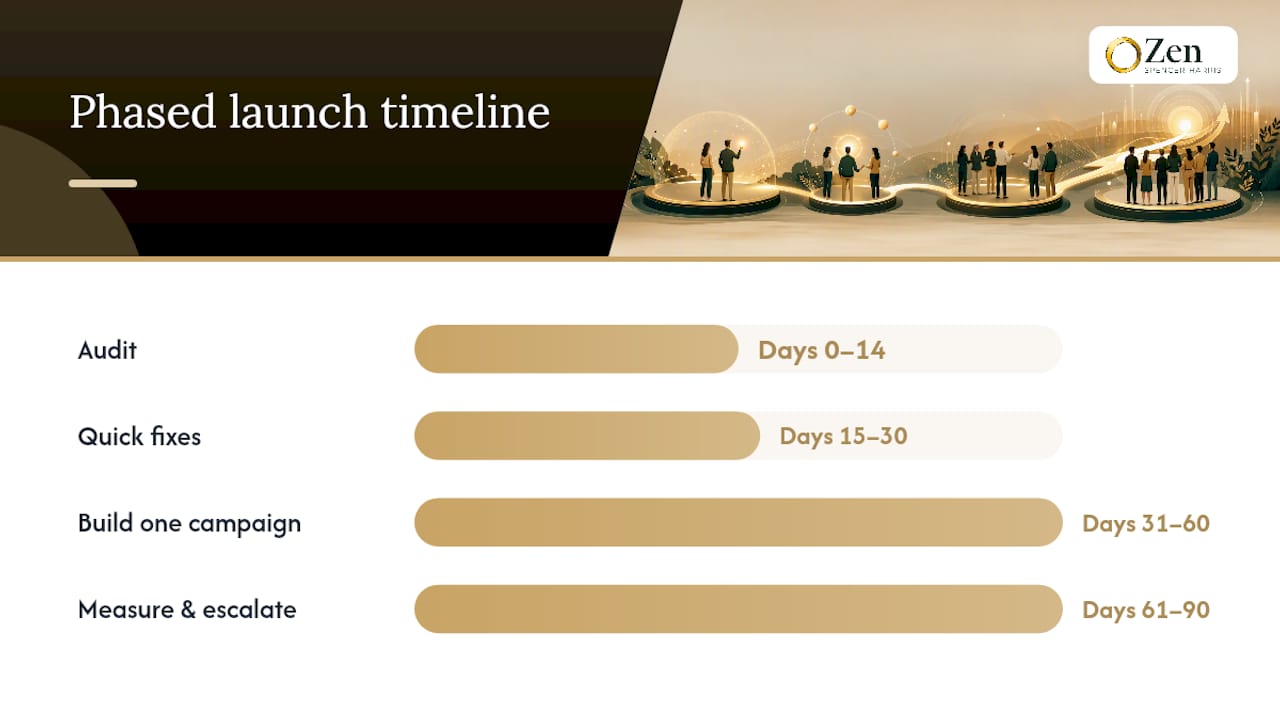
Sequencing matters more than budget size. A phased rollout that builds the digital foundation before spending on ads consistently protects your PAC-to-LTV ratio better than launching every channel at once.
- Days 0 to 14: Audit. Map your "digital front door," meaning your Google Business Profile, website booking flow, and intake forms. Separately, map your referral sources and how (or whether) you're acknowledging them.
- Days 15 to 30: Quick fixes. Complete your GBP listing, turn on self-scheduling for top services, and launch an automated post-visit review request.
- Days 31 to 60: Build one campaign. Pick a single high-intent service line, build a dedicated landing page, and launch paid search with call tracking attached. Resist the urge to launch five campaigns simultaneously.
- Days 61 to 90: Measure and escalate. Set up a weekly dashboard tracking booked appointments by source, PAC by channel, and time-to-first-response. Scale whatever channel is beating your PAC-to-LTV target; pause what isn't.
Assign ownership clearly: one person owns the audit and reporting cadence, one owns intake response time (with a service-level target under two hours), and one owns creative testing and campaign builds. In a small practice, one person may wear all three hats, but the accountability still needs to be explicit.
Budget conservatively at first. A modest monthly spend focused on Google Business Profile management, review automation, and one paid search campaign is enough to see early signals: a measurable uptick in booked-appointment volume by day 45 and directional clarity on PAC by day 90.
What KPIs Prove a Patient Acquisition Program Is Working?
Track outcomes, not activity. Clicks and form fills feel productive but tell you nothing about revenue.
- New patients booked (not leads, not calls, actual appointments on the calendar)
- PAC (patient acquisition cost), calculated per channel, not blended across your entire budget
- PAC-to-LTV ratio, the single number that tells you whether growth is profitable
- Conversion rate, from site visit to booked appointment
- Booking-to-show rate, since a booked appointment that no-shows generates zero revenue
- Referral close rate, tracked separately from digital channels
For attribution, tag every booking with its source at the point of scheduling, not after the fact. Use dynamic call tracking so phone bookings get credited to the right campaign, and timestamp every inquiry so you can calculate time-to-first-response. Operational delays in follow-up correlate with lost bookings, which makes that timestamp one of your highest-value data points.
Run these experiments on a rolling basis:
- A/B test your landing page's headline and CTA placement quarterly.
- Rotate paid social creative every two to three weeks to fight fatigue.
- Test referral follow-up timing (same-day versus next-day acknowledgement) and measure the impact on referral close rate.
Statistic callout: Access to healthcare and how quickly practices respond to inquiries directly affect patient engagement and utilization, which is exactly why response-time tracking belongs on every acquisition dashboard, not just a marketing report.
What Technology Do You Need to Support Acquisition?
Your tech stack should reduce friction and feed clean data back into your PAC calculation. Buy for integration first, features second.
- Online scheduling / self-scheduling: reduces the biggest drop-off point in the funnel.
- Intake and triage forms: should be HIPAA-aware by design, not retrofitted. Tools like HIPAA-compliant intake forms protect patient data while still improving conversion.
- Practice CRM: tracks every patient touchpoint from first inquiry through follow-up visits.
- Call and web tracking: platforms such as CallRail or WhatConverts attribute bookings to the right channel; see our comparison of call-tracking platforms for how they differ on PAC reporting.
- Reputation management: automates review requests and monitors response times across platforms.
- Analytics and reporting: exports data cleanly enough to calculate PAC and PAC-to-LTV without manual spreadsheet work.
Selection checklist, in order of priority:
- Does it comply with HIPAA and support consent-based, privacy-preserving tracking?
- Does it integrate with your existing EHR or calendar system?
- Does it support source tagging so every booking traces back to a channel?
- Can you export data for PAC reporting without a developer?
- What's the vendor's uptime SLA and data portability policy if you switch later?
For appointment booking specifically, independent reviews of scheduling tools for wellness and healthcare practices are worth reading before you commit to a platform, since switching costs after integration can be steep. Integration priorities that matter most: intake timestamping, source attribution at the point of booking, and automated referral acknowledgements, since structured referral communications measurably increase referral conversion and retention.
How Do Performance-Based Acquisition Models and AI Visibility Work?
A performance-based model ties payment to results, typically booked appointments or defined visibility milestones, rather than hours billed or media spend managed. That structure only works when both sides agree on measurement definitions before the engagement starts.
- Pros: aligned incentives, lower financial risk during ramp-up, forces clear KPI definitions upfront.
- Cons: requires real data access and integration on your end; a partner can't measure booked appointments they can't see.
- Minimum requirements: shared access to booking data, call tracking, and enough historical baseline to judge improvement.
Before signing, request a checklist covering measurement definitions (what counts as a "booked appointment"), attribution rules, a defined ramp period, dispute resolution terms, and an early termination clause if data access stalls.
AI visibility, meaning how a practice shows up when someone asks ChatGPT, Claude, or Perplexity a health question, is becoming part of that same visibility conversation alongside traditional Google rankings. Predictive analytics and data-driven segmentation improve targeting for high-probability referrals and high-LTV patients, and the same logic increasingly applies to which practices AI tools recommend.
Zen Spencer-Harris built Zensweb's AI Share of Voice model specifically because practices that were fully invisible on traditional Google rankings were still losing patients to competitors who showed up in AI-generated answers instead.
What Counts as Ethical Marketing in Healthcare?
Ethical marketing in healthcare starts with a simple test: would you be comfortable explaining this tactic to a state medical board? Testimonials must be genuine and, in most states, cannot promise specific outcomes. A patient who says a treatment "changed their life" is fine; a patient claiming a guaranteed cure crosses into deceptive advertising territory that both the FTC and most state licensing boards scrutinize closely.
Avoid manufactured urgency. "Limited spots" or countdown timers that don't reflect real scarcity erode trust the moment a prospective patient notices the same "limited time offer" running for six months straight. Pricing transparency matters too, especially for elective or cash-pay services; vague pricing pushes people toward practices willing to state a number upfront.
Review solicitation has its own ethical line. Asking every patient for a review is fine. Asking only satisfied patients while quietly steering unhappy ones away, sometimes called "review gating," violates most platform policies and increasingly draws regulatory attention.
Referral marketing needs the same scrutiny. Anti-kickback and Stark Law considerations apply to certain referral relationships, particularly when a practice compensates another provider for sending patients. If a referral partnership involves any financial exchange, get legal review before launching it, not after.
The through-line: market the truth persuasively rather than manufacturing a more exciting version of it.
How Should You Segment and Target Prospective Patients?
Not every prospective patient looks the same, and treating them identically wastes budget on messages that don't land. Segment first by intent stage: someone searching "is [procedure] right for me" needs educational content, while someone searching "[procedure] near me" needs a booking link, not an explainer article.
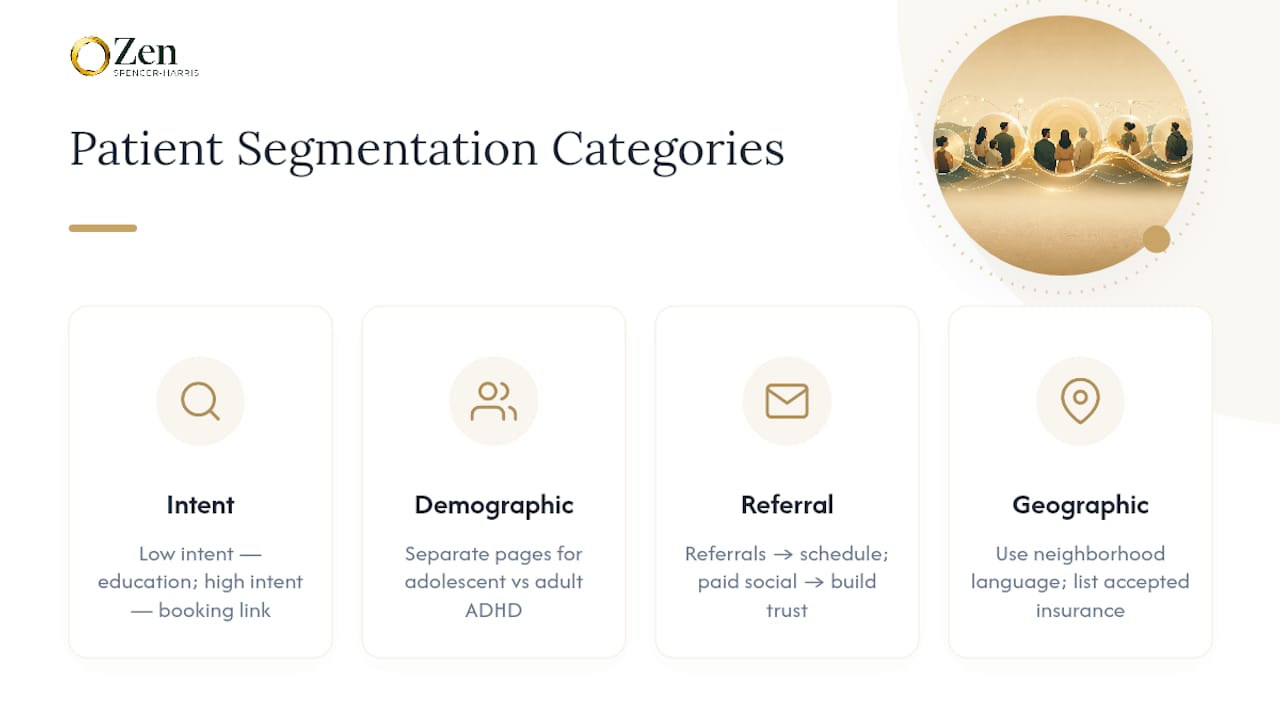
Demographic and condition-based segmentation matters most for specialty and behavioral health practices, where the patient journey differs sharply by age, life stage, or symptom severity. A practice treating both adolescent and adult ADHD, for example, needs entirely separate landing pages and messaging, since a parent searching on behalf of a teenager has different questions than an adult self-diagnosing.
Referral source is its own segment. Patients arriving through a physician referral typically need less persuasion and more scheduling ease, while patients arriving through paid social need more trust-building content before they'll book. Treating both groups with the same landing page usually underperforms for one or the other.
Geographic segmentation still matters even for a single-location practice. Google Business Profile posts and paid search should reflect neighborhood-level language, since reputable local listings increasingly shape where patients decide to seek care. Layer in insurance and payer segments where relevant. A practice that accepts a specific plan should say so explicitly on the landing page for that plan's typical patient population, since burying that information behind a phone call costs bookings.
How Does Acquisition Fit Into Overall Practice Growth?
Treating acquisition and retention as separate departments, each with its own budget and no shared data, is one of the more common structural mistakes practices make. A patient acquired through paid search and a patient retained through a well-run recall program should feed the same dashboard, because the PAC-to-LTV ratio only means something when both halves are visible together.
Practice growth compounds when acquisition informs clinical capacity planning. If a specific service line is converting well through paid search, that's a signal to invest in additional provider capacity for that service, not just more ad spend. Growth also runs the other direction: strong retention data (which conditions bring patients back, which providers generate the most repeat visits) should inform which service lines get the acquisition budget in the first place.
Staff training closes the loop. Front-desk and intake staff are effectively part of the acquisition funnel, since they handle the first live human interaction after a booking. A practice that invests heavily in advertising but trains its front desk poorly will see strong click-through and weak booking-to-show rates, because the breakdown happens after the marketing has already done its job.
Build one integrated view: acquisition channels feed booked appointments, booked appointments feed retention programs, and retention data feeds back into which acquisition channels deserve more budget next quarter.
How Are Data and AI Changing Patient Acquisition?
Predictive analytics is shifting acquisition from "spend and see what happens" toward targeting patients most likely to book and stay. Data-driven segmentation and predictive analytics can improve targeting for high-LTV patients and prioritize high-probability referrals, which means practices can direct budget toward the segments most likely to convert rather than spreading spend evenly and hoping.
AI tools now influence two distinct layers of acquisition. The first is operational: AI-assisted scheduling, intake triage, and follow-up messaging that catch the handover gap before a lead goes cold. The second, newer layer is discovery itself. Patients increasingly ask ChatGPT or Perplexity health questions the way they used to type them into Google, and a practice with no presence in those answers is invisible to a growing slice of prospective patients regardless of how well its website ranks traditionally.
That shift means structured data and schema markup on your website aren't optional technical housekeeping anymore. AI tools pull from structured, well-organized content to generate answers, so a practice's condition pages, provider bios, and service descriptions need the same clarity a human reader expects and the same machine-readable structure an AI model needs to cite it accurately.
The practical takeaway: run predictive segmentation on your existing patient data to find your highest-LTV patterns, then make sure your content and technical setup are visible both to traditional search and to the AI tools an increasing share of patients now consult first.
How Long Does It Take to See Results, and What Should You Budget?
Early signals, not full results, typically show up within 30 to 45 days: a Google Business Profile refresh often lifts calls and direction requests within two to three weeks. Referral acknowledgement changes show up faster, sometimes within days, since it's a process fix rather than a media campaign ramping up.
Paid search usually needs 60 to 90 days to reach a stable cost-per-booked-appointment, since the algorithm needs volume to optimize and your landing page needs real traffic to A/B test meaningfully. Content and organic strategies run longest: condition-specific pages often take three to six months to rank meaningfully, though content that directly answers treatment and candidacy questions tends to convert well once it does start ranking.
Budget conservatively and sequence spend rather than launching everything simultaneously. A phased approach, digital foundation first, referral systems second, paid amplification third, protects your PAC-to-LTV ratio better than an all-channels-at-once launch, since you're not paying to acquire patients through a broken booking flow.
Set expectations internally before you start: a 90-day program should show clear directional data (which channels are converting, what your early PAC looks like) even if full ROI isn't proven yet. Treat the first 90 days as a measurement and calibration period, not a final verdict on whether the program works.
What Legal and Privacy Rules Apply to Patient Acquisition?
HIPAA governs more of your marketing stack than most practice managers initially assume. Any intake form, chatbot, or scheduling tool that collects protected health information needs a business associate agreement with the vendor, and that includes tools you might assume are "just marketing software." A scheduling widget that asks "what are you being seen for" is collecting PHI the moment a patient answers.
Advertising platforms complicate this further. Meta and Google both restrict how healthcare advertisers can use tracking pixels and audience data, partly because of HIPAA and partly because of their own health-category ad policies. Sending PHI to an ad platform through an improperly configured pixel, even accidentally, is a real compliance risk that has resulted in enforcement actions against healthcare organizations in recent years.
Consent matters at every touchpoint. Integrated scheduling and messaging that respects privacy and consent improves conversion, which tells you consent design isn't just a legal checkbox, it's part of the user experience that determines whether someone finishes booking.
Cookie consent and analytics tracking need the same scrutiny, particularly as more states pass their own privacy laws layered on top of HIPAA. Review your website's tracking setup with a consent management platform built for healthcare rather than assuming your general marketing tools are compliant by default. When in doubt on any of this, loop in compliance counsel before launching a new tracking or intake tool, not after a patient complaint surfaces the gap.
What Do the Most Common Program Failures Look Like?
The programs that stall almost always fail in the same three places: a measurement gap that hides which channel is actually working, a slow handover between inquiry and human follow-up, and a creative bottleneck where nobody owns testing new messages. None of these are marketing problems. They're operational ones wearing a marketing costume.
For every new client, I prioritize one thing first: timestamping the gap between inquiry and first response. Fix that, and most of the other problems become visible instead of hidden.
How Can a Performance-Based Partner Accelerate Your Results?
Most practices don't need more marketing tactics. They need someone accountable for turning those tactics into booked appointments, which is the entire premise behind Zensweb's performance-based model: you pay for delivered results, not hours logged or impressions served.
A typical initial engagement starts with the same audit outlined in the 90-day playbook above, then layers in Zensweb's AI Share of Voice work to get your practice visible on ChatGPT, Claude, Perplexity, and Google within 90 days, alongside the technical SEO, reputation building, and local SEO work that fills the gaps most practices don't know they have. One current client engagement documents the visibility and revenue gains from this exact approach; details are available on request as a proprietary case study.
If you want a clear picture of where your practice is losing visibility and bookings before committing to anything, start with a free healthcare visibility audit. It's the fastest way to see which of the levers covered above are already working for you and which ones are quietly costing you patients.
Frequently Asked Questions
What is a patient acquisition program? A patient acquisition program is a coordinated set of marketing, technology, and operational tactics designed to convert prospective patients into booked appointments, measured by patient acquisition cost and PAC-to-LTV rather than by leads alone.
How much should a practice budget for patient acquisition? Budget conservatively at first and sequence spend: fund your digital foundation (Google Business Profile, scheduling, review automation) before allocating meaningfully to paid search or paid social, since a broken booking flow wastes ad spend regardless of budget size.
What's the fastest way to improve patient acquisition results? Fixing your time-to-first-response is usually the fastest, cheapest improvement available, since delayed follow-up directly correlates with lost bookings you've already paid to generate.
Do patient referral programs still work as an acquisition strategy? Yes, and often better than paid channels for specialty practices, since formalized referral communication and acknowledgement measurably increases referral conversion and retention.
How does AI visibility fit into a patient acquisition strategy? AI visibility ensures your practice appears when prospective patients ask tools like ChatGPT or Perplexity health questions directly, a discovery channel that's growing alongside traditional Google search and requires the same structured, well-organized content those platforms pull from.