

For most teams, Semrush is the strongest starting point because it balances AI visibility tracking, content optimization, and workflow integrations in one platform. But the right pick depends on your job-to-be-done: Surfer leads for content scoring and LLM citation optimization, Ahrefs for technical depth and backlink intelligence, SE Ranking for budget-conscious teams that still need AI Overview tracking, Clearscope for content quality at scale, Writesonic for AI-assisted drafting, and Rank Prompt or Perplexity for teams building AEO-first workflows.
- Overall best: Semrush. Covers keyword research, site audit, AI Overview monitoring, and integrates with GA4 and Search Console out of the box.
- Best for content and LLM visibility: Surfer. Positions itself explicitly as an AI visibility platform and scores content against what AI models are likely to cite.
- Best for technical SEO and backlinks: Ahrefs. Unmatched crawl depth and link index freshness.
- Best budget pick with AEO tracking: SE Ranking. Introduced AI Overview trackers that measure your presence in Google's AI-generated answers at a fraction of enterprise pricing.
- Best for enterprise content governance: Clearscope. Consistent scoring across large content teams with strong CMS integrations.
- Best for LLM/AEO workflow: Rank Prompt. Built specifically to optimize prompts and content for LLM citation.
- Best for autonomous drafting: Writesonic. Fast AI content generation with built-in SEO scoring.
Pick one tool that matches your primary constraint (budget, content volume, or AEO visibility), run a 30-day pilot on a single content cluster, and measure LLM citation rate alongside traditional rank movement.
Key Takeaways
The best AI SEO tools in 2026 combine traditional rank tracking with LLM citation monitoring, and teams that measure both metrics consistently outperform those optimizing for rank position alone.
| Point | Details |
|---|---|
| Match tool to primary bottleneck | Choose Surfer for LLM content visibility, Ahrefs for technical depth, SE Ranking for budget AEO tracking, Semrush for all-in-one coverage. |
| Hybrid stacks outperform single suites | Industry testing shows teams using 2–4 specialized tools get better long-term results than those relying on one all-in-one platform. |
| Integration fit beats feature count | Tools that add manual data-wrangling get abandoned within weeks; prioritize CMS and GA4 connectivity before evaluating AI features. |
| Track AI Share of Voice alongside rank | Measure LLM citation rate and AI Overview presence as separate KPIs from traditional rank position to capture the full visibility picture. |
| Zensweb for managed AEO outcomes | Healthcare practices and specialty clinics that prefer expert-managed AI visibility can achieve measurable results through Zensweb's performance-based AI Share of Voice program. |
Table of Contents
- How the best AI SEO tools compare at a glance
- Detailed reviews of the top AI SEO tools for 2026
- How we chose and tested these tools
- How to choose the right AI SEO tool for your team
- Recommended AI SEO stacks by team type
- Why AI Share of Voice predicts outcomes better than rank position alone
- Common mistakes when adopting AI SEO tools
- Updates and future roadmap of each AI SEO tool
- The case for measuring what AI models actually say about you
- Zensweb's AI visibility program for healthcare practices
- Useful sources and further reading
How the best AI SEO tools compare at a glance
| Dimension | Semrush | Ahrefs | Surfer | Clearscope | SE Ranking | Writesonic | Rank Prompt |
|---|---|---|---|---|---|---|---|
| Best for | All-in-one SEO + AEO | Technical SEO + links | Content + LLM visibility | Content governance | Budget AEO tracking | AI drafting | LLM/AEO optimization |
| Core AI capability | AI Overview monitor, content assistant | AI content grader, link scoring | Content scoring, LLM citation optimization | NLP content scoring | AI Overview tracker, rank monitoring | GPT-4 drafting, SEO scoring | Prompt optimization for LLM citation |
| Key features | Keyword research, site audit, AI tracking, GA4 integration | Crawl, backlink index, content explorer | Content editor, SERP analysis, AI visibility score | Content briefs, grading, CMS sync | Rank tracker, AI Overview monitor, site audit | Article writer, brand voice, SEO mode | Prompt builder, citation tracking, brief generation |
| Pricing (starter/mid/enterprise) | $139/$249/custom | $129/$249/custom | $89/$129/custom | $170/$350/custom | $52/$95/custom | $20/$99/custom | Not publicly listed |
| Workflow fit | GA4, Search Console, APIs, CMS plugins | Search Console, APIs | WordPress, Jasper, Google Docs | WordPress, HubSpot, Google Docs | GA4, Search Console | WordPress, Zapier | API, custom integrations |
| Ease of use | Moderate learning curve | Moderate | Low to moderate | Low | Low | Very low | Moderate |
| Data freshness | Daily rank + live AI Overview | Frequent crawl updates | Real-time SERP + LLM signals | Weekly content updates | Daily rank + AI Overview | Real-time generation | LLM signal monitoring |
| Agency / multi-site | Yes, agency plans | Yes, agency plans | Yes, team plans | Yes, team plans | Yes, agency plans | Yes, team plans | Limited |
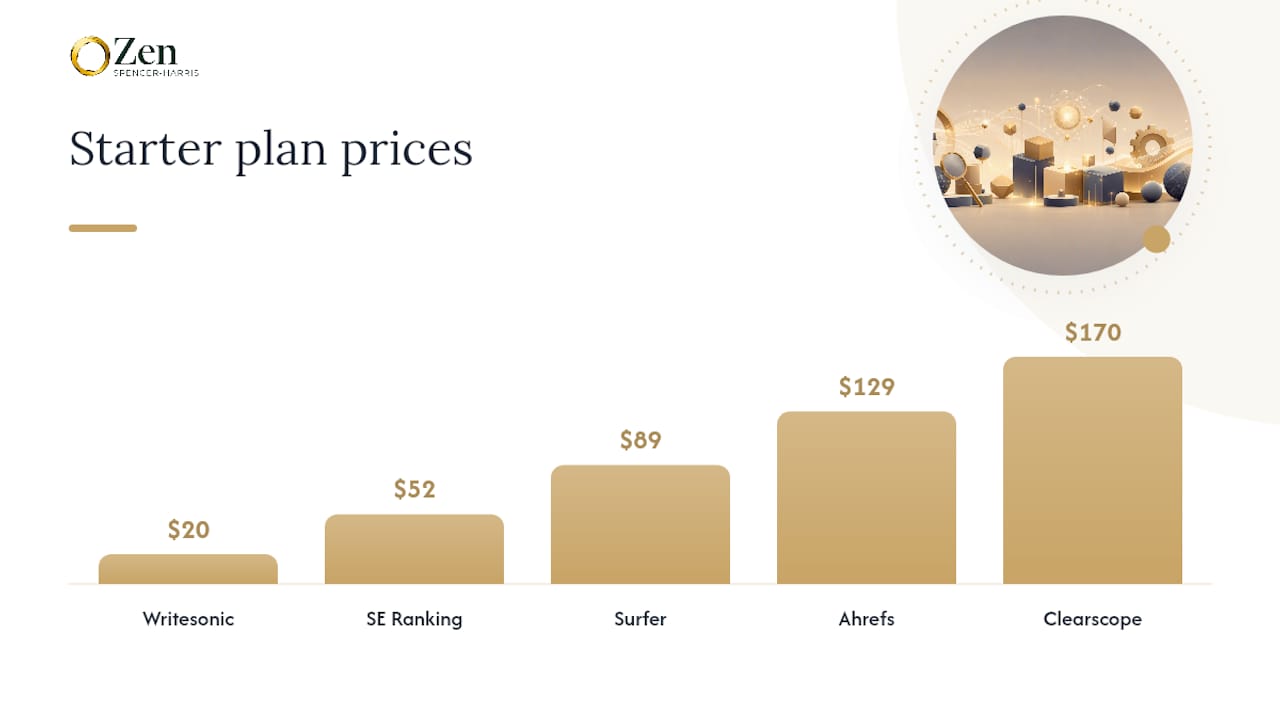
Read the Core AI capability column first. If your primary gap is LLM citation, Surfer and Rank Prompt belong at the top of your trial list. If it is technical crawl coverage, Ahrefs wins. During any trial, test the tool against a real content cluster you own, not a demo dataset, and measure both rank movement and AI Overview appearance within 30 days.
Detailed reviews of the top AI SEO tools for 2026
Semrush
Semrush has evolved well past keyword research. Its AI Overview monitoring now surfaces when your pages appear inside Google's AI-generated answers, and the content assistant generates briefs grounded in live SERP data rather than static templates. The platform's breadth is its biggest advantage and its biggest risk: teams that only use 20% of the features still pay for the full suite.
Key features:
- AI Overview position tracker integrated with standard rank reporting
- Content marketing toolkit with AI brief generation and readability scoring
- Site audit with automated issue prioritization and fix recommendations
Pros: Deep integration with GA4 and Search Console; strong agency workflow with sub-accounts; reliable data freshness. Cons: Expensive at scale; the AI content features lag behind dedicated content tools like Clearscope in scoring precision.
Pricing: Starts at $139/month (Pro), $249/month (Guru), custom Enterprise pricing. Best for: In-house teams and agencies that want one platform covering keyword research, technical audit, and AI Overview monitoring without stitching together multiple tools.
Ahrefs
Ahrefs remains the gold standard for backlink intelligence and crawl depth. Its AI content grader scores pages against top-ranking competitors and flags gaps in topical coverage, but the real edge is the link index: it updates faster than most alternatives and surfaces link opportunities that other tools miss entirely.
Key features:
- AI content grader with topical gap analysis
- Backlink index with freshness scoring and lost-link alerts
- Content Explorer for finding high-citation content in any niche
Pros: Best-in-class backlink data; reliable crawl for large sites; strong API for custom reporting. Cons: LLM/AEO visibility tracking is less developed than Semrush or SE Ranking; no native CMS publishing integration.
Pricing: Starts at $129/month (Lite), $249/month (Standard), custom for Enterprise. Best for: Technical SEO leads and agencies where link acquisition and crawl quality are the primary bottlenecks.
Surfer
Surfer's positioning as an AI visibility platform is not just marketing. Its content editor scores pages against what AI models are likely to cite, not just what ranks on page one. The workflow is tight: you get a brief, write or import content, and the editor scores in real time against NLP signals drawn from live SERP data and LLM citation patterns. Teams that use Surfer consistently report content that performs across both Google and AI Overviews.
Key features:
- Real-time content score tied to LLM citation signals
- SERP analyzer that maps topical coverage gaps
- AI-generated content briefs with semantic keyword clusters
Pros: Best content scoring for LLM visibility; clean editor that integrates with Google Docs and WordPress; fast onboarding. Cons: Limited technical SEO features; no backlink data; requires pairing with a research tool like Ahrefs or Semrush.
Pricing: Starts at $89/month (Essential), $129/month (Scale), custom for Enterprise. Best for: Content teams and in-house marketers whose primary goal is ranking in both Google and AI-generated answers.
Clearscope
Clearscope is the tool content teams trust when consistency across dozens of writers matters more than speed. Its NLP scoring is precise, the CMS integrations (WordPress, HubSpot, Google Docs) are stable, and the grading system gives every writer a clear target. It does not try to do everything, which is exactly why large content operations keep it in the stack.
Key features:
- NLP-driven content grading with term frequency recommendations
- CMS sync for WordPress and HubSpot
- Team reporting that tracks grade distribution across published content
Pros: Reliable scoring consistency; easy for non-technical writers to use; strong team management features. Cons: No keyword research, backlink data, or AI Overview tracking; pricing jumps sharply at higher content volumes.
Pricing: Starts at $170/month (Essentials), $350/month (Business), custom for Enterprise. Best for: Enterprise content teams and agencies managing high-volume publishing where consistent quality scoring is the primary need.
Writesonic
Writesonic sits at the drafting end of the AI SEO stack. It generates full articles, product descriptions, and landing page copy using GPT-4, with a built-in SEO mode that pulls keyword targets and structures content around them. The speed is real: a 1,500-word draft with SEO scoring takes minutes. The quality ceiling is lower than human-edited content, so it works best as a first-draft accelerator, not a publish-and-forget solution.
Key features:
- Article writer with SEO mode and keyword targeting
- Brand voice settings for consistent tone across outputs
- Zapier and WordPress integrations for publishing workflows
Pros: Very fast drafting; low entry price; good for scaling content production on a budget. Cons: Output quality requires human editing before publishing; limited LLM citation optimization compared to Surfer.
Pricing: Starts at $20/month (Individual), $99/month (Teams), custom for Enterprise. Best for: Solo marketers and small teams that need to produce content at volume without a full editorial team.
SE Ranking
SE Ranking punches above its price point. The AI Overview tracker measures how often your pages appear inside Google's AI-generated answers, which most tools at this price tier simply do not offer. The rank tracker is reliable, the site audit covers the technical basics, and the agency features (white-label reporting, multi-site management) are genuinely usable at the $95/month tier.
Key features:
- AI Overview position tracker alongside standard rank monitoring
- Site audit with automated issue detection
- White-label reporting for agencies
Pros: Best price-to-AEO-feature ratio on the market; clean interface; strong agency reporting. Cons: Backlink index is smaller than Ahrefs; content optimization features are basic compared to Surfer or Clearscope.
Pricing: Starts at $52/month (Essential), $95/month (Pro), custom for Business. Best for: Budget-conscious teams, freelancers, and small agencies that need AEO tracking without enterprise pricing.
Rank Prompt
Rank Prompt is purpose-built for the AEO era. Where most tools retrofit LLM visibility onto existing rank-tracking infrastructure, Rank Prompt starts from the question: "What does an LLM need to cite this content?" It builds content briefs around prompt structures that align with how ChatGPT, Claude, and Perplexity surface answers, and it tracks citation frequency across those models as a primary KPI.
Key features:
- Prompt-optimized content brief generation
- LLM citation tracking across major AI models
- Brief-to-publish workflow with API integrations
Pros: Most focused AEO tooling available; citation tracking is genuinely useful for teams prioritizing LLM visibility. Cons: Narrow feature set; pricing not publicly listed; requires pairing with a broader SEO platform for keyword research and technical coverage.
Pricing: Not publicly listed; contact for pricing. Best for: Teams and agencies where LLM citation rate is the primary KPI and traditional rank tracking is handled by another tool.
Perplexity (as an SEO research tool)
Perplexity is not an SEO platform, but it belongs in the research layer of any AEO-focused stack. It surfaces how AI models currently answer queries in your niche, which tells you exactly what content structure and sources those models favor. Running your target queries through Perplexity before writing a brief is one of the fastest ways to reverse-engineer what LLM-cited content looks like in practice.
Key features:
- Real-time AI-generated answers with cited sources
- Query research for understanding LLM answer structure
- Pro mode with deeper source analysis
Pros: Free tier is genuinely useful; fast for competitive AEO research; shows which domains LLMs currently trust. Cons: Not an SEO platform; no rank tracking, content scoring, or site audit capabilities.
Pricing: Free tier available; Pro at $20/month. Best for: Any team doing AEO research, especially for understanding which content formats and sources LLMs currently cite in your vertical.
How we chose and tested these tools
The shortlist above came from a structured evaluation across six criteria, weighted by how much each factor affects real-world outcomes in 2026.
-
AI visibility and Share of Voice tracking. Does the tool measure LLM citation frequency, AI Overview presence, or both? Tools that only track traditional rank positions scored lower, since the shift toward AI Search Visibility platforms treating Google, ChatGPT, and Perplexity as interconnected surfaces is the defining change in 2026.
-
Automation vs. recommendations. Tools that implement fixes (not just flag them) reduce time-to-impact. Live site testing showed that autonomous implementation tools improve time-to-impact, though a hybrid stack often yields the best long-term results.
-
Integration and workflow fit. A tool that adds manual data-wrangling instead of removing it gets abandoned. This criterion weighted CMS integrations, GA4/Search Console connectivity, and API availability heavily, consistent with agency-focused analysis showing onboarding friction as the leading cause of tool abandonment.
-
Data freshness. Rank data and AI Overview signals that lag by more than 24 hours create blind spots in fast-moving SERPs.
-
Price-to-value ratio. Evaluated across three team profiles: solo/freelancer (under $100/month), in-house team ($100–$300/month), and agency/enterprise ($300+/month or custom).
-
Ease of onboarding. Measured by time-to-first-insight on a new site: how long before the tool surfaces something actionable?
Tools were evaluated against sample site profiles ranging from small specialty sites (under 10,000 monthly sessions) to mid-size content operations (50,000–200,000 monthly sessions) across healthcare, SaaS, and e-commerce verticals.
Pro Tip: Before committing to any tool, run a 14-day trial on a single content cluster you already own. Measure AI Overview appearance and LLM citation rate for your target queries at the start and end of the trial. That 14-day delta tells you more than any feature comparison.
How to choose the right AI SEO tool for your team
The feature list rarely makes the decision. Workflow fit and team structure do.
Decision checklist:
- Team size. Solo operators need speed and simplicity; agencies need multi-site management and white-label reporting; enterprise teams need governance and API access.
- Primary bottleneck. Content quality? Use Surfer or Clearscope. Technical crawl issues? Use Ahrefs. AEO visibility on a budget? Use SE Ranking. Full-stack coverage? Use Semrush.
- Automation vs. advisory. Do you need a tool that flags issues or one that fixes them? Autonomous platforms like those described by Search Atlas promise faster ROI through automation, but they require governance to avoid publishing errors at scale.
- AI visibility requirements. If LLM citation rate is a KPI, the tool must track AI Overview presence and LLM mentions natively. Not every platform does this yet.
- CMS and workflow integrations. A tool that does not connect to your CMS will create a manual handoff that slows every content cycle.
- Compliance constraints. Healthcare teams have additional considerations around data handling and HIPAA. Review HIPAA-compliant AI practices before deploying any AI tool that processes patient-adjacent content.
Red flags to watch for:
- No native AI Overview or LLM citation tracking (the tool is living in 2022)
- Opaque data sources with no documentation of crawl frequency or index size
- "Fully autonomous" publishing with no human review step, especially in regulated verticals
- Backlink acquisition features that do not let you audit link quality before they go live (see cautionary notes on automated link models)
- Contracts that lock you in before you have validated the tool against your actual site
Buying process in three steps:
- Shortlist two tools that match your primary bottleneck and budget tier.
- Run a 30-day pilot on one content cluster. Measure rank movement, AI Overview appearance, and time spent per piece of content.
- At day 30, compare cost-per-result (not cost-per-feature). The tool that moves your target metric for the lowest total time investment wins.
Pro Tip: When negotiating agency or multi-site plans, ask for a pilot at single-site pricing before committing to the full seat count. Most vendors will agree to a 30-day proof-of-concept at reduced cost if you frame it as a pre-commitment evaluation.
Recommended AI SEO stacks by team type
The industry finding that teams end up using 2–4 specialized tools rather than one all-in-one suite holds up in practice. Here is how to configure a stack for each team profile.
Solo / freelancer (budget stack, under $120/month)
Small in-house team (efficiency stack, $200–$350/month)
- Who owns what: — SEO lead owns research and audit; content team owns briefs and editing; marketing manager owns reporting
Agency (multi-client stack, $400–$700/month)
Enterprise (scale and governance stack, $600+/month)
For healthcare-specific deployments, the behavioral health marketing performance guide covers sector-specific stack considerations that apply across these team types.
Why AI Share of Voice predicts outcomes better than rank position alone
The most important shift in SEO measurement in 2026 is not a new ranking factor. It is the recognition that a significant share of search journeys now end inside an AI-generated answer, not on a clicked result. AI Share of Voice measures how often an LLM or AI Overview cites or recommends your brand or content when a user asks a relevant question. Teams that track this metric alongside traditional rank position get a materially more complete picture of their actual visibility.
Testing across live sites shows that tools focused on AI visibility and hybrid stacks outperform single-suite thinking in real-world deployments. The teams that improved LLM citation rates did so by optimizing content structure for how AI models extract and attribute answers, not just by targeting keywords. Surfer's positioning as an AI visibility platform reflects this directly: content optimized for LLM citation patterns performs across both Google and AI Overviews simultaneously.
The practical implication is straightforward. If you are only measuring rank position, you are missing the portion of your audience that never clicks a blue link. A healthcare practice that ranks #4 for a specialty query but appears in zero AI Overviews is invisible to a growing share of prospective patients who ask ChatGPT or Perplexity for a recommendation instead of scrolling search results.
Stat to watch: SE Ranking's AI Overview tracker measures presence in Google's AI-generated answers as a distinct metric from rank position, reflecting the industry's recognition that these are now separate visibility surfaces that require separate measurement.
Pro Tip: Run your 10 highest-value queries through ChatGPT, Claude, and Perplexity right now. Note which competitors get cited and which sources those models reference. That 20-minute audit will tell you more about your LLM visibility gap than any dashboard.
For teams optimizing specifically for Claude and other LLMs, the Claude SEO guide for specialty healthcare covers the content structure and citation signals that matter most.
Common mistakes when adopting AI SEO tools
Picking tools that don't fit your workflow. The most capable tool on the market is useless if it requires a manual export-import cycle every time you want to act on its recommendations. Integration friction is the leading cause of tool abandonment, and it shows up within the first two weeks of deployment. Before signing a contract, map every handoff point between the tool and your CMS, your reporting stack, and your content team's daily workflow.
Over-automating without governance. Autonomous publishing and link acquisition features exist in several platforms. They can accelerate output, but without a human review step, they produce content that fails quality checks and backlinks that damage domain authority. This risk is amplified in regulated verticals like healthcare, where a single inaccurate published claim creates compliance exposure.
Ignoring attribution for AI-driven pages. Teams that use AI tools to produce content at scale often lose track of which pages were AI-assisted and which were fully human-written. When a page underperforms, there is no clean way to diagnose whether the issue is the AI output, the brief, the keyword targeting, or the promotion. Tag AI-assisted content in your CMS from day one.
Relying on a single LLM signal. ChatGPT, Claude, Perplexity, and Google AI Overviews do not always cite the same sources. A brand that appears frequently in ChatGPT answers may be nearly invisible in Perplexity. Tracking one signal and ignoring the others gives a false sense of AEO coverage.
Corrective practices:
- Map your workflow before you evaluate tools, not after
- Set a governance rule: no AI-generated content publishes without a named human reviewer
- Tag all AI-assisted content in your CMS with a custom field from day one
- Track AI Overview presence and LLM citation rate across at least two models simultaneously
Pro Tip: The highest abandonment risk is weeks 3–6 of a new tool rollout, after the initial enthusiasm fades and before results are visible. Assign one person to own the tool's KPI dashboard and schedule a 30-day review meeting before you even start the trial. The calendar commitment reduces abandonment more reliably than any onboarding tutorial.
Updates and future roadmap of each AI SEO tool
The pace of product development across AI SEO platforms in 2026 is fast enough that a feature gap today may close within a quarter. Here is where each tool stands and where it is heading.
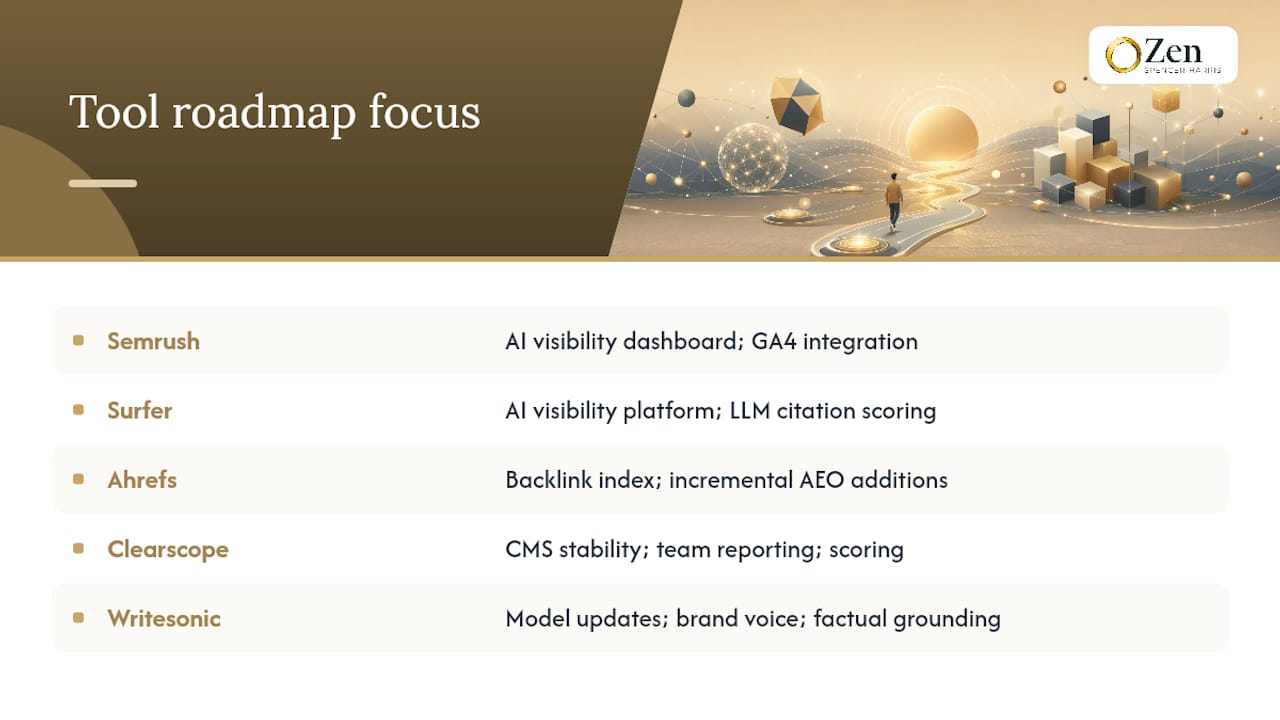
Semrush has been shipping AI Overview tracking updates steadily and is expanding its content assistant to include structured data recommendations. The roadmap signals deeper GA4 integration and an expanded AI visibility dashboard that consolidates LLM mention tracking alongside traditional rank data.
Ahrefs is investing in its AI content grader and has signaled plans to expand LLM visibility features, though its core strength remains the backlink index and crawl infrastructure. Expect incremental AEO additions rather than a platform pivot.
Surfer is leaning fully into its AI visibility platform positioning. Recent updates added LLM citation scoring to the content editor, and the roadmap includes deeper integrations with AI writing tools and expanded SERP analysis that incorporates AI Overview data directly into content briefs.
Clearscope has focused recent updates on CMS stability and team reporting features. Its roadmap is more conservative: the priority is scoring accuracy and integration reliability rather than AEO-specific features. Teams that need LLM citation tracking will need to pair it with another tool.
SE Ranking shipped its AI Overview tracker as a core feature rather than an add-on, which is notable at its price point. The roadmap includes expanded AI visibility reporting and additional white-label options for agencies. It is moving faster on AEO features than its pricing tier would suggest.
Writesonic continues to update its underlying models and has added brand voice controls and a factual grounding mode that reduces hallucination risk in published content. The roadmap includes deeper SEO scoring integration and expanded Zapier workflows.
Rank Prompt is early-stage relative to the other tools on this list, but its development velocity is high. Recent updates added multi-model citation tracking (ChatGPT, Claude, Perplexity simultaneously) and improved brief generation. The roadmap is focused on expanding the citation monitoring dashboard and adding direct CMS integrations.
Perplexity as a research tool continues to improve source attribution and add Pro features for deeper competitive analysis. It is not building toward becoming an SEO platform, but its value as an AEO research layer increases as its citation network grows.
The case for measuring what AI models actually say about you
The conventional wisdom in SEO procurement is to find the tool with the most features at the best price. That framing made sense when search was a single surface. It does not hold in 2026, when a meaningful share of high-intent queries resolve inside an AI-generated answer that never produces a click.
The teams getting the best results right now are not the ones with the most sophisticated platforms. They are the ones that identified their LLM visibility gap early, picked two or three tools that address it directly, and built a governance process that keeps human judgment in the loop for high-stakes content. The practitioner recommendation for hybrid stacks is not a hedge. It reflects what actually happens when you deploy these tools on real sites with real content teams.
One thing that gets underestimated: the gap between a tool that tracks AI visibility and a team that acts on that data. Rank Prompt can tell you that a competitor gets cited in 70% of ChatGPT answers for your target query. That number means nothing unless someone on your team owns the brief, the content structure, and the publishing cadence that closes that gap. The tool is the measurement instrument. The strategy is still yours.
For healthcare practices specifically, this matters more than in most verticals. Patients asking ChatGPT or Perplexity for a psychiatrist or specialty clinic recommendation are high-intent and often ready to book. A practice that does not appear in those answers is invisible to that patient at the exact moment they are ready to act. That is the visibility problem Zensweb's AI Share of Voice program was built to solve.
Zensweb's AI visibility program for healthcare practices
Most of the tools covered in this article are built for digital marketers and SEO teams who want to self-implement. If you run a specialty healthcare practice, a behavioral health organization, or a community health center, you likely do not have a dedicated SEO team to manage a four-tool stack, interpret LLM citation data, and publish optimized content on a consistent cadence.
Zensweb's performance-based AI Share of Voice program handles the full execution: structured data implementation, authority content creation, LLM citation optimization, and Google Business Profile management, all tied to a single outcome metric: booked patient appointments. The program is designed to get specialty practices visible on ChatGPT, Claude, Perplexity, and Google within 90 days, and the fee structure is tied to delivered results, not retainer hours. Healthcare practices that want to see exactly what that looks like for their specialty can request a free audit to get a baseline visibility assessment before committing to anything.
Useful sources and further reading
| Resource | What it covers |
|---|---|
| Best AI SEO Software 2026: Indie Hackers | First-hand testing of AI SEO tools across live sites; strong on hybrid stack recommendations and AI visibility scoring |
| Surfer AI Visibility Platform | Surfer's product positioning and feature documentation for LLM citation optimization and content scoring |
| AI SEO Tools — Whatagraph Blog | Agency-focused analysis of integration pitfalls and workflow fit considerations |
| 15 Best AI SEO Tools Compared — get-ryze.ai | Structured comparison of 15 tools with live site testing data and time-to-impact analysis |
| SE Ranking | Product documentation for SE Ranking's AI Overview tracker and agency reporting features |
| Search Atlas | Autonomous AI SEO automation platform; useful reference for understanding full-automation trade-offs |
| SEO.ai | AI-first SEO agent with autonomous publishing and link acquisition; review cautionary notes on backlink quality validation |
| Own AI Search in 90 Days — Zensweb | Zensweb's AI Share of Voice program page; relevant for healthcare teams seeking managed AEO outcomes |
| HIPAA-Compliant AI for Healthcare Marketing | Compliance guidance for healthcare teams adopting AI SEO tools in regulated environments |
| Claude vs. ChatGPT for Healthcare Marketing | Practical comparison of LLM strengths for healthcare content workflows and AEO strategy |