

Google AI Overviews are AI-generated summaries that sit at the top of search results, synthesizing answers from multiple web sources and linking out to them as citations. No special tag or opt-in gets you into one. Eligibility rides entirely on whether Google can crawl, index, and rank your page in the first place.
That single fact should change how you spend your time. Chasing an "AI Overview meta tag" is a dead end. Fixing crawlability and writing content that answers a real question in plain language is not.
Do this first:
- Confirm Google can actually render your page (check for JavaScript that hides your answer from crawlers).
- Write a direct, quotable answer near the top of the page, not buried under three paragraphs of preamble.
- Check whether your target queries already trigger featured snippets, a strong signal AI Overviews may show up too.
Pro Tip: Pull your top 20 informational queries into Search Console and check impressions before and after an AI Overview appears. That delta tells you more than any ranking tool.
Key Takeaways
Google AI Overviews reward crawlable, human-first pages that answer specific sub-questions clearly, and citation share now matters as much as organic rank.
| Point | Details |
|---|---|
| No special opt-in exists | Eligibility depends on standard crawlability, indexing, and rankability, not schema tricks. |
| Citations beat rank position | AI Overviews cite roughly 11 sources per query, so narrow sub-question answers can earn a spot without ranking first. |
| Clicks are shifting, not vanishing | Pew Research found lower raw click rates with AI summaries present, but citation traffic tends to convert at higher intent. |
| Track new metrics | Measure citation share, conversion rate from citation visits, and query-level engagement, not just impressions. |
| Concise beats exhaustive | Human-centric, extractable answers outperform sprawling long-form guides for citation purposes. |
Table of Contents
- What Are Google AI Overviews, and How Do They Differ From Snippets?
- Where and When Do AI Overviews Show Up?
- How Do AI Overviews Actually Work?
- How Are AI Overviews Changing Clicks and SEO Priorities?
- How Can You Improve Your Odds of Being Cited?
- Can You Turn Off or Report AI Overviews?
- A 90-Day Test Plan for Service-Based Sites
- What Privacy Concerns Come With AI-Generated Overviews?
- Why Most AI Overview Advice Misses the Point
- Sources
What Are Google AI Overviews, and How Do They Differ From Snippets?
An AI Overview is not a bigger featured snippet. It's a generated synthesis, built from several sources at once, wrapped in a conversational interface that invites follow-up questions. Google's own documentation describes AI Overviews as AI-generated snapshots that appear when generative AI can genuinely help answer a query, complete with links to the sources it drew from.
The pieces that make up a typical AI Overview:
- A collapsed summary box with an option to expand for more detail.
- Bulleted takeaways pulled from multiple pages, not just one.
- Inline links, images, and sometimes product carousels for commercial queries.
- A prompt to keep asking follow-up questions, which can carry the session into full AI Mode.
A featured snippet quotes one page. An AI Overview blends several, then lets the searcher keep digging without leaving the results page. That's the real shift: from "here's a source" to "here's an answer, and here's where it came from."
Where and When Do AI Overviews Show Up?
AI Overviews lean heavily toward informational queries: how-to questions, comparisons, symptom checks, "what is" searches. Google documents general availability and notes some behavior differs for signed-in versus signed-out users, though the core triggering logic stays consistent across both.
Watch for these signals that a query is AI Overview territory:
- The query is complex, multi-part, or long-tail rather than a simple navigational search.
- It already surfaces a featured snippet or People Also Ask box. BrightEdge's analysis found AI Overviews correlate strongly with these existing SERP features.
- It involves images, product comparisons, or something naturally suited to multimodal answers.
If your keyword tracker shows a featured snippet history, treat that as a proxy for AI Overview risk (or opportunity, depending on your angle).
How Do AI Overviews Actually Work?
Google runs AI Overviews on custom Gemini models paired with a technique called query fan-out. Instead of answering your literal search term, the system breaks it into several related sub-questions, runs searches against each, then stitches the results into one synthesized response.
That's why a single search can pull from a dozen different domains. Industry analysis from SEER Interactive found AI Overviews cite an average of roughly 11 sources per query. No single page has to cover every angle of a topic to earn a citation. It just has to nail one sub-question clearly.
That reframes the competition entirely:
- You're not fighting for the #1 organic slot. You're fighting for one of several citation slots spread across a synthesized answer.
- Being "quotable" (a clean, self-contained sentence or short paragraph that answers a specific question) matters more than sprawling word count.
- Pages that are technically accessible to crawlers get considered; pages buried behind heavy client-side rendering often don't.
Fan-out also means Google can research a question the way a person would: pull a fact, check a follow-up angle, cross-reference a third source, then synthesize. Your content needs to survive being picked apart into fragments.
How Are AI Overviews Changing Clicks and SEO Priorities?
Raw click-through rates on traditional blue links are falling for queries where an AI Overview appears. Pew Research documented this directly: users are less likely to click on links when an AI-generated summary shows up in the results.
That statistic alarms a lot of marketers. It shouldn't, not entirely. Fewer clicks doesn't mean fewer valuable clicks. A citation link inside an AI Overview reaches someone who already read a synthesized answer and still chose to click through for more. That's a warmer visitor than someone skimming ten blue links and picking one at random.
What actually deserves tracking now:
- Citation share: how often your domain appears among the sources cited for your priority queries, not just where you rank organically.
- Conversion rate from citation traffic: segment these visits separately in your analytics rather than lumping them into generic organic sessions.
- Query-level engagement: time on page and scroll depth for the visitors arriving after an AI Overview, compared to your baseline.
Total impressions can hold steady while total clicks fall. That's zero-click dynamics at work, not necessarily a traffic collapse. Treat it as a shift in what "visibility" means rather than a straight loss column on a spreadsheet.
How Can You Improve Your Odds of Being Cited?
Google is explicit on this point: there's no special markup, no AEO plugin, and no schema shortcut that guarantees an AI Overview citation. Eligibility rides on the same fundamentals that have always mattered, applied more rigorously.
- Fix crawlability first. Confirm Google can render your page without relying on client-side JavaScript to reveal the actual answer text.
- Write extractable answers. Structure key facts as clean question-and-answer blocks or short bulleted lists Google can lift cleanly.
- Front-load the point. State your answer in the first sentence or two of a section, then support it. Don't make the reader (or the crawler) hunt for it.
- Target sub-questions, not just head terms. Since fan-out breaks queries apart, a page answering one narrow sub-question well can get cited even without ranking #1 for the broad term.
- Skip the "ultimate guide" instinct. SEER's research found AI Overviews favor concise, human-centric answers over exhaustive 5,000-word pillar pages.
- Confirm good page experience. Slow load times and intrusive interstitials still hurt your baseline rankability, which is the gate to citation eligibility.
Pro Tip: Run a "quotability audit" on your top 10 pages: read only the first two sentences under each H2. If those sentences alone don't answer the question, rewrite them before touching anything else.
Guidance from Google's AI optimization documentation backs this up directly: standard SEO fundamentals, not special hacks, drive AI Overview eligibility.
Can You Turn Off or Report AI Overviews?
Users can toggle AI Mode and Labs experiments from their Google Search settings, which controls how much AI-generated content appears in their results. A web-only filter also exists, letting searchers strip AI summaries out entirely and see a traditional links-only results page.
If an AI Overview gets something wrong, Google provides feedback buttons directly beneath the summary. Google's own support documentation acknowledges AI responses can include mistakes and encourages users to flag them, since that feedback feeds back into model refinement.
A 90-Day Test Plan for Service-Based Sites
Most healthcare marketing teams treat AI Overviews as a black box. It isn't. It's measurable if you set up the right KPIs before you touch a single page.
Track three numbers: citation share across your priority queries, qualified inquiry rate from visitors who arrive after clicking a citation, and booked appointments tied to that traffic segment. Vanity impressions mean nothing if none of it converts to a filled appointment slot.
- Weeks 1 to 2: audit. Identify which queries in your specialty already trigger AI Overviews or featured snippets, and map your current citation share against competitors.
- Weeks 3 to 8: optimize. Fix rendering issues, rewrite key pages into extractable question and answer blocks, and tighten internal linking so related sub-questions point to your most authoritative page rather than splitting authority across five thin ones.
- Weeks 9 to 12: validate. Track citation appearances weekly and connect conversion data back to specific pages, not just the domain overall.
Zensweb built its AI Share of Voice approach around exactly this cadence for specialty healthcare practices, because a citation that never turns into a booked patient isn't worth much.
Pro Tip: Canonicalize duplicate service pages before your audit. AI Overviews can't cite a page Google isn't sure is the authoritative version.
What Privacy Concerns Come With AI-Generated Overviews?
AI Overviews raise a quieter set of questions most SEO discussions skip: what happens to the data behind the answer. Google synthesizes responses from crawled web content, and that content sometimes includes information original publishers didn't necessarily expect to be repackaged and served without a click-through.
For healthcare-adjacent sites, this matters more than average. If your page discusses patient outcomes, pricing specifics, or condition-related guidance, an AI Overview may lift and restate that information without the surrounding context you intentionally included, such as disclaimers about individual variation or when to consult a provider directly.

There's also the question of what users share when they interact with AI Mode's conversational follow-ups. Multi-turn conversations can reveal more about a searcher's intent and personal situation than a single query ever did, which raises the stakes for how that session data gets stored and used. Google's help documentation addresses feedback and accuracy mechanisms but stays relatively quiet on granular data retention specifics for these extended sessions.
The practical takeaway for site owners: write with the assumption that any sentence could be lifted verbatim and displayed out of its original context. Avoid absolute claims that need surrounding caveats to be accurate, and keep sensitive comparisons (pricing, outcomes, side effects) framed carefully enough that a stripped fragment still reads responsibly on its own.
Why Most AI Overview Advice Misses the Point
Most of what gets published about AI Overviews focuses on chasing the feature itself, as if there's a secret lever somewhere. There isn't. The research is consistent on this: Google keeps pointing back to the same fundamentals that mattered before generative search existed. Crawlable pages. Clear answers. Content a machine can lift without losing meaning.
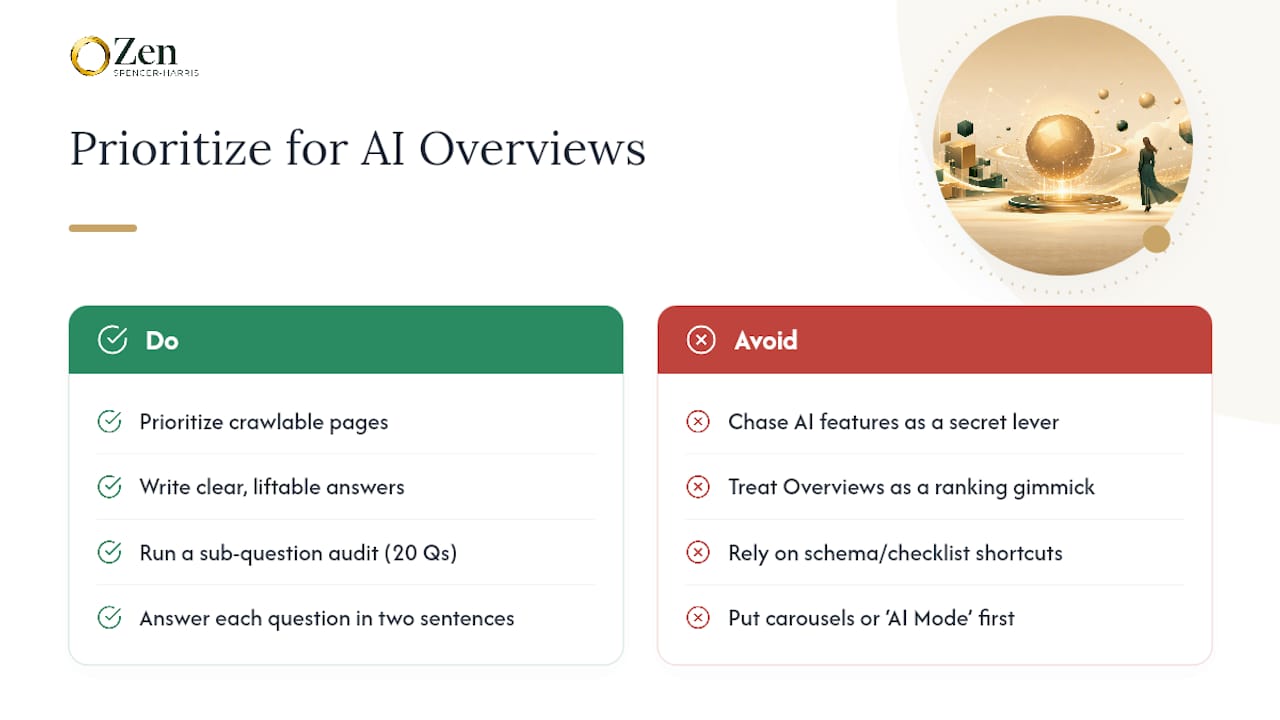
Where conventional advice falls short is treating AI Overviews like a ranking factor to game rather than a distribution mechanism to earn. Schema markup and "AEO checklists" get sold as shortcuts, but SEER's data on citation patterns tells a different story: Google's synthesis engine rewards clarity over cleverness.
If you run a service-based site, especially in healthcare, prioritize the sub-question audit before anything else. Find the twenty questions your patients actually type into Google, answer each one in two clean sentences, and measure whether citations follow. Everything else, the carousels, the schema debates, the "AI Mode strategy" decks, comes second. Clarity is the whole game here, and it always was.
— Zen
Sources
- AI features in Search — Google Search Central
- Find information in faster & easier ways with AI Overviews in Google Search — Google Search Help
- Generative AI in Search: Let Google do the searching for you — Google Blog
- Google users are less likely to click on links when an AI summary appears in the results — Pew Research Center
- What It Takes To Rank In Google's AI Overviews in 2026 Isn't What You Think — SEER Interactive
- The Ultimate Guide to Google AI Overviews — BrightEdge