

AI search visibility measures how often and how prominently your brand appears inside AI-generated answers across platforms like ChatGPT, Perplexity, Google AI Overviews, and Gemini. The single highest-impact action you can take right now: run a structured prompt set across those engines and record your Visibility Score, Citation Share, and Prompt Coverage before you change a single page.
TL;DR — start here:
- Build a prompt library of 20–40 queries your audience actually asks, then run them across at least three AI engines and log every mention, citation link, and position.
- Capture your baseline Visibility Score and Citation Share. Without a baseline, you cannot prove improvement to a client or a C-suite.
- If you have the bandwidth to run weekly sweeps and analyze cached answers, audit in-house. If not, a performance-based provider with documented methodology is the faster path.
Pro Tip: Before you touch your content, run the same 10 prompts in incognito mode on ChatGPT and Perplexity. Screenshot every answer. That raw evidence is more persuasive in a board deck than any score a tool generates.
Table of Contents
- What is AI search visibility, and how does it differ from traditional SEO?
- Which metrics actually matter for AI search visibility?
- Which AI engines and signals should you monitor?
- How do you evaluate an AI visibility tool or provider?
- How to run your first AI visibility audit
- Concrete actions that increase AI citations
- Who benefits most, and what does a healthcare example look like?
- Measurement limits and risks you need to understand
- How a performance-based AI Share of Voice program works in 90 days
- Key Takeaways
- The operating model most teams get wrong
- Zensweb's AI Share of Voice program for healthcare practices
- Useful sources for further reading
What is AI search visibility, and how does it differ from traditional SEO?
AI search visibility, also called Answer Engine Optimization (AEO) or AI Share of Voice, measures how often and how prominently your brand, product, or website appears in answers that AI systems compose. When someone asks ChatGPT which psychiatrist accepts new patients in their city, the model does not return ten blue links. It writes a single answer. Either your practice is named in that answer, or it is not.

That binary outcome is the core difference from traditional organic search. Classic SEO optimizes for a ranked URL position. AI visibility optimizes for a mention, citation, or recommendation inside a generated response.
| Dimension | Traditional SEO | AEO / AI Search Visibility |
|---|---|---|
| Primary output | Ranked URL position | Named mention or citation in generated answer |
| Success metric | Impressions, clicks, ranking position | Visibility Score, Citation Share, Prompt Coverage |
| Measurement tool | Google Search Console, rank trackers | Prompt sweep logs, AI visibility dashboards |
| Core tactic | Keyword targeting, link authority | Passage extractability, entity trust, source diversity |
| Content format | Pages optimized for crawlers | Self-contained, quotable passages |
| Competitive signal | SERP position vs. competitors | Share of AI mentions vs. competitors |
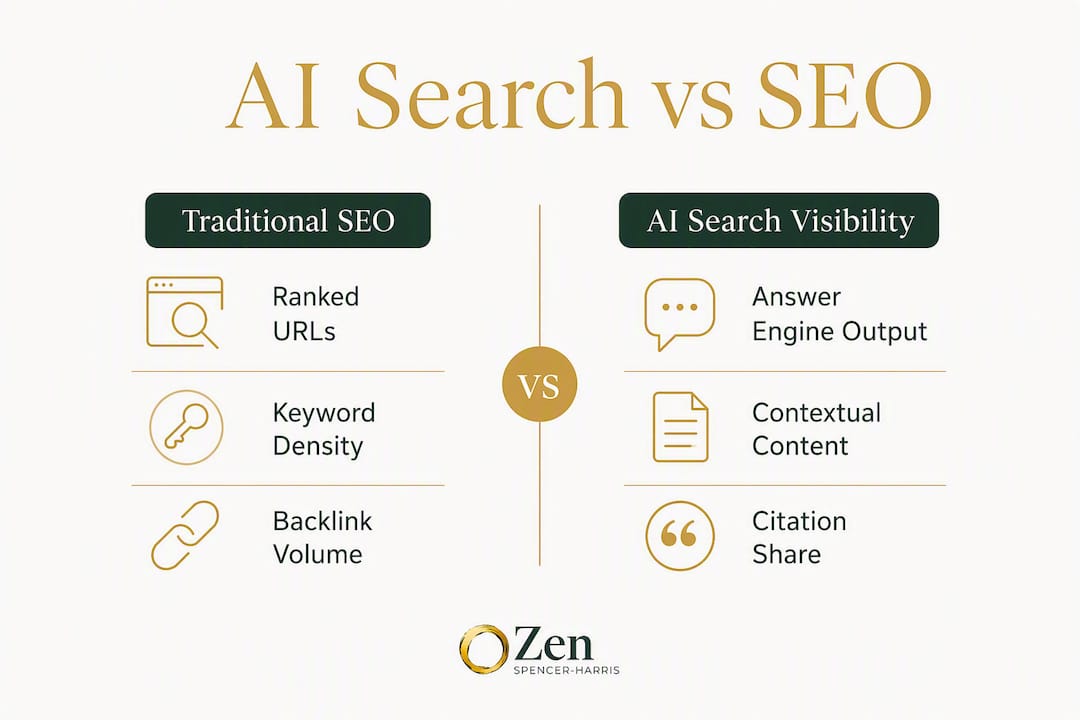
The tactics diverge sharply too. Traditional SEO rewards keyword density and backlink volume. AI visibility rewards content that AI systems can extract and quote directly: short, specific, self-contained passages that stand alone without surrounding context. A 3,000-word pillar page may rank well on Google and still be invisible in a Perplexity answer if none of its sections are independently quotable.
Which metrics actually matter for AI search visibility?
The field has settled on a core set of metrics. Each one measures a different dimension of how AI systems interact with your content.

| Metric | What it measures | How it's captured | Signal type |
|---|---|---|---|
| Visibility Score | Percentage of tracked prompts where your brand appears in the answer | Prompt sweep across engines; mentions logged | Quantitative |
| Citation Share | Your brand's share of all citations across the prompt set | Citation URLs extracted from answers | Quantitative |
| Prompt Coverage | Number of prompt categories where you appear at least once | Prompt library mapped to topic clusters | Quantitative |
| Mention Frequency | How often your brand is named per answer (once vs. multiple times) | Raw mention count per response | Quantitative |
| Recommendation Rate | Percentage of answers where your brand is actively recommended, not just mentioned | Sentiment tagging on mention context | Qualitative |
| Source Diversity | Number of distinct domains cited alongside yours | Citation URL extraction | Qualitative |
Citation Share is the metric most directly tied to referral traffic. When AI systems include a clickable citation link alongside a mention, that link drives measurable visits. Visibility Score, by contrast, tracks brand awareness even when no link is present. Both matter, but they answer different questions: one tells you whether you exist in the conversation; the other tells you whether you are driving action from it.
Prompt Coverage is the most underused metric. A brand that appears in 80% of "best psychiatrist near me" prompts but 0% of "how to find a behavioral health provider" prompts has a coverage gap that no amount of Visibility Score improvement will fix.
Which AI engines and signals should you monitor?
Not all AI engines behave the same way, and tracking only one gives you a dangerously incomplete picture.
Must-track engines in 2026:
- ChatGPT / GPT-based assistants — the highest consumer query volume; exposes brand mentions, citation links, and position within the answer.
- Google AI Overviews and AI Mode — Google's generative features use the same core ranking and quality systems as Search, so indexability is a prerequisite. Track mention text, citation URL, and position.
- Gemini — Google's standalone AI assistant; surfaces citations differently from AI Overviews and warrants separate tracking.
- Perplexity — citation-heavy by design; every answer includes numbered source links, making it the richest engine for Citation Share data.
- Claude — growing enterprise adoption; tends toward longer, more nuanced answers with fewer but higher-authority citations.
Signals to capture per engine for each prompt:
- Mention text (exact wording the model used)
- Citation link presence (yes/no)
- Citation URL (which page was cited)
- Position within answer (first mention, mid-answer, closing recommendation)
- Sentiment (positive, neutral, cautionary)
- The exact prompt that triggered the answer
Recommended sampling cadence:
- Daily: only if you are in a fast-moving category or running an active campaign. Model updates can shift coverage overnight.
- Weekly: the right default for most brand managers. Enough frequency to catch volatility without overwhelming your team.
- Monthly: acceptable for baseline tracking and executive reporting, but too slow to catch a model update that drops your Citation Share.
Pro Tip: Test whether your key pages are even extractable before you optimize them. Paste the raw HTML of your most important page into a plain text file and ask ChatGPT to summarize it. If the model cannot produce an accurate summary from the raw HTML, an AI engine crawling that page will have the same problem. Many LLM-based systems do not execute JavaScript, so content injected via JS is effectively invisible to them.
How do you evaluate an AI visibility tool or provider?
The market for AI visibility tools is young, and the quality gap between providers is wide. A tool that claims to track "all major AI engines" without disclosing its prompt library or sampling methodology is telling you almost nothing useful.
Checklist for evaluating any tool or vendor:
- Declared engine coverage: Which specific engines are tracked? "Major AI platforms" is not an answer.
- Prompt library transparency: How many prompts are in the library? Are they disclosed or auditable? A library of 10 generic prompts produces a Visibility Score that means very little.
- Sampling cadence: How often are prompts re-run? Daily, weekly, or on-demand?
- Evidence exports: Can you download cached answers and raw prompt-response pairs as CSV or PDF? If not, you cannot verify the score.
- Integration points: Does the tool connect to Google Search Console or your analytics platform so you can correlate AI mentions with actual traffic?
- Methodology documentation: Is the Visibility Score formula published? A score without a formula is a black box.
Red flags:
- Claiming coverage for engines the tool does not actually query
- Presenting a Visibility Score with no explanation of how it is calculated
- No export function for raw answer evidence
- Prompt libraries that are not disclosed or auditable
When talking to vendors, ask three questions directly: Where does your data come from? How are citations matched to domains? What happens to my score when a model update changes answer behavior? A vendor who cannot answer all three clearly is not ready to be your measurement partner.
How to run your first AI visibility audit
A structured audit takes a few hours to set up and produces a defensible baseline you can track against.
- Define your goal. Are you measuring brand awareness, lead generation, or local patient acquisition? The goal shapes which prompts you build.
- Build your prompt library. Start with 20–40 prompts across three categories: category queries ("best behavioral health providers in [city]"), product or service comparisons ("psychiatry vs. therapy for anxiety"), and local intent queries ("psychiatrist accepting new patients near me"). Include prompts your competitors would want to own.
- Choose your engines. Run every prompt on ChatGPT, Perplexity, and Google AI Overviews at minimum. Add Gemini and Claude if resources allow.
- Include your competitor set. Log competitor mentions alongside yours so you can calculate relative Citation Share, not just absolute mention counts.
- Run the initial sweep. Copy each answer into a structured log. Do not rely on memory or screenshots alone.
- Capture cached answers and export to CSV. Name each file with the engine, prompt text, and date (e.g.,
chatgpt_best-psychiatrist-chicago_2026-06-01.csv). This naming convention makes files auditable during vendor conversations.
Suggested dashboard fields:
- Visibility Score (% of prompts with a brand mention)
- Citation Share (% of all citations that point to your domain)
- Mention Context (the sentence in which your brand was named)
- Top cited URLs (which of your pages are being pulled)
- Engine coverage (which engines mentioned you)
- Trend line (week-over-week change in Visibility Score)
Tracking inbound conversions from AI-driven traffic alongside your visibility metrics closes the loop between AI mentions and actual booked appointments.
Concrete actions that increase AI citations
Improving AI visibility follows a clear priority order: fix extractability first, then build authority.
Immediate wins (1–4 weeks, low cost):
- Rewrite key sections as short, self-contained passages of 40–80 words. AI systems extract answerable content best when it does not depend on surrounding context.
- Add specific statistics and named sources to every claim. Models prefer citable, verifiable content over vague assertions.
- Include a concise summary block at the top of each page. Think of it as a passage the model can quote directly.
- Verify that your most important pages are indexed and crawlable. Google's generative AI features require pages to meet standard Search technical requirements before they are eligible for inclusion.
Tactical investments (1–3 months, moderate cost):
- Add structured data markup using Schema.org vocabulary for your organization, services, and FAQs. Structured data helps models understand entity relationships.
- Fix JavaScript-rendered content. If your primary answerable text is injected via JS, rewrite it as server-rendered HTML. AI crawlers that do not execute JavaScript will never see it otherwise.
- Audit canonical tags and ensure no important pages are accidentally excluded from indexing.
Authority building (3–9+ months, higher investment):
- Secure mentions in industry roundups, peer-reviewed directories, and authoritative publications. Source diversity, the number of distinct domains that cite you, signals to models that your brand is worth referencing.
- Place structured data in partner content and contributed articles so the entity association travels with the citation.
- Structure content to satisfy multiple related query intents from a single URL. A page that answers "what is behavioral health therapy," "how to find a behavioral health provider," and "what to expect at a first appointment" will be cited across a broader prompt set than a page that answers only one of those questions.
Who benefits most, and what does a healthcare example look like?
AI visibility work delivers the clearest ROI in four scenarios: brand awareness campaigns where share of voice is the KPI, local service businesses competing for "near me" queries, product comparison categories where AI answers directly influence purchase decisions, and reputation monitoring where you need early warning of negative mentions.
Primary use cases:
- Brand awareness: Track Visibility Score across category prompts to measure whether your brand is part of the conversation at all.
- Lead generation: Monitor Citation Share and citation link presence to identify which pages are driving referral clicks from AI answers.
- Local patient acquisition: For healthcare practices, local intent prompts ("psychiatrist accepting new patients in [city]") are the highest-value category to own.
- Reputation monitoring: Set up alerts for prompts that could surface negative mentions and track sentiment scores over time.
Healthcare practice example: A small specialty psychiatry practice in Chicago runs a prompt sweep across 30 local intent queries on ChatGPT and Perplexity. Their Visibility Score is 12% at baseline. They rewrite their "About" page and services pages as self-contained passages, add Schema.org markup for their practice and providers, and secure mentions in local health directories. Eight weeks later, their Visibility Score on the same prompt set has climbed to 34%. More importantly, the Citation Share data shows Perplexity is now linking directly to their appointment booking page. For FQHC and community health practices, the same approach scales to a broader geographic prompt set and a larger competitor comparison list.
Behavioral health organizations can apply the same framework across psychiatry private practices and outpatient programs, adjusting the prompt library to reflect the specific conditions and services they treat.
Measurement limits and risks you need to understand
AI visibility measurement is genuinely hard, and any vendor who tells you otherwise is overselling.
Core data limitations:
- Model non-determinism: The same prompt run twice on the same engine can produce different answers. A single-run snapshot is not a reliable Visibility Score; you need repeated sampling.
- Prompt sensitivity: Small changes in prompt wording produce meaningfully different answers. A prompt library that is too narrow will overstate or understate your real coverage.
- Regional differences: Models often return different citations for the same query depending on the user's apparent location. US-based tracking may not reflect what patients in a specific city actually see.
- Sampling bias: If your prompt library skews toward queries you already rank well for, your Visibility Score will look better than it actually is.
Model churn: AI engines update their underlying models frequently. A model update can shift citation behavior across thousands of prompts overnight. Design your sampling cadence to detect these shifts, not just track steady-state performance.
Vendor traps: Watch for improbable coverage claims ("we track 50 AI engines"), Visibility Scores presented without a published methodology, and prompt libraries that are never disclosed. Cached answer exports and raw CSV data are the most defensible evidence you have when a vendor's score does not match what you see in manual testing.
Regulatory note for healthcare marketers: Keep all patient health information out of test prompts entirely; use fictional or generic clinical scenarios instead, and review HIPAA-compliant AI testing practices before running any AI visibility audit in a clinical context.
How a performance-based AI Share of Voice program works in 90 days
The Zensweb AI Share of Voice program is structured around a simple premise: your practice should appear in AI-generated answers when patients search for the care you provide. If it does not, that is a solvable problem with a measurable timeline.
The program runs in three phases across several months:
Weeks 1–4 (Baseline and technical foundation):
- Initial AI visibility audit: prompt sweep across ChatGPT, Claude, Perplexity, and Google AI Overviews
- Visibility Score and Citation Share baseline documented with cached answer evidence
- Technical audit: indexability, JS rendering issues, schema gaps, and canonical errors identified and fixed
Weeks 5–8 (Content and entity optimization):
- Authority content created and published with self-contained, extractable passages
- Schema.org markup deployed for practice, providers, and services
- Local entity signals built: directory listings, Google Business Profile, and structured citations
Weeks 9–12 (Authority and measurement):
- Off-site citation campaign: industry directories, health roundups, and partner content
- Weekly prompt sweeps with CSV exports documenting Visibility Score trend
- Final report with before/after Visibility Score, Citation Share lift, and booked appointment data
The performance-based model means payment aligns to delivered results: booked patient appointments or predefined visibility milestones, documented with exported evidence. Every claim is backed by cached answer data, not a proprietary score alone. The full program structure and guarantee terms are detailed on the service page.
Key Takeaways
AI search visibility is a measurable channel, and the practices that build a structured audit process now will hold a compounding citation advantage as AI-generated answers replace traditional search results for high-intent queries.
| Point | Details |
|---|---|
| Run a baseline audit first | Build a 20–40 prompt library, sweep at least three engines, and log Visibility Score and Citation Share before making any changes. |
| Fix extractability before authority | Rewrite key pages as short, self-contained passages and resolve JS-rendering issues; these are the fastest wins. |
| Demand evidence exports | Any tool or vendor that cannot produce cached answers and CSV exports is not giving you verifiable data. |
| Healthcare practices have a clear playbook | Local intent prompts, Schema.org markup, and directory citations are the three highest-leverage moves for specialty clinics. |
| Zensweb's 90-day program | Zensweb delivers a documented Visibility Score baseline, technical fixes, and authority content, with payment tied to booked appointments or visibility milestones. |
The operating model most teams get wrong
Most marketing teams treat AI visibility as an SEO task and hand it to one person. That is the wrong structure. The work spans at least three functions: SEO handles technical eligibility and schema; content owns passage architecture and extractability; PR and partnerships drive the off-site citations and source diversity that models use to decide which brands are worth recommending. When those three functions do not share a common prompt library and a common measurement cadence, you get three separate efforts that do not compound.
The other thing teams consistently underestimate is the importance of evidence exports. A Visibility Score from a tool is a useful signal. A folder of cached answer exports, named by engine, prompt, and date, is a defensible record. When a model update drops your Citation Share and you need to explain it to a client or a CMO, the cached answers are what you reach for. Performance-based accountability, whether internal or with a vendor, only works when the evidence is exportable and auditable.
Zensweb's AI Share of Voice program for healthcare practices
Specialty healthcare practices face a specific version of this problem: patients are asking AI assistants for provider recommendations, and most practices have no idea whether they appear in those answers. Zensweb's AI Share of Voice program is built for exactly that situation. The engagement starts with a free AI visibility audit that includes a prompt sweep across ChatGPT, Claude, Perplexity, and Google, a documented Visibility Score baseline, and a list of the pages currently driving your citations (or the gaps where competitors are being cited instead).
From there, the 90-day program covers technical fixes, authority content, schema deployment, and off-site citation building, with payment structured around delivered results: booked patient appointments or documented visibility milestones. Not a retainer for effort. Not a monthly report with no accountability. If you want to know where your practice stands in AI-generated answers right now, request your free healthcare audit and get a documented baseline within days.
Useful sources for further reading
- Google's guide to optimizing for generative AI features — the authoritative technical reference for eligibility and indexing requirements for Google AI Overviews and AI Mode.
- Schema.org — the structured data vocabulary used to help AI systems understand entity relationships on your pages.
- FQHC marketing and AI visibility: 90-day patient growth — sector-specific guidance for community health centers applying AI visibility tactics.
- Claude vs. ChatGPT for healthcare marketing leaders — a platform comparison covering how each engine handles healthcare queries and what that means for your prompt strategy.
- HIPAA-compliant AI for specialty healthcare marketing — practical guidance on running AI visibility audits without exposing protected health information.