

Medical content review is the paid service that evaluates and edits your practice's patient-facing clinical content for clinical accuracy, regulatory compliance, and AI/SEO visibility. Hire a vendor that provides clinician sign-off (MD/DO/NP/PharmD), WCAG 2.1 AA accessibility remediation, and measurable patient-acquisition outcomes. The urgency is real: HHS Section 504 deadlines are already in motion, and Zen Spencer-Harris is one of the few performance-based providers that ties clinical content work directly to booked appointments.
What a qualified vendor delivers:
- Clinical accuracy review with named MD/DO/NP/PharmD sign-off on every patient-facing page
- WCAG 2.1 AA compliance audit and remediation across your website, mobile app, and kiosks
- SEO and AI visibility optimization including medical schema, FAQ schema, and llms.txt readiness
- PHI-safe analytics architecture with BAA-signed infrastructure
- A prioritized remediation plan with implementation-ready content files
Key Takeaways
A medical content review that drives booked appointments requires clinician sign-off, WCAG 2.1 AA remediation, and PHI-safe analytics — all three, not one at a time.
| Point | Details |
|---|---|
| HHS deadlines are firm | May 11, 2026 for 15+ employee practices; May 10, 2027 for smaller recipients under 45 C.F.R. § 84.84. |
| Clinician sign-off is non-negotiable | Require named MD/DO/NP/PharmD credentials and a dated approval record on every clinical page. |
| Scope includes third-party tools | Appointment schedulers, telehealth platforms, and bill pay portals must meet WCAG standards too. |
| PHI-safe analytics protect you | Require BAA-signed infrastructure and PHI-excluded tracking before any vendor touches your data. |
| Zensweb ties fees to results | The performance-based model links payment to booked appointments and AI visibility gains, not deliverable counts. |
Table of Contents
- Why the HHS Section 504 deadline changes everything for your practice
- What a full medical content review actually covers
- What the review process looks like phase by phase
- Who should perform a medical content review?
- How to choose a vendor: questions that separate real from performative
- What timelines and pricing look like
- What your internal team should do before the vendor starts
- What measurable outcomes should you expect?
- The gap most practice leaders miss
- Zensweb delivers performance-based medical content review
- Sources
Why the HHS Section 504 deadline changes everything for your practice
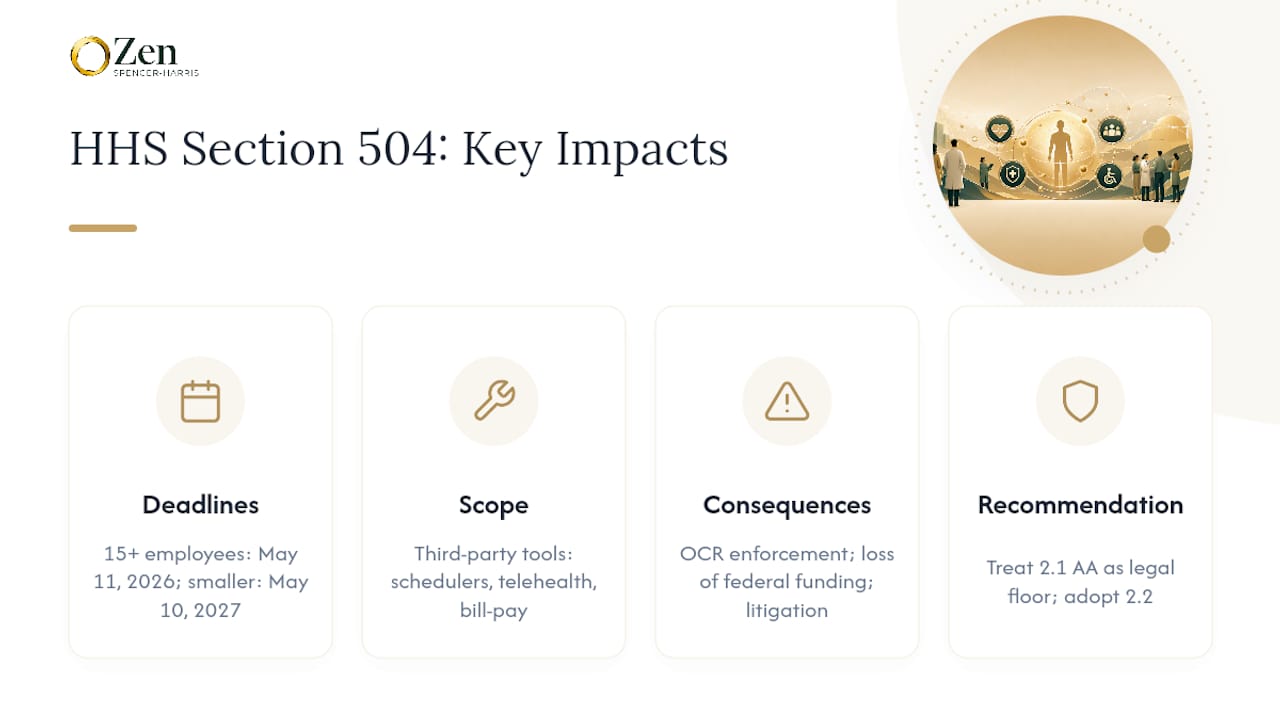
The regulatory clock is no longer abstract. 45 C.F.R. § 84.84 requires covered recipients to meet WCAG 2.1 Level A and AA by May 11, 2026 for organizations with 15 or more employees, and May 10, 2027 for smaller recipients. Miss the deadline and you face OCR enforcement, loss of federal funding, and a litigation environment that plaintiff attorneys are already watching.
The HHS Section 504 final rule covers more than your main website. Third-party tools your practice uses — appointment schedulers, telehealth platforms, bill pay portals — are in scope when provided on your behalf. That means your vendor contracts need WCAG conformance clauses today, not after an OCR complaint lands.
Deque recommends treating WCAG 2.1 AA as the legal floor and adopting WCAG 2.2 where feasible. Remediating to 2.2 now reduces rework later, since 2.2 adds user-experience criteria that overlap existing standards.
What a full medical content review actually covers
A thorough healthcare content evaluation goes well beyond proofreading. Here is the scope your RFP or statement of work should specify:
Clinical accuracy
Every procedure page, condition overview, and FAQ gets reviewed by a named clinical SME (MD/DO/NP/PharmD) against peer-reviewed sources. Clinician sign-off is documented with credentials and a review date, which satisfies Google's E-E-A-T expectations and reduces malpractice exposure.
Regulatory and accessibility review
Manual testing with assistive technologies — screen readers, keyboard-only navigation, voice control — is required for full conformance validation. Kiosk hardware procurement follows EN 301 549 guidance per Deque's framework.

SEO and AI visibility
Medical SEO differs from generic SEO: pages need named author credentials, reviewer attribution with a date, peer-reviewed citations, medical schema markup, FAQ schema, and llms.txt configuration for AI answer-engine readiness. For specialty practices competing on procedure-specific queries, this layer is where organic appointments are won or lost.
Privacy and PHI-safe analytics
Standard tracking pixels on intake forms carry HIPAA risk. A proper medical writing review includes an analytics audit that flags pixel placements and recommends server-side CAPI or PHI-excluded setups with BAA-signed infrastructure. See the HIPAA-compliant AI guide for a deeper look at compliant content workflows.
Deliverables to require from any vendor:
| Deliverable | What it contains |
|---|---|
| Audit findings report | Itemized issues by page, severity, and category |
| Priority-coded remediation plan | Fixes ranked by compliance risk and patient impact |
| Clinician sign-off record | Named reviewer, credentials, and dated approval |
| CMS-ready redlines | Edited content files ready for direct upload |
| JSON-LD/schema recommendations | Medical schema and FAQ schema markup per page |
| Accessibility VPAT or score | Conformance level per WCAG 2.1 AA criteria |
What the review process looks like phase by phase
A structured clinical content assessment runs in six phases. Knowing them helps you set internal milestones and hold vendors accountable.
- Discovery and inventory — catalog every patient-facing asset: web pages, PDFs, mobile app screens, kiosk interfaces, and third-party embedded tools.
- Clinical review and tagging — SMEs review each page for accuracy, flag outdated claims, and tag content requiring citation updates or full rewrites.
- Accessibility and SEO audit — automated scans run first; manual assistive-technology testing follows. SEO engineers audit schema, page structure, and AI-readiness signals.
- Remediation and QA — writers and developers execute fixes against the priority plan. A versioned change log tracks every edit.
- Clinician sign-off — the named clinical reviewer approves final content. The sign-off record is stored with credentials and date.
- Handoff and tracking — implementation-ready files transfer to your CMS team. KPI baselines are set for booked appointments, organic visibility, and accessibility pass rates.
Pro Tip: Ask vendors for a sample versioned audit trail from a past engagement before you sign. An SME workflow with a documented approval chain — not just a verbal "our doctor reviewed it" — is the difference between a defensible record and a liability.
Who should perform a medical content review?
The right vendor team is not a single generalist. SMEs are essential to clinical accuracy, and their absence is the most common reason content reviews fail to reduce legal risk.
Core roles to require:
- Clinical SME (MD/DO/NP/PharmD): reviews and signs off on clinical claims
- Medical content editor: rewrites for clarity and accuracy without diluting clinical meaning
- Accessibility specialist: runs manual WCAG testing and produces the VPAT
- SEO/AI engineer: implements medical schema, FAQ schema, and llms.txt
- Project manager: owns the timeline, change log, and approval SLAs
Trust signals to verify before signing:
- Named reviewer credentials on sample deliverables (not just "reviewed by a physician")
- A sample VPAT or accessibility conformance report from a healthcare client
- Dated clinician sign-off records from past engagements
- A signed BAA for any workflow that touches PHI
Contractually, require vendor liability limits that reflect the clinical and regulatory stakes, proof of past healthcare engagements, and WCAG conformance clauses in any third-party tool contracts.
How to choose a vendor: questions that separate real from performative
Most vendors claim clinical review capability. Few can prove it. These questions cut through:
- Who specifically reviews clinical content? What are their credentials and license numbers?
- Can you show a sample clinician sign-off record from a past healthcare client?
- How do you test for WCAG conformance — automated only, or manual assistive-technology testing?
- Do you sign a BAA? What is your analytics architecture for PHI-safe attribution?
- What outcomes have you delivered — booked appointments, organic visibility gains, accessibility scores?
Red flags that should disqualify a vendor:
- No named clinical reviewers, only vague "medical team" language
- Accessibility "compliance" based on automated scans alone
- Standard Google Analytics or Meta Pixel on intake forms with no PHI exclusion
- No examples of accessibility remediation for a healthcare client
- No performance commitments or outcome metrics in the contract
Pro Tip: Before a full engagement, run a small paid pilot on 10–15 high-traffic pages. Request the raw audit output — not a summary deck — so you can evaluate methodology, not just conclusions.
What timelines and pricing look like
A full-site audit for a mid-size specialty practice typically runs 2–6 weeks. Remediation sprints follow at 4–12 weeks depending on site size, number of procedure pages, and accessibility remediation depth. Ongoing retainers cover content updates, new page reviews, and quarterly accessibility re-scans.
Common pricing models:
- Fixed project fee: scoped to page count and review depth; predictable for budget planning
- Monthly retainer: covers ongoing content updates, new procedure pages, and re-audits
- Performance-based: fees tied to booked appointments or visibility milestones — the model Zensweb uses
Cost drivers include site size, number of conditions and procedures covered, depth of clinical review required, and whether kiosk or mobile-app remediation is in scope.
What your internal team should do before the vendor starts
Vendor ramp time shrinks significantly when your team completes these steps first:
- Inventory every patient-facing asset: web pages, PDFs, appointment flows, kiosk screens
- Grant scoped CMS access with role-based permissions (no full admin for external vendors)
- Identify your clinical point people and confirm their availability for review cycles
- Collect any existing VPATs, accessibility audits, or contractual accessibility commitments
- Define KPIs upfront: booked appointments attributed to content, AI citation appearances, accessibility pass rates
- Set communication SLAs: how fast will your team turn around clinical review requests?
Pro Tip: Freeze noncritical content updates during active remediation sprints. New edits on pages mid-remediation create versioning conflicts and force rework — a common reason projects run over budget.
For HIPAA-compliant form selection during onboarding, vet every intake form vendor for BAA availability before granting access.
What measurable outcomes should you expect?
Primary KPIs for a well-executed clinical content review:
- Booked appointments attributed to organic content changes (tracked via PHI-safe server-side attribution)
- Organic visibility gains for procedure-specific and condition queries
- Accessibility conformance score improvement toward WCAG 2.1 AA
Vendors prove impact through pre/post audits with clinician-signed correction records, and analytics built on BAA-signed infrastructure that excludes PHI from attribution models. For specialty practices, the AI Share of Voice metric — how often your practice appears in ChatGPT, Claude, Perplexity, and Google AI answers — is an emerging KPI that correlates with qualified patient inquiries.
Regulatory signal: Under 45 C.F.R. § 84.84, non-compliant practices risk OCR enforcement and federal funding loss — making accessibility pass rate a compliance KPI, not just a UX metric.
The gap most practice leaders miss
The conventional wisdom treats medical content review as a one-time cleanup project. It is not. Clinical content drifts: treatment guidelines update, new procedures get added, staff write patient FAQs without clinical sign-off, and a new scheduling tool gets embedded without an accessibility check. The practices that see sustained patient acquisition gains treat content review as a recurring operational function, not a remediation event.
The other gap: most vendors separate clinical accuracy from SEO and accessibility. That separation is expensive. When a page gets rewritten for clinical accuracy and then handed to an SEO team that restructures it without clinical re-review, you have introduced new risk. The most defensible and commercially effective approach runs all three workstreams — clinical, compliance, and visibility — in a single coordinated review cycle.
Zensweb delivers performance-based medical content review
Specialty practices that need clinical accuracy, WCAG compliance, and measurable patient acquisition in one program have a direct path with Zensweb. The patient acquisition program ties fees to delivered results — booked appointments and AI Share of Voice gains — not hours logged.

After an initial audit, you receive a prioritized 90-day action plan covering clinical sign-off gaps, accessibility remediation priorities, and AI/SEO visibility opportunities. Zensweb's performance-based model means the work does not stop at the report. Request your free vital audit to see exactly where your content stands before committing to a full engagement.
Sources
- eCFR :: 45 CFR 84.84 -- Requirements for web and mobile accessibility.
- Section 504 digital accessibility deadlines: What every HHS-funded provider must know - Deque
- Why SMEs Are Crucial in Healthcare Content Creation
This article is general information, not a substitute for advice from a qualified doctor. Consult a qualified healthcare professional about your own circumstances before acting on anything here.