

A medical knowledge graph, in the practical sense that matters to your practice, is the network of structured entities and relationships your website publishes so search engines and AI assistants understand who you are, what you treat, and where to book. This is not a research database mapping drugs to genes. It's markup: JSON-LD code that turns your homepage, provider bios, and condition pages into machine-readable facts.
Get this right and your practice starts showing up inside AI Overviews, knowledge panels, and chatbot answers that end with a booking link. Get it wrong (or skip it entirely) and you're invisible no matter how good your content reads to a human.
The single highest-leverage move, according to Vida Together's healthcare AEO research, is implementing MedicalOrganization schema, provider bio markup, and FAQPage schema together, before anything else.
- MedicalOrganization schema establishes your practice as a recognized entity
- Provider bios with credentials build the trust signals AI systems check before citing you
- FAQPage markup gives AI tools exact question and answer pairs to quote
Key Takeaways
A medical knowledge graph earns AI citations and bookings when MedicalOrganization, provider, and FAQPage schema are implemented together, validated, and kept current.
| Point | Details |
|---|---|
| Start with three schema types | Implement MedicalOrganization, provider bios, and FAQPage schema before any other markup. |
| Use stable @id references | Give every organization, location, provider, and service node a consistent @id inside one JSON-LD @graph. |
| Build the sameAs network | Link Wikidata, directories, and professional profiles to strengthen entity recognition. |
| Validate before you publish | Run Rich Results Test and structured-data linting in CI/CD to catch broken schema early. |
| Zensweb builds this schema-first | Zensweb's AI Share of Voice program implements this exact sequence on a performance-based model. |
Table of Contents
- What a Medical Knowledge Graph Actually Covers
- Which Schema Types Should You Add First?
- How Do You Build the Graph Step by Step?
- Which Pages Should You Build and Mark Up First?
- How Do You Test and Validate Your Schema?
- How Often Should You Update Your Knowledge Graph?
- Why This Playbook Is Zen's Starting Point With Every Practice
- An Editorial Take on Building AI Visibility
- Get Your Schema Built by People Who Do This Daily
- Frequently Asked Questions
- Sources
What a Medical Knowledge Graph Actually Covers
Think of your knowledge graph as a set of labeled facts and the lines connecting them. Your practice is an entity. Dr. Patel is an entity. "Cognitive behavioral therapy" is an entity. The graph states, in code, that Dr. Patel is a member of your practice, offers CBT, and treats generalized anxiety disorder. Each of those connections is what engineers call a triple: subject, relationship, object.
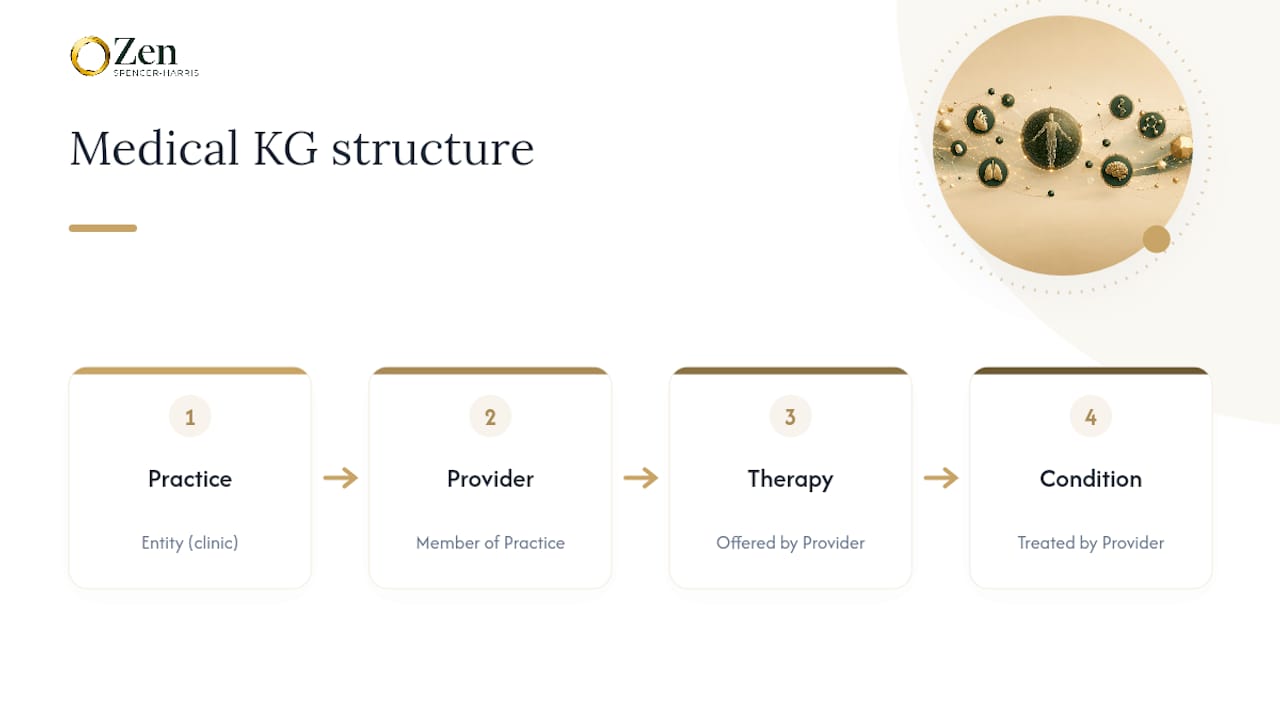
This is explicitly not the biomedical research graphs that link genes, drugs, and clinical trial data for pharmaceutical research. Your graph has one job: help Google and AI assistants recognize your practice as a real, credible, bookable entity.
That recognition compounds. Once an engine identifies your practice as an entity with consistent properties, it starts pulling your data into knowledge panels and citing your pages in AI answers, according to Search Engine Land's guide to Google's Knowledge Graph. Miss the entity signals and your content, however well written, gets treated as unstructured text competing against pages that made the machine's job easy.
Which Schema Types Should You Add First?
Add them in this order:
- MedicalOrganization / MedicalClinic / LocalBusiness. Populate
medicalSpecialty, full address with geocoordinates,openingHoursSpecification,aggregateRating, andmember(linking to each provider). These are the fields Vida Together identifies as what AI systems check first when deciding whether to trust an entity. - Physician / Provider. Include name, board certifications, National Provider Identifier (NPI), hospital affiliations, and a
sameAsarray pointing to LinkedIn, Doximity, or Healthgrades profiles. - MedicalCondition, MedicalProcedure, MedicalTest. Link these directly to your
availableServicelist so a condition page and a treatment page reference the same entity rather than duplicating it in prose. - FAQPage and Article schema. These increase citation probability because they hand an AI system an exact quotable answer instead of a paragraph it has to interpret and summarize.
Pro Tip: Don't mark up every service with every schema type. A crowded, over-tagged page confuses validators and dilutes the signals that actually matter, like medicalSpecialty and member.
How Do You Build the Graph Step by Step?
Building this out is an editorial project first, a technical one second.
- Audit your canonical facts. Pull every instance of your practice name, address, and phone number across your website, Google Business Profile, and directory listings. Inconsistent NAP data is the fastest way to tank entity confidence, and Fuel Online's GEO research treats mismatched listings as a direct trust penalty.
- Design your node structure. Give your organization, each location, each provider, and each service a stable
@id, typically a URL fragment likehttps://yourpractice.com/#organization. Every other node references that@idinstead of repeating the same data. - Write the JSON-LD as a single
@graph. Nesting everything into one@grapharray with@idlinks between nodes avoids duplicate entity declarations, a common error that confuses crawlers. MedRankSEO's 2026 guide confirms JSON-LD remains Google's preferred format for this exact reason. - Reconcile your
sameAsnetwork. Link out to Wikidata, Wikipedia (if applicable), your state medical board listing, and major directories. Webserv.io's entity SEO research notes that a small stack of corroborating third-party mentions, paired with consistent schema, often clears the bar for Knowledge Graph recognition even without a Wikipedia page. - Deploy with validation built in. If your site runs on a static site generator or Next.js, compile the
@graphat build time rather than at runtime. AiPress's technical research recommends this to keep page speed low and avoid schema drift across multi-location sites.
Pro Tip: Never ship a placeholder value like "TBD" or a dummy phone number in production schema. AI systems treat placeholder data as a trust violation, not a minor error, once it's live and indexed.
Which Pages Should You Build and Mark Up First?
Not every page deserves equal schema investment. Four page types drive most of the citation and booking activity.
- Provider bios need named authorship, verifiable credentials, NPI numbers, and hospital or board affiliations, linked back to the organization's
@idso the entity relationship is unambiguous. - Condition and treatment pages should cite real clinical sources and semantically link to the procedures that treat them, since Fuel Online's research shows LLMs favor brand-owned domain content for medical queries over third-party aggregators.
- Booking and insurance pages need
makesOffer,availableService, andopeningHoursSpecificationso an AI assistant can answer "does this practice take my insurance and when can I book" without a phone call. - FAQ sections should answer real patient questions in 40 to 60 words directly under each heading, paired with FAQPage schema. AI tools extract those Q&A pairs almost verbatim when they're structured this cleanly.
How Do You Test and Validate Your Schema?
Publishing schema without validating it is how practices end up with broken markup that's invisible to everyone but them.
- Run every template through Google's Rich Results Test before deployment, and add a structured-data linting step to your CI/CD pipeline so a bad deploy never ships bad schema.
- Submit updated URLs through IndexNow or Bing's submission API for faster discovery. Most WordPress and Cloudflare setups support this with a plugin or worker script.
- Prompt-test your own practice across ChatGPT, Gemini, and Perplexity with real patient-style questions, then log which pages get cited and which don't. Our comparison of Claude and ChatGPT citation behavior is a useful reference for why the same schema performs differently across models.
- Watch for the recurring errors: missing
@idreferences, duplicate entity declarations, and orphaned nodes that never connect back to the organization. All three quietly break the graph without throwing a visible error.
How Often Should You Update Your Knowledge Graph?
Treat schema maintenance like a clinical record, not a one-time build.
- Refresh clinical content and citations on a 90-day cadence at minimum, and push immediate schema updates the moment a provider leaves, a location changes, or hours shift.
- Track AI citation counts, share-of-voice against nearby practices, rich result impressions, and click-through rate as your core KPIs.
- Run a weekly directory consistency check and a quarterly full schema validity audit.
- Tag booked appointments by source using UTM parameters and call tracking so leadership can see which AI citations actually convert to a filled chair, not just a mention.
Why This Playbook Is Zen's Starting Point With Every Practice
Zensweb built its AI Share of Voice approach around exactly this sequence because the mechanics are consistent: entity recognition drives citation, citation drives booking. Our AI visibility program work with specialty and behavioral health practices starts with the same audit, node design, and validation steps outlined above.
- We prioritize schema and provider pages first because that's where AI systems look first
- Our model is performance-based, so we're paid on booked appointments, not deliverables
- Practices typically see measurable AI citation gains within 90 days of full implementation
An Editorial Take on Building AI Visibility
The conventional SEO advice for healthcare practices still treats content quality as the whole game: write authoritative articles, get backlinks, wait. That advice isn't wrong, but it's incomplete for how AI assistants actually work. An AI system doesn't read your beautifully written condition page and infer that you're a credentialed, bookable specialist. It looks for the structured facts that say so explicitly.
Most practices I've seen get this backward. They invest in blog content before they've told Google, in machine-readable terms, who their providers are and what NPI numbers back their credentials. That's building a house before pouring the foundation.
The fix isn't complicated, but it is sequential. Fix your entity data first: organization, providers, sameAs network. Then layer in FAQPage and condition schema. Content quality still matters, but it can't compensate for a practice that AI systems can't confidently identify. Prioritize the graph, and the citations follow faster than most marketing teams expect.
Get Your Schema Built by People Who Do This Daily
Building a compliant, fully connected knowledge graph across dozens of provider pages, condition pages, and location schemas is a real technical lift, and most practice marketing teams don't have a spare engineer sitting around to do it. Zensweb handles the entire buildout: MedicalOrganization schema, provider bio markup with verified credentials, FAQPage implementation, and the sameAs reconciliation work that gets your practice recognized as a genuine entity.
Our model ties payment to results, meaning booked appointments, not deliverables checked off a list. If you want a clear picture of where your current schema stands and what's missing, request a free healthcare audit and we'll show you exactly what's blocking your practice from AI citations right now.
Frequently Asked Questions
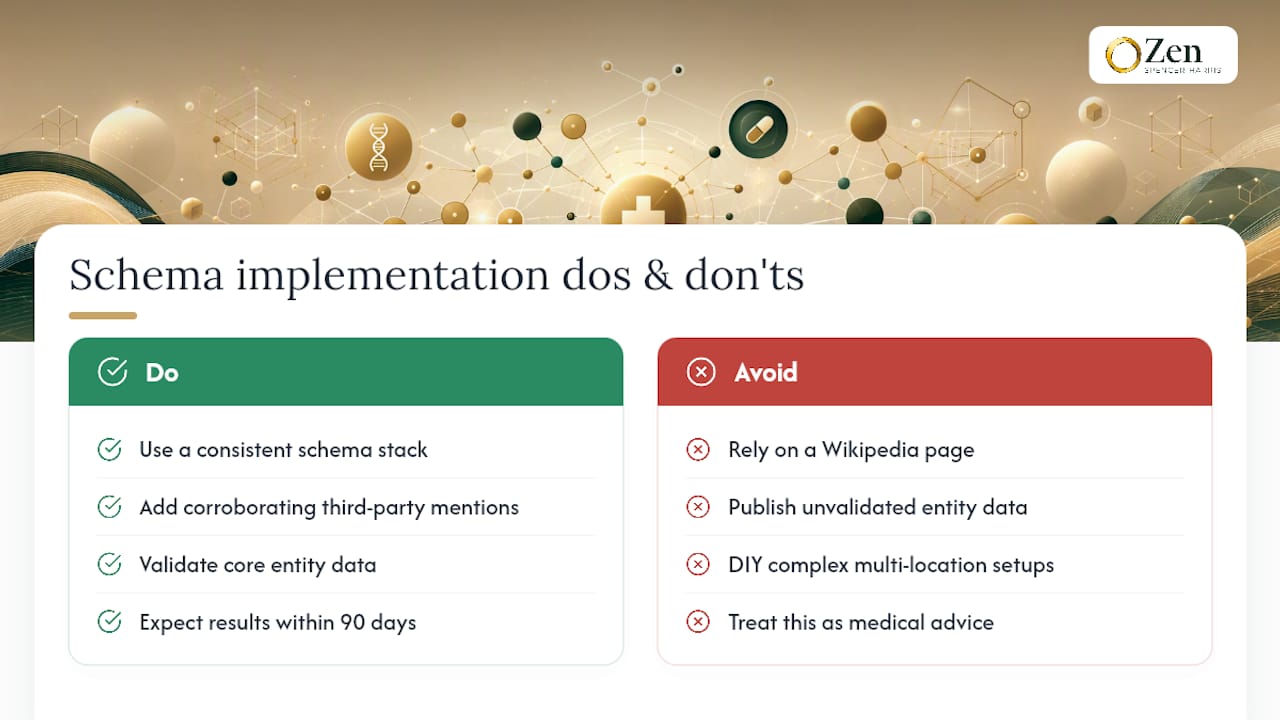
Does a medical knowledge graph require a Wikipedia page to work? No. A consistent schema stack combined with a handful of corroborating third-party mentions, like accreditor directories or payer listings, often clears the bar for entity recognition without a Wikipedia article.
What's the difference between a medical knowledge graph and a biomedical research graph? A practice-focused medical knowledge graph is schema markup that helps search engines and AI assistants recognize your practice, providers, and services. Biomedical research graphs link drugs, genes, and clinical trial data for scientific research, an entirely separate use case.
How long does it take to see results from schema implementation? Most practices see measurable AI citation gains within 90 days of full implementation, assuming the core entity data (organization, providers, services) is accurate and validated.
Can I implement this schema myself, or do I need a developer?
Basic JSON-LD can be added through many WordPress plugins, but multi-location practices with several providers usually need a developer or agency to design the @id structure correctly and avoid duplicate entity errors.
This article is general information, not a substitute for advice from a qualified doctor. Consult a qualified healthcare professional about your own circumstances before acting on anything here.