

The single highest-leverage move for any practice this year: enable a privacy-safe, automated post-visit review request for every patient, sent by text or email within hours of checkout. A 0.5-star rating increase correlates with roughly 37% more monthly bookings, and doctors in the top 25% by review volume pull in about five times more appointments than those in the bottom quartile. A doctor reviews strategy built on that single habit outperforms most reputation efforts practices spend months planning.
Your next step today:
- Turn on an automated post-visit request in your patient management system, or
- Hand front-desk staff a one-line script to ask in person before the patient leaves
Key Takeaways
A doctor reviews strategy built on automated, HIPAA-safe post-visit requests and consistent monitoring produces measurable booking gains, not just a better-looking profile.
| Point | Details |
|---|---|
| Automate the ask | Turn on immediate post-visit requests plus one or two reminders instead of relying on staff memory. |
| Rating moves bookings | A 0.5-star rating increase tracks with roughly 37% more monthly bookings. |
| Stay HIPAA-safe | Use generic language like "your recent visit" and never confirm care details in public replies. |
| Use an experience filter, not gating | Give every patient a public ask, but route dissatisfied patients to private feedback too. |
| Track velocity, not just count | Monitor review velocity, average rating trend, and response rate monthly to prove ROI. |
| Connect reviews to acquisition | Zensweb ties reputation work to booked-appointment outcomes through performance-based visibility programs. |
Table of Contents
- Why Patient Reviews Move the Needle for Bookings and Visibility
- How Do You Get Patients to Actually Leave Reviews?
- Should You Automate Review Requests or Do It Manually?
- What Can You Legally Say When Asking for or Responding to Reviews?
- How Should You Monitor and Respond to Reviews Each Week?
- How Do You Turn Reviews Into New Patients?
- Legal Considerations Beyond HIPAA You Shouldn't Ignore
- What Makes a Review Request Ethical, Not Just Effective?
- How Do You Measure ROI From a Review Strategy?
- What the Data Actually Tells Doctors to Prioritize
- How Zensweb Turns Review Programs Into Booked Appointments
- Sources
Why Patient Reviews Move the Needle for Bookings and Visibility
A 0.5-star jump in your average rating (say, 3.5 to 4.0) tracks with about 37% more monthly bookings, and practices with the highest review volume receive roughly five times more appointments than those with the least, according to Zocdoc's analysis. That gap isn't about better medicine. It's about visibility and trust signals compounding.
Patients now shop for doctors the way they shop for everything else online: they scan ratings, read the three most recent reviews, and move on if the picture looks stale or thin. The shift mirrors what retail experienced years ago, where transparency and social proof replaced word-of-mouth as the primary trust mechanism. Practices that treat reviews as optional are quietly losing patients to competitors who don't.
What patients actually weigh when reading reviews:
- Bedside manner and how rushed or heard they felt during the visit
- Wait time, both in the lobby and inside the exam room
- How staff handled scheduling, billing, and follow-up questions
- Recency matters more than volume, since most patients discount reviews older than a year
How Do You Get Patients to Actually Leave Reviews?
Most practices fail here not because patients are reluctant, but because nobody asks at the right moment, in the right way. Fix the mechanics and the volume follows.
- Ask immediately after the visit, while the experience is fresh, not three weeks later in a generic newsletter.
- Send a reminder cadence. One initial request plus one or two follow-up nudges over the following week outperforms a single blast, since immediate timing paired with reminders materially improves response rates.
- Put the ask in front of the patient physically, not just digitally: checkout signage, a QR code on the receipt, or a card handed over at discharge.
- Keep the link one tap away. A text with a direct Google review link converts far better than a request that sends patients hunting for your practice name.
In-person script for front-desk staff: "If you have thirty seconds, a quick Google review really helps other patients find us. I'll text you the link."
That's it. No pressure, no mention of the visit's clinical content.
- Front desk: verbal ask at checkout, plus triggering the automated text
- Clinical staff: no direct review solicitation, ever, to avoid any perception of coercion tied to care
- Practice manager: owns the monitoring dashboard and reminder cadence
Pro Tip: Train staff to ask every patient, not just the ones who seemed happy. Cherry-picking who gets asked skews your rating upward temporarily but collapses your credibility the moment a pattern of only-positive outreach gets noticed.
Should You Automate Review Requests or Do It Manually?
Manual asks don't scale past a handful of patients a day, and they introduce bias: staff naturally skip the visit that went sideways. Automation solves both problems by asking every patient the same way, every time, which produces a fairer, more representative rating than any hand-picked approach.
You have two real options. Patient management systems with built-in review automation integrate scheduling data directly, so the request fires the moment a visit closes out. Standalone reputation platforms work independently of your PM system but require a bit more setup to sync appointment data.
- Cadence: one immediate request, then one or two reminders spaced across the following week
- Avoid asking every patient on the same day of the week. A slow, steady trickle of 5 to 15 new reviews a month (adjusted for practice size) builds a more durable signal than a burst
- Claim and complete your profile on Google Business Profile first, since it's the primary discovery surface for new patients, then extend the same effort to Healthgrades and Zocdoc, where specialty-specific searches concentrate
A sudden spike of forty reviews in one week looks less like organic enthusiasm and more like a prompted campaign, both to platform algorithms and to skeptical readers scrolling through timestamps.
Sudden spikes also raise flags with platform moderation systems built to catch incentivized or bulk-solicited reviews. Steady beats fast here.
What Can You Legally Say When Asking for or Responding to Reviews?
HIPAA doesn't prohibit asking for reviews. It prohibits referencing any specific health information in the request or in your public reply, ever.
Forbidden in any patient-facing review communication:
- Mentioning a diagnosis, treatment, procedure, or medication by name
- Confirming that someone is or was a patient in a public reply
- Referencing visit dates, appointment types, or provider names tied to specific care
Safe phrasing sticks to generic language: "your recent visit," "your experience with our team," "thanks for coming in." Nothing clinical, nothing date-specific, nothing that confirms a treatment relationship in a searchable public comment.
There's a critical distinction between review gating, which is prohibited, and an experience filter, which is standard practice. Gating means asking patients to rate you privately first and only pushing the happy ones to post publicly. That's considered deceptive by every major platform. An experience filter is different: you ask everyone publicly, but you also give dissatisfied patients a private feedback channel so they can raise concerns before or alongside posting.
Pro Tip: If a public reply requires more than "thank you, please reach out to our office directly," escalate it to your practice manager rather than improvising. A well-meaning staff response that confirms even indirectly that someone was treated for a condition can trigger a real compliance problem.
How Should You Monitor and Respond to Reviews Each Week?
Reviews scattered across five platforms are impossible to manage by memory. Centralize monitoring, then run a consistent response process.
- Set up alerts across Google Business Profile, Healthgrades, and Zocdoc so new reviews land in one inbox or dashboard rather than requiring manual checks.
- Respond within 48 hours. Acknowledge, thank the patient, and for anything negative, invite them to continue the conversation offline rather than litigating details publicly.
- Correct factual profile errors directly through each platform's business tools (wrong hours, outdated address, mismatched specialty listing).
- Flag suspected fake reviews through the platform's reporting tool rather than responding publicly and drawing more attention to it.
Track average rating, review velocity (new reviews per month), and response rate monthly.
How Do You Turn Reviews Into New Patients?
Collecting reviews is only half the strategy. The other half is making sure prospective patients actually see them at the moment they're deciding.
- Feature your best review excerpts on your provider bio page and homepage, paired with a current, professional headshot. Photos plus social proof convert better than either alone.
- Keep your Google Business Profile fully updated with services, hours, and photos, since it's usually the first thing a searcher sees before your website.
- Optimize your Healthgrades profile the same way. Learn the specific steps for Healthgrades optimization if you haven't touched that profile in a while.
- Pull recurring themes out of your reviews. If multiple patients mention short wait times or a specific staff member by name, feature that in your marketing copy. It's free market research.
- Never use a patient's review to make or imply a clinical claim about outcomes. Stick to describing the experience, not the medicine.
Complaints repeated across several reviews (long check-in lines, hard-to-reach scheduling staff) point to fixable operational issues you can remediate and then re-measure in the following month's ratings.
Legal Considerations Beyond HIPAA You Shouldn't Ignore
HIPAA gets most of the attention, but it isn't the only regulatory line in a doctor reviews strategy. The FTC treats incentivized reviews (gift cards, discounts, or fee waivers in exchange for a review) as a deceptive practice if the incentive isn't disclosed, and undisclosed incentives can draw scrutiny regardless of disclosure since some platforms ban incentivized reviews outright in their terms of service. Never offer compensation tied to a review, positive or otherwise.
State medical boards also weigh in on advertising and testimonial rules, and some states restrict how patient testimonials can be used in paid advertising, separate from organic reviews on third-party platforms. Check your state medical board's advertising guidelines before repurposing review content into paid campaigns.
Defamation exposure runs in the other direction too. If a review contains outright false factual claims (not just a negative opinion), you generally cannot respond by disclosing protected health information to "set the record straight," no matter how tempting. The correct move is reporting the review to the platform for removal and, if warranted, consulting legal counsel. A negative but honest review, even one that stings, is not something you can legally rebut with clinical details.
Finally, keep records of your request cadence and any templates you use. If a compliance question ever arises, being able to show a consistent, non-coercive process across all patients is your best protection.
What Makes a Review Request Ethical, Not Just Effective?
The line between effective and manipulative is thinner than most practices realize, and crossing it does lasting damage.
Ethical review solicitation means asking every patient the same way, not just the ones you suspect were satisfied. Selectively targeting happy patients while quietly skipping difficult ones isn't a marketing tactic. It's a form of the review gating that platforms explicitly prohibit, and it produces a rating that misrepresents the actual patient experience.

Genuine reviews also mean no incentives, no scripted five-star language you ask patients to copy, and no review swapping with other practices. Authenticity is what gives a review its persuasive power in the first place. A rating built on selective asking or incentivized posts might look good for a quarter, but it collapses the moment patients notice a pattern, or a platform's fraud detection flags it.
There's also an obligation to your own patients: asking for a review should never feel like a condition of care, and it should never happen in a moment when a patient is vulnerable, frustrated, or still processing a difficult diagnosis. Timing the ask to genuinely neutral or positive moments protects both the patient relationship and the integrity of your rating.
The practices that build durable five-star reputations over years, not months, are the ones asking everyone, consistently, without shortcuts.
How Do You Measure ROI From a Review Strategy?
Reviews are one of the few marketing efforts where the ROI math is genuinely traceable, if you track the right numbers from day one.
Start with three metrics: review velocity (new reviews per month), average rating trend (quarter over quarter), and response rate (percentage of visits that generate a review). Layer new-patient volume and booking source on top, and you can start connecting rating movement to actual appointment increases.
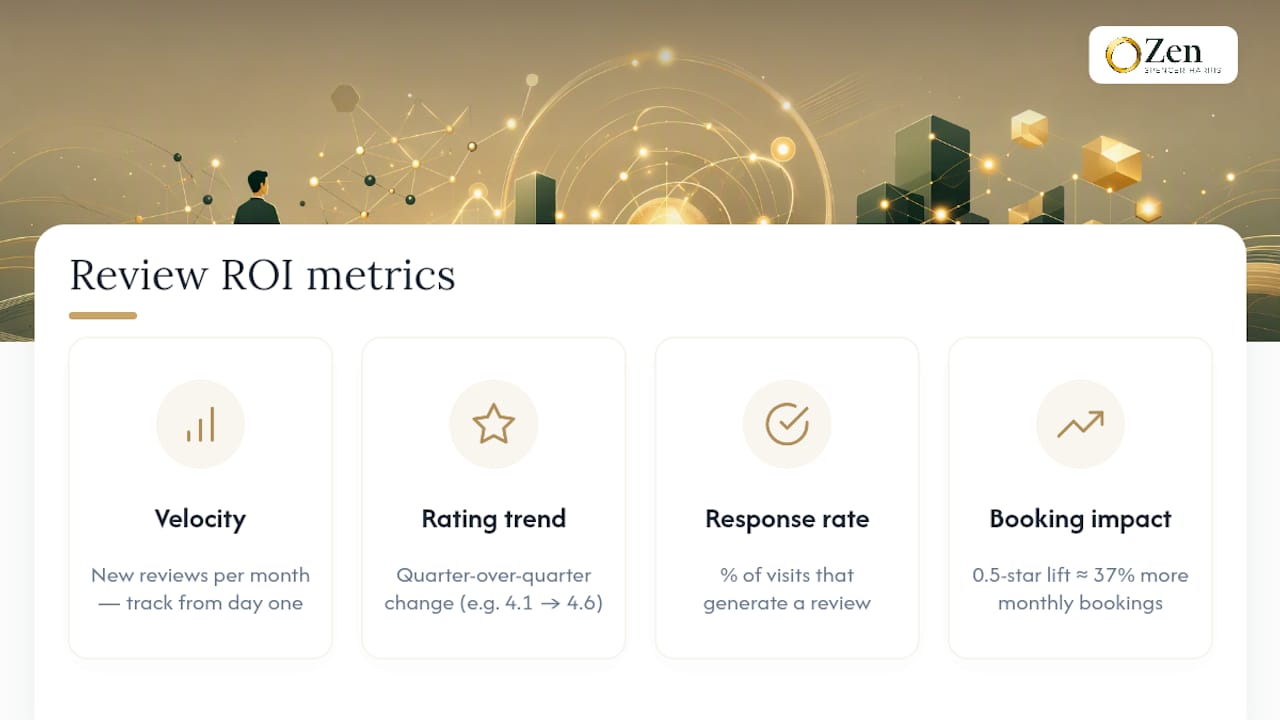
The connection is measurable because rating changes correlate with booking changes at a known rate: a 0.5-star lift tracks with roughly 37% more monthly bookings. If your average rating moves from 4.1 to 4.6 over two quarters and your new-patient bookings from Google or Zocdoc climb by a comparable margin, that's your ROI signal, no separate attribution model required.
Cost side is simple too: automation tools typically run a modest monthly fee, and staff time for manual follow-up is minimal once the system is running. Compare that cost against the value of even a handful of new patient bookings per month, and the payback period is usually measured in weeks, not quarters.
The mistake most practices make is measuring review count alone. Count without velocity, recency, and rating trend tells you almost nothing about whether the program is actually working. Track the full set, and the ROI conversation with practice leadership becomes a lot easier to have.
What the Data Actually Tells Doctors to Prioritize
Most reputation advice buries the lede under a pile of platform-specific tips, when the real finding is simpler: consistency beats cleverness. A steady, automated ask to every patient outperforms any clever script, incentive, or manual campaign a practice manager might design.
The conventional wisdom oversells response templates and undersells timing. Plenty of guides hand you a perfectly worded reply for a one-star review, but the practices actually moving their ratings are the ones who fixed their ask process first: automated, immediate, sent to everyone. A brilliant response to a bad review matters far less than preventing the operational issue that caused it in the first place.
If you do only one thing this quarter, fix the intake side of your doctor reviews strategy before touching your response templates. Get the automated, HIPAA-safe request running for every patient, claim and complete your top three platform profiles, and only then invest time in crafting response language. Practices that reverse that order spend months polishing replies to a trickle of reviews that never grows, because nobody fixed the request process underneath it.
— Zen
How Zensweb Turns Review Programs Into Booked Appointments
Reputation work only pays off when it connects to something measurable: more clicks, more calls, more booked visits. That's the gap Zensweb closes for specialty practices. Beyond the review tactics in this guide, Zensweb builds the visibility layer around them, optimizing your Google Business Profile and directory listings, automating compliant review requests, and extending your presence into AI search platforms like ChatGPT and Perplexity, where a growing share of patients now start their search.

Zensweb runs on a performance-based model: fees are tied to delivered outcomes like booked appointments and measurable visibility gains, not hours billed or campaigns launched. If your review program has stalled at a handful of scattered ratings with no system behind it, a full patient acquisition program can connect the dots between reputation, search visibility, and your booking calendar. Explore Zensweb's services to see where a review-driven acquisition strategy fits into your practice's next quarter.
Sources
- The Importance of Patient Reviews (And Why Doctors Should Leverage Them)
- 6 Strategies to Skyrocket Your Patient Reviews + Free Request Templates
- Doctor Google Reviews | HIPAA-Safe Review Playbook
- 10 Proven ways to increase patient reviews for your practice