

The fastest, highest-return SEO move for most therapy practices is to optimize your Google Business Profile, publish one clear specialty page, and fix one technical speed issue. Those three moves cover local intent, search relevance, and the technical baseline Google uses to rank you at all.
Expect Google Business Profile changes to show up within weeks. Specialty pages typically need two to six months to climb, and the compounding effect of consistent content and citations builds over six to twelve months. Getting these pillars right also determines whether tools like ChatGPT or Perplexity ever mention your practice, since AI Share of Voice depends on the same foundation: clean Core Web Vitals, a claimed Google Business Profile, and pages written to answer real questions.
- Fix your Google Business Profile categories, hours, and booking link first
- Publish one specialty page built around a real search question
- Run a PageSpeed Insights check and resolve the worst mobile issue
Key Takeaways
Therapy practice SEO succeeds when Google Business Profile, one focused specialty page, and one technical fix are handled first, with AI-citable answer content compounding results afterward.
| Point | Details |
|---|---|
| Fix Google Business Profile first | Complete categories, photos, and booking links for visibility that can shift within weeks. |
| Build specialty pages, not generic ones | One modality or condition per page outranks a blended "services" page over two to six months. |
| Publish fees and insurance openly | Transparency on cost drives conversions and gives AI assistants clearer answers to cite. |
| Track the right KPIs | Watch local rank, page-level traffic, and booking conversion rate, not just total site visits. |
| Zensweb ties payment to bookings | The AI Share of Voice program targets AI and Google visibility within 90 days on a performance basis. |
Table of Contents
- Therapy Practice SEO Starts With the Right Keywords
- What Should Your Therapy Website's Titles and Headers Say?
- How Do You Optimize Google Business Profile for a Therapy Practice?
- Which Technical SEO Issues Actually Move Rankings?
- Building Content That Ranks and Gets Cited by AI
- Off-Page Signals That Build Trust and Rankings
- How Long Does SEO Take to Bring In New Clients?
- Getting Recommended by ChatGPT and Other AI Assistants
- How Zensweb Puts These Tactics Into Practice
- What Therapists Consistently Get Wrong About SEO
- Get a Free Audit Before You Change Anything
- Frequently Asked Questions
- Sources
Therapy Practice SEO Starts With the Right Keywords
Most therapists guess at keywords instead of finding the ones that actually convert. Search terms for a therapy practice fall into four buckets: local ("therapist in [neighborhood]"), specialty ("EMDR therapist for trauma"), condition or problem ("why can't I sleep after a breakup"), and insurance or fee questions ("does Blue Cross cover couples counseling"). Each bucket needs its own page, not one blended "services" page trying to rank for all of them.
Free tools handle most of this work. Google Keyword Planner shows rough search volume for specialty and condition terms, while Google Search Console reveals what people already type to find your existing pages. Watch what clients ask ChatGPT or Google's AI Overview too. Those phrasings ("how many sessions does EMDR usually take") often become your best headline questions.
- Pull 15 to 20 raw keyword ideas across all four buckets.
- Score each by conversion potential (would a searcher book?), then by volume, then by competition.
- Map your top scorers to specific pages, one keyword focus per page.
A solo anxiety-focused therapist might map "anxiety therapist in [city]" to a local landing page, "CBT for panic attacks" to a specialty page, and "does therapy help with panic attacks" to an FAQ-style blog post that funnels into the specialty page.
Pro Tip: Don't chase high-volume generic terms like "therapist near me." They're crowded and vague. A specific phrase like "postpartum anxiety therapist accepting Aetna" converts at a far higher rate even with a fraction of the search volume.
What Should Your Therapy Website's Titles and Headers Say?
Every page needs one focus keyword, and Google still uses your title tag and H1 as the strongest relevance signals on the page. A pattern that works consistently for therapists: [Specialty] + [Modality] + [Trust phrase], like "Postpartum Anxiety Therapy in Denver | EMDR-Trained, Now Accepting Clients." Meta descriptions should answer the click-through question directly, following the same clarity principle Yoast recommends for writing descriptions that earn the click instead of just describing the page.
Above the fold, every service page needs to answer three things fast:
- What you actually do in sessions (not a vague mission statement)
- Who you help, named specifically (teens, couples, first responders, new parents)
- How to book, with a visible call-to-action and no hunting required
Fees and insurance information belongs near the top too, not buried in an FAQ three scrolls down. Practices that list accepted insurance and self-pay rates convert better because they filter out mismatched inquiries before the contact form.
Pro Tip: Write a one-sentence "what to expect at your first session" blurb on every specialty page. It reduces the anxiety that keeps anxious searchers from ever clicking "contact."
How Do You Optimize Google Business Profile for a Therapy Practice?
Local search ranking runs on three factors: relevance, proximity, and prominence, and Google's own local ranking guidance confirms your profile controls the first and third. A fully built-out Google Business Profile is often the single fastest lever in therapy practice SEO, since profile edits can move visibility within days rather than months, according to the checklist TherapySites built for private practices.
- Fill every category slot (primary category plus all relevant secondary ones) and list specific services, not generic labels.
- Write a description that names your specialties and location, add real photos of your office, and link your booking page directly.
- Post updates monthly. Even a short note about a new group or availability signals an active business.
- Match your name, address, and phone number exactly across your website, Psychology Today, TherapyDen, GoodTherapy, and Healthgrades. Inconsistent formatting quietly kills local rankings.
Reviews matter, but ethics come first. Ask verbally after a positive interaction, never in writing that references treatment, and respond to every review with a neutral, HIPAA-safe line like "thank you for sharing your experience." Never confirm someone was a client in a public reply.
Localized service pages make sense once you serve multiple distinct areas or offer several specialties per location. A single-location generalist practice should put nearly all its local effort into the profile itself before building city-specific pages nobody's searching for.
Pro Tip: Claim your practice on modality-specific directories too. A completed Gottman or EMDRIA referral listing does double duty: it drives referral traffic and gives AI assistants a trusted source to cross-reference your credentials against.

Which Technical SEO Issues Actually Move Rankings?
Most therapy websites lose rankings to slow load times and broken mobile layouts before content even becomes a factor. Run your homepage and top specialty page through PageSpeed Insights or GTmetrix and fix whatever scores red first. Mobile speed issues, in particular, cost bookings since most local searches now happen on a phone.
The non-negotiable technical baseline:
- HTTPS enabled site-wide, with no mixed-content warnings
- A submitted XML sitemap and clean robots.txt file
- Canonical tags on any page with duplicate or near-duplicate content
- A mobile layout that doesn't require pinch-zooming to read
Add schema markup where it's genuinely useful. ProfessionalService or LocalBusiness schema helps Google understand your practice type and hours, and FAQ schema on Q&A-formatted pages increases your odds of landing a featured snippet. Fix load speed and mobile layout before touching schema. Structured data on a slow site rarely moves anything.
Building Content That Ranks and Gets Cited by AI
Generic "our services" pages rarely rank or get cited, because they don't answer a specific question well enough for Google or an AI assistant to trust them. A dedicated page for each modality or specialty consistently outperforms a blended page, a pattern Seobility's sector guide confirms across therapy practice sites.
Structure each specialty page the same way:
- Open with a short, direct answer: what happens in a session, who it's for, typical session count, and fee or insurance basics.
- Follow with supporting detail: your approach, credentials, and what makes your version of this modality different.
- Close with an FAQ section written in real question form ("How many EMDR sessions does trauma usually take?").
That opening block is what answer-engine optimization depends on. AI assistants pull direct, well-structured answers, not marketing copy. Publish your highest-intent specialty pages first, then support them over time with blog posts that answer adjacent questions and link back to the anchor page. A prioritized content plan built around specialty and condition pages beats a generic weekly blog schedule almost every time.
Pro Tip: Publishing your fees and insurance list openly is one of the highest-converting moves in therapy marketing, and most practices skip it entirely.

Off-Page Signals That Build Trust and Rankings
Your website is owned media. Directory listings are rented, and you need both. Prioritize Psychology Today, GoodTherapy, TherapyDen, and Healthgrades first, since these carry disproportionate trust with both Google and AI assistants.
- Claim and complete profiles on modality organizations relevant to your training
- Pitch a guest post to a reputable local health publisher or community wellness site
- Build reciprocal links with local physician referral networks or wellness collectives
- Track every review across Google, Psychology Today, and Healthgrades in one place, since scattered feedback is impossible to act on
- Link from your homepage to each specialty page, and from your specialty pages back to your GBP and directory profiles
A reputation management approach that treats reviews as an ongoing system, not a one-time ask, tends to compound faster than sporadic requests ever do.
How Long Does SEO Take to Bring In New Clients?
Google Business Profile changes typically surface in search results within a few weeks. Specialty pages generally need two to six months to earn ranking positions, and the real compounding effect, more organic traffic feeding more bookings, tends to show up between six and twelve months in.
- Track local ranking position for your top three specialty keywords weekly.
- Watch organic sessions on those specific pages in GA4, not just site-wide traffic.
- Monitor your contact form or booking conversion rate, since traffic without bookings means the page itself needs work.
- Check GBP calls and direction requests monthly. Those are the clearest signals of local intent turning into action.
| Metric | Tool | Typical Timeframe |
|---|---|---|
| Local map rankings | Local rank tracker | a few weeks |
| Specialty page traffic | GA4 + Search Console | two to six months |
| Booking conversion rate | CRM or booking platform | Ongoing |
| GBP calls and directions | Google Business Profile insights | two to six months |
Run one change at a time when possible. If you rewrite a title tag and add a new photo to GBP in the same week, you won't know which one moved the needle.
Getting Recommended by ChatGPT and Other AI Assistants
AI assistants look for the same signals a skeptical referral source would: a clear, specific answer and outside verification that you're legitimate. A page stuffed with marketing language rarely gets cited. A page that states plainly what EMDR sessions involve, who they help, and how many sessions clients typically need does.
- Write explicit "what to expect" sections in bulleted, scannable form
- Name your license, your modality certifications, and where you trained
- Get listed on EMDRIA, Gottman, or your state license board page, since AI systems cross-reference these third-party sources before naming a provider
- Search your own specialty terms in ChatGPT or Perplexity every month and note whether your practice appears
Pro Tip: A technical AI visibility audit can show you exactly which pages assistants are already pulling from, and which ones need restructuring before they'll ever get cited.
How Zensweb Puts These Tactics Into Practice
Zensweb runs on a performance model: you pay for delivered results like booked appointments, not hours billed. The AI Share of Voice offering focuses specifically on getting practices named inside ChatGPT, Claude, Perplexity, and Google within 90 days, built on the exact foundation covered above.
A typical 90-day cycle includes a full Google Business Profile rebuild, one flagship specialty page, and one prioritized technical fix such as mobile load speed.
Verifiable trust signals move both rankings and AI citations: an active state license number, a completed EMDRIA or Gottman directory profile, and consistent NAP data across every listing.
- License numbers and modality certifications published on-site
- Completed profiles on recognized modality organizations
- Documented case results tied to specific practices, not generic claims
What Therapists Consistently Get Wrong About SEO
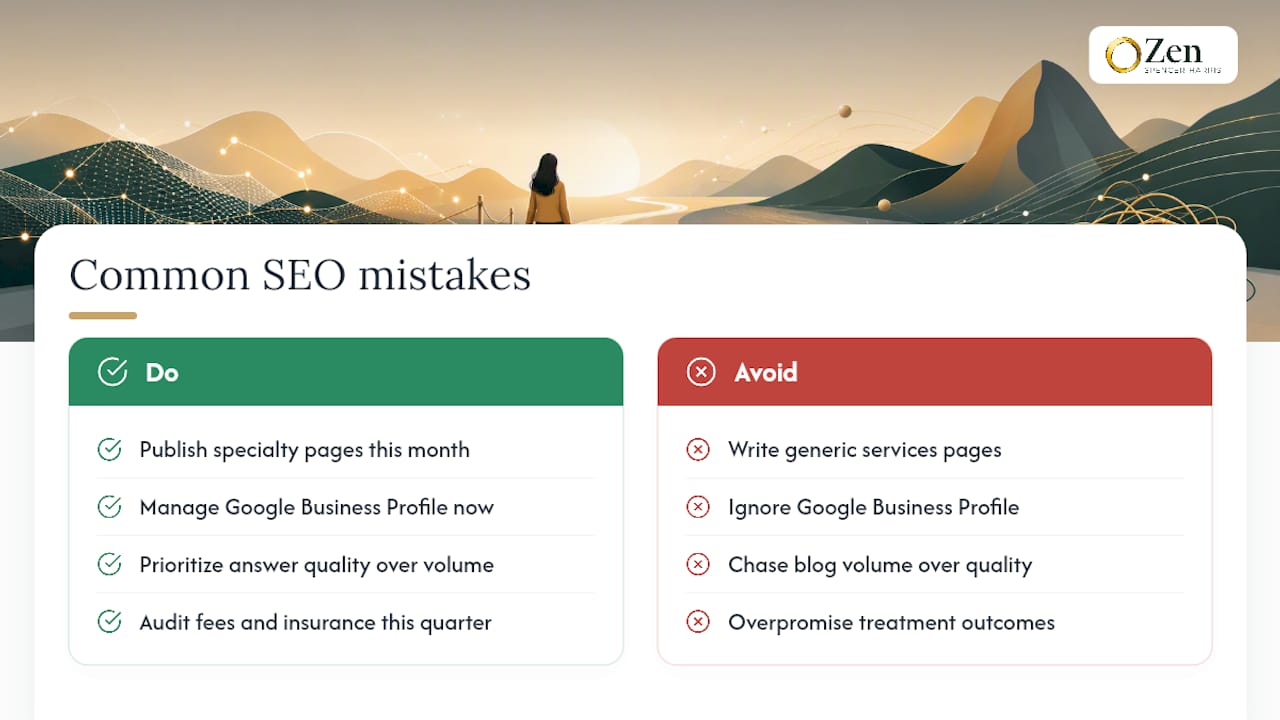
Clinicians tend to make three mistakes: writing generic "services" pages instead of specialty pages, ignoring Google Business Profile until reviews pile up, and chasing blog volume over answer quality. Fix your profile this week, publish one specialty page this month, and audit fees and insurance transparency this quarter. Marketing ethically means describing your work honestly, never overpromising outcomes.
Get a Free Audit Before You Change Anything
Before you touch a single page, it helps to know exactly where your practice stands against the therapists already ranking in your area. Zensweb's free healthcare audit reviews your Google Business Profile, your top specialty page, and your AI Share of Voice standing across ChatGPT, Claude, and Google, then hands you a prioritized list instead of a generic report.
The performance-based model means Zensweb gets paid when you get booked appointments, not for hours logged or reports delivered. That's a meaningfully different arrangement than the retainer-and-hope structure most agencies still run. If you'd rather have a team execute the specialty page, the technical fix, and the AI visibility work covered in this guide instead of doing it solo, the SEO services page outlines exactly how that engagement works. Book the free audit and find out which of the moves above will move your practice fastest.
Frequently Asked Questions
How long does therapy practice SEO take to show results? Google Business Profile changes often surface within weeks. Specialty pages usually take two to six months, with compounding traffic gains building over six to twelve months.
What's the single best SEO move for a solo therapy practice? Complete your Google Business Profile fully, then publish one specialty page targeting a specific modality or condition rather than a generic services page.
Do therapists need blog content, or just service pages? Specialty pages should come first since they capture booking-intent searches. Blog posts support them by answering adjacent questions and linking back to the anchor page.
How does AI visibility differ from regular SEO for therapists? AI assistants pull from pages with clear, direct answers and cross-reference third-party sources like modality organizations, so structure and outside verification matter as much as keywords.
This article is general information, not a substitute for advice from a qualified doctor. Consult a qualified healthcare professional about your own circumstances before acting on anything here.